What shape tendency is predicted for PNs originating from progenitors more massive than Sun-like stars in that mass range?
Answer
Highly irregular and bipolar forms.
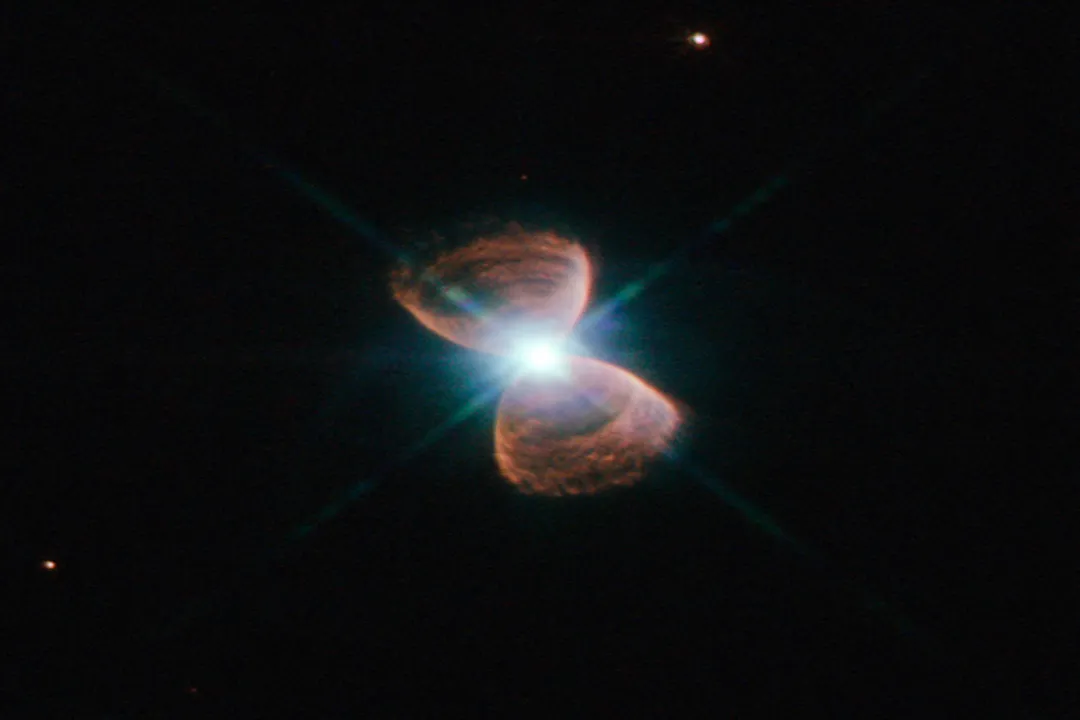
The characteristics of the progenitor star appear to dictate the resulting geometry of the Planetary Nebula (PN). Stars comparable to our own Sun are generally predicted to yield simpler shapes, such as spherical or slightly elliptical forms, following the shedding of their outer layers. Conversely, progenitors that were more massive, yet still within the range capable of forming PNs, tend to generate the most complex visual outcomes, specifically resulting in highly irregular or distinct bipolar shapes.
Related Questions
What material primarily constitutes the diffuse gas and dust clouds comprising nebulae?How long does the glowing phase of a typical Planetary Nebula (PN) last before its gas dissipates into the ISM?Which three morphological types are identified as the most common categories for Planetary Nebulae (PNs)?How do Binary Companions influence the resulting structure of a Planetary Nebula (PN)?What two primary energetic outputs sculpt the morphology of young Emission Nebulae (H II regions)?What process lights up the interior structure of the Crab Nebula, a Supernova Remnant (SNR) from 1054?What shape tendency is predicted for PNs originating from progenitors more massive than Sun-like stars in that mass range?What surprising orderly arrangement was observed for bipolar PNs in the Milky Way’s central bulge?Why were Planetary Nebulae (PNs) historically given a misleading name unrelated to planets?In star-forming clouds, what carving mechanism is responsible for creating features like the Pillars of Creation in the Eagle Nebula?