How do nebulae get their shape?
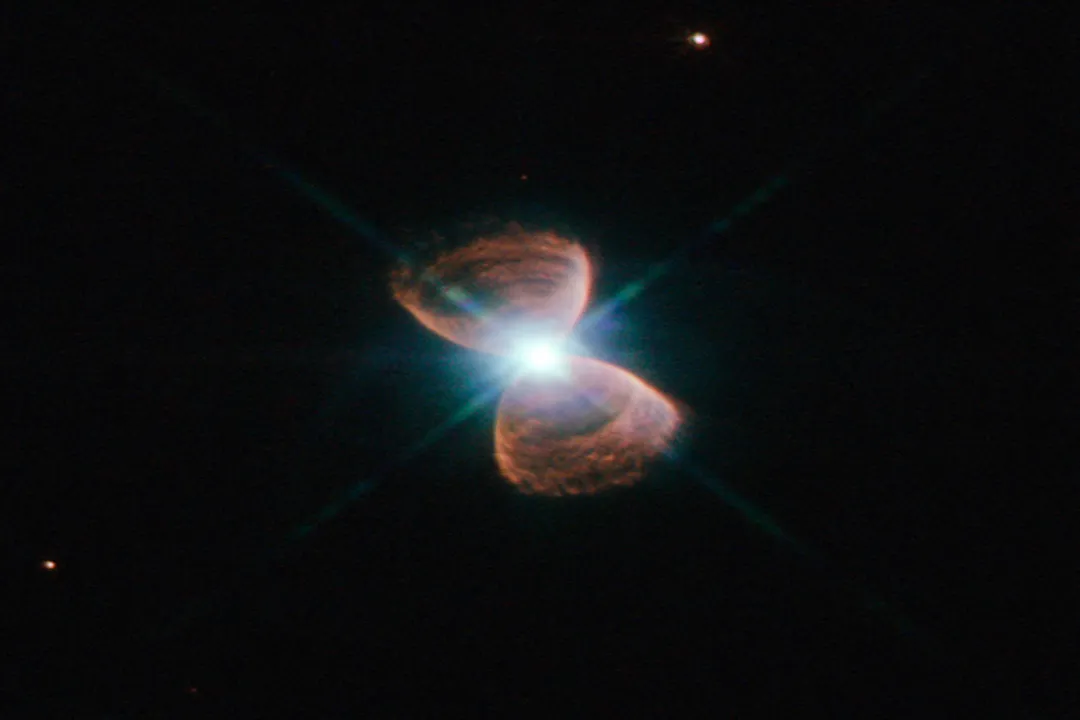
The ethereal, often bizarre geometries we see in nebulae—the swirling arcs, sharp pillars, and vast, ghostly bubbles—are not static monuments in space. Instead, they are transient expressions of immense cosmic energies captured at a single moment in time. The shape a nebula assumes is a direct consequence of the dominant forces acting upon its gas and dust at that precise phase of its existence, whether that phase is the dramatic death of a star or the energetic birth of new suns. [2]
Understanding these shapes requires first acknowledging that "nebula" is a broad term, encompassing everything from dense stellar nurseries to the remains of stellar explosions. [2][5] Nebulae are primarily composed of hydrogen and helium gas, along with fine cosmic dust, existing in the interstellar medium (ISM)—a medium so diffuse that a cubic centimeter of air on Earth contains more particles than the same volume in deep space. [5] The visual morphology arises when this diffuse material is concentrated into clouds, often by gravity pulling matter together or by stars expelling their guts into the void. [3][5]
# Stellar Death Forms
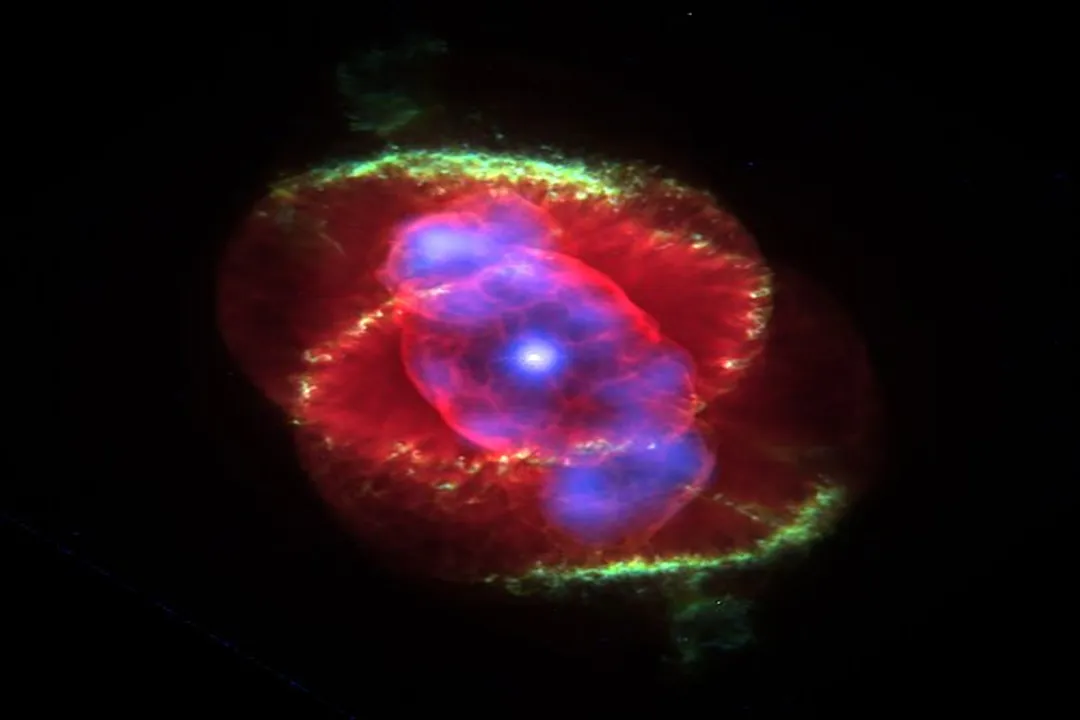
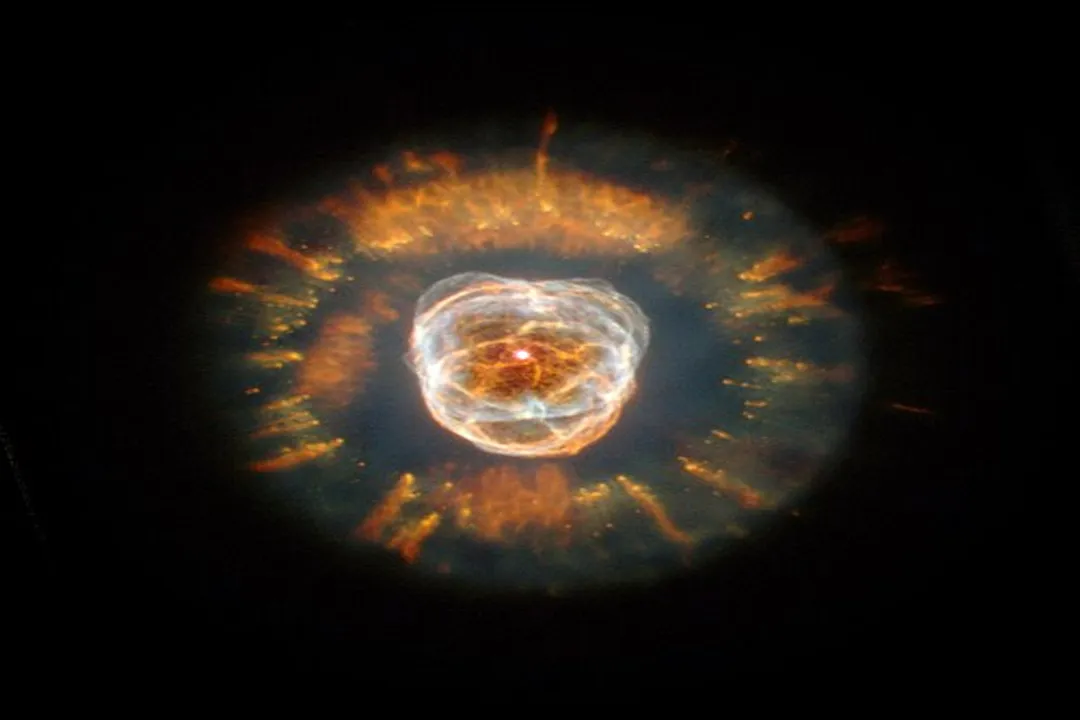
One of the most visually stunning classes of nebulae are Planetary Nebulae (PNs). Despite their misleading historical name, they have nothing to do with planets; the label originated because early, low-resolution telescopes showed them as faint, round, planet-like disks. These objects mark the final, relatively brief stage in the life of a low-to-intermediate-mass star, like our Sun, after it has exhausted its core fuel and evolved into a red giant. The star sheds its outer layers via strong stellar winds during the Asymptotic Giant Branch (AGB) phase, leaving behind a hot, dense core called a White Dwarf Nucleus (P.N.N.).
The resulting gas shell is ionized by the intense ultraviolet radiation from this exposed core, causing the nebula to glow. [5] For a typical PN, this glowing phase lasts only about ten thousand years before the gas dissipates into the ISM. [2]
# PN Variety
While the process starts with the star puffing off material, the outcome is far from uniform. Only about one-fifth of observed PNs are roughly spherical. The majority display complex shapes like rings, hourglasses, ellipses, or quadrupoles. Astronomers categorize these, identifying spherical, elliptical, and bipolar types as the most common, though classifications like helical and irregular also appear.
The mechanisms responsible for this rich variety are not entirely settled, but several candidates are strongly implicated: [2]
- Binary Companions: The presence of a second star orbiting the dying giant can drastically alter the outflow. Gravitational interaction with a companion can twist the ejected material or funnel it into complex structures, leading to extreme shapes. [2]
- Stellar Rotation and Winds: The rotation rate of the progenitor star system, coupled with the intensity of the resultant stellar wind, dictates the initial geometry of the expanding bubble. [2] Jets of material ejected perpendicular to the star’s orbital plane are thought to form the dramatic lobes seen in bipolar (hourglass or butterfly-shaped) nebulae.
- Magnetic Fields: Evidence of magnetic fields around central stars suggests they may play a role in channeling or shaping the outflowing gas as it separates from the star. [2]
It is interesting to observe that the nature of the progenitor star may correlate with the resulting shape. Stars similar to our Sun are predicted to produce more spherical or simple shapes, while the more massive progenitors in this mass range seem to create the highly irregular and bipolar forms. Thus, the visual shape of a planetary nebula acts as a snapshot telling us not just that the star died, but perhaps how it was configured—whether it was solitary or part of a tightly-bound system—right before it inflated its final shell. [2]
# Star Formation Shaping
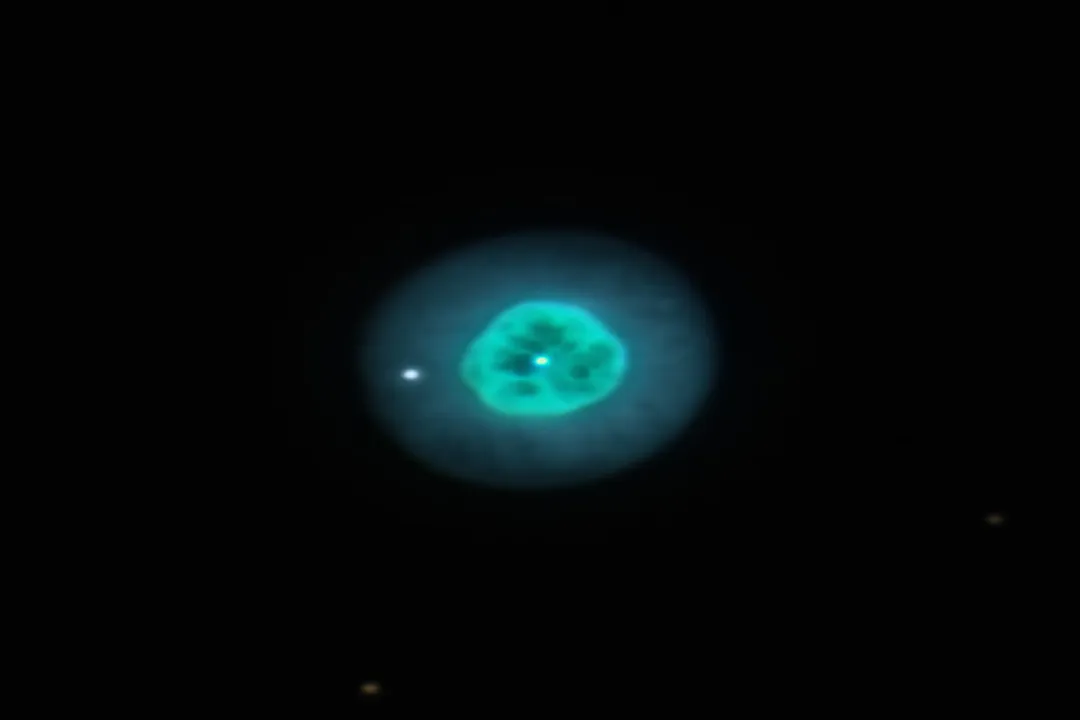
Nebulae formed during star birth operate under a different set of shaping rules, primarily driven by the intense output of the massive young stars they create. [5] These are often categorized as Emission Nebulae or H II regions. [2][5]
In these star-forming clouds, young, massive stars—sometimes 15 to 100 times the mass of our Sun—unleash tremendous amounts of ultraviolet radiation. [5] This radiation floods the surrounding gas, ionizing it (stripping electrons from atoms). [5] As the electrons recombine with the atoms, the gas glows, giving the nebula its light. [5]
The shape is then violently sculpted by these luminous residents:
- Radiation Pressure: The sheer outward force of the intense light pushes the gas away from the central energy source. [3][5]
- Stellar Winds: Powerful streams of charged particles emanating from the stars act like cosmic sandblasters, carving out large caverns in the cloud material. [5]
In iconic structures like the Pillars of Creation within the Eagle Nebula, this sculpting process carves out vast columns of denser gas that are more resistant to the stellar radiation. [2][5] The variation in dust density within the cloud determines which parts "evaporate" or erode faster, leading to the complex, towering features we observe. [2]
# Supernova Remnants
When the most massive stars reach their end, they explode as a Supernova, scattering their contents at speeds reaching tens of thousands of kilometers per second. [5] The resulting Supernova Remnant (SNR) shape is defined by this initial blast wave and what it sweeps up. [5] For instance, the Crab Nebula, an SNR from an explosion seen in 1054, is powered by a rapidly spinning remnant core—a pulsar. [5] The pulsar generates a magnetic field, and the high-energy electrons interacting with it create synchrotron radiation, which lights up the remnant's interior, often contributing to the complex internal structure. [5]
| Nebula Type | Origin Process | Primary Shaping Agents | Typical Longevity (Approx.) |
|---|---|---|---|
| Planetary Nebula | Death of Sun-like star (AGB phase) | Stellar winds, binary interaction, rotation, magnetic fields | years [2] |
| Emission Nebula (H II Region) | Star formation/Massive star clusters | Ionizing radiation, photon pressure, stellar winds | to $10^7$ years [2][3] |
| Supernova Remnant (SNR) | Massive star explosion or White Dwarf merger | Initial blast wave, central pulsar wind, swept-up ISM | to $10^6$ years [2] |
| Dark Nebula | Interstellar Cloud Concentration | Absence of strong internal radiation/shaping source (simple occlusion) | Highly variable; often long-lived structures within larger clouds |
# Large Scale and Hidden Influences
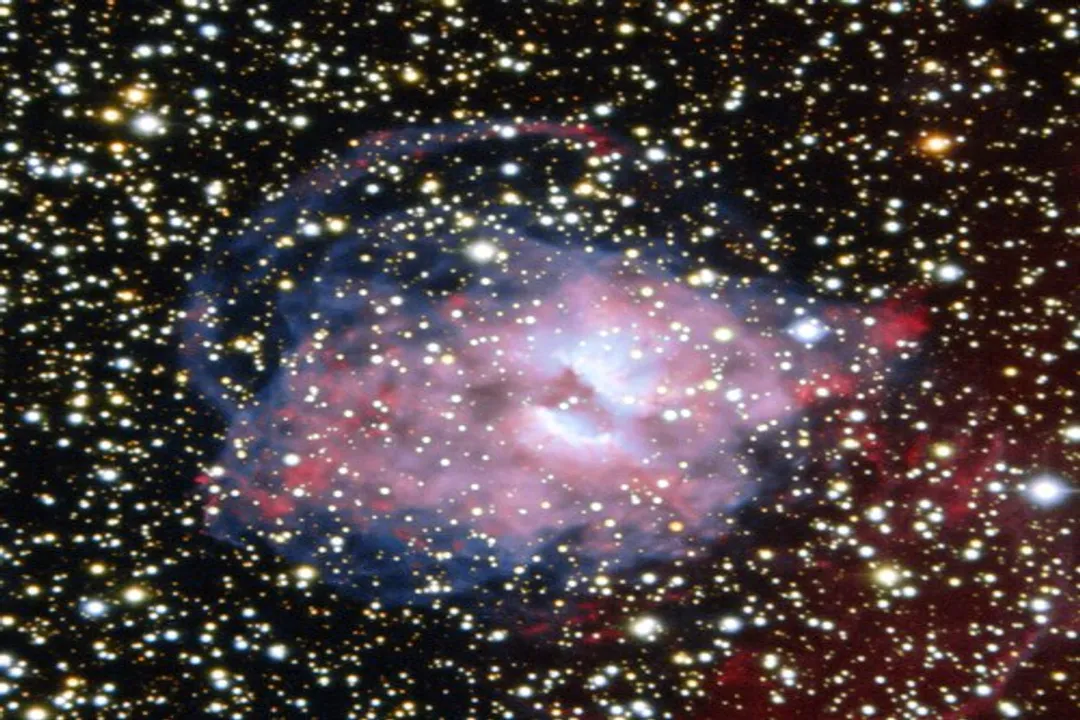
Beyond the immediate stellar environment, the larger context of the galaxy influences nebular appearance, particularly for PNs. On galactic scales, general shaping forces include gravity, turbulence, photon pressure, and collisions between interstellar material flows. [6] While shapes are chaotic, recent deep observations of PNs in the Milky Way’s central bulge revealed a surprising phenomenon: many bipolar nebulae showed a preferred alignment, with their long axes oriented along the plane of the galaxy.
This orderly arrangement is unexpected because the stars forming these nebulae are in a crowded region and should have formed with random orientations relative to one another. One bold suggestion to explain this large-scale coherence is the influence of strong magnetic fields present throughout the galactic bulge when those stars formed. If true, this implies that the early Milky Way possessed magnetic environments far more influential than the fields present in our local neighborhood today, demonstrating how the macro-environment can leave a subtle, structural fingerprint on the death throes of individual stars.
Ultimately, the shapes of nebulae are never truly "held" for long in cosmic terms; they are fleeting sculptures. [2] Whether being carved by the radiation from a young cluster, twisted by a binary companion, or slowly expanding into the void, the dramatic forms captured by telescopes like Hubble are records of intense activity that will persist only for a geological blink of an eye before dissolving back into the background interstellar medium. [2][5]
Related Questions
#Citations
How big are nebulae, what causes them, and what do they form later ...
Hubble's Nebulae - NASA Science
Did we discover how nebulae hold their shapes?
Planetary nebula - Wikipedia
Bizarre alignment of planetary nebulae - ESA/Hubble