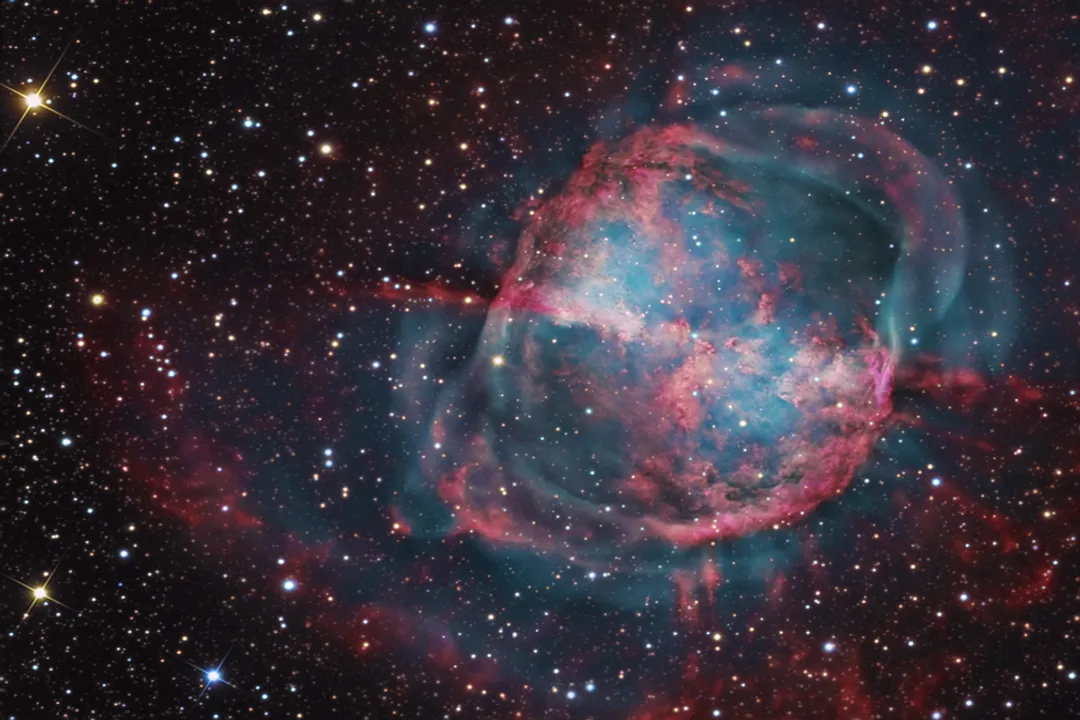
What determines whether a planetary nebula appears perfectly round or wildly asymmetrical?
Interactions disrupting the initial uniform outflow, such as the presence of a binary companion.
The geometry of a planetary nebula is fundamentally determined by whether the initial mass ejection process remains uniform or is disturbed by external or internal factors. The default expectation, dictated by simple physics where an isotropic outflow from a central point occurs, is a perfect sphere. This spherical baseline is established during the initial slow wind phase when the dying star sheds its outer layers symmetrically. However, perfect sphericity is rare because deviations arise. The most significant deviations, leading to bipolar or elliptical shapes, are caused by external influences, primarily the gravitational sculpting effect of a binary companion orbiting the primary star. This companion stirs the ejected material or channels subsequent faster winds into opposing jets, thereby introducing massive anisotropy into the structure.