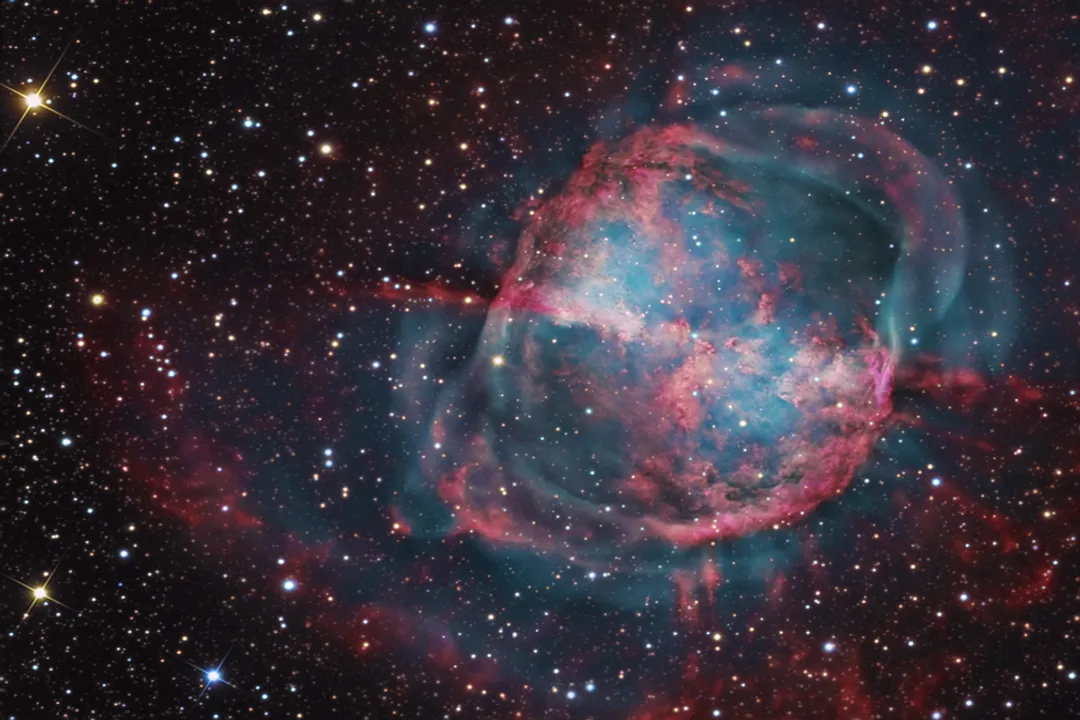
How does the internal density profile of a bipolar nebula contrast with that of a truly spherical nebula regarding emission?
Bipolar nebulae have significantly higher density concentrated along the polar axis due to confined jets, unlike the uniform density expected in a sphere.
The internal density structure inferred from emission patterns differs starkly between the two shapes. In a truly spherical nebula, assuming uniform conditions, the emission map should be smooth, with brightness decreasing predictably according to the inverse square of the distance from the central star. Conversely, bipolar nebulae are defined by having density highly concentrated along the axis of the established jets, meaning the density of the ionized gas is significantly greater along the polar axis than near the 'equator.' This forces models for bipolar objects to account for at least two distinct density components, often influenced by magnetic fields or angular momentum confining the outflow.