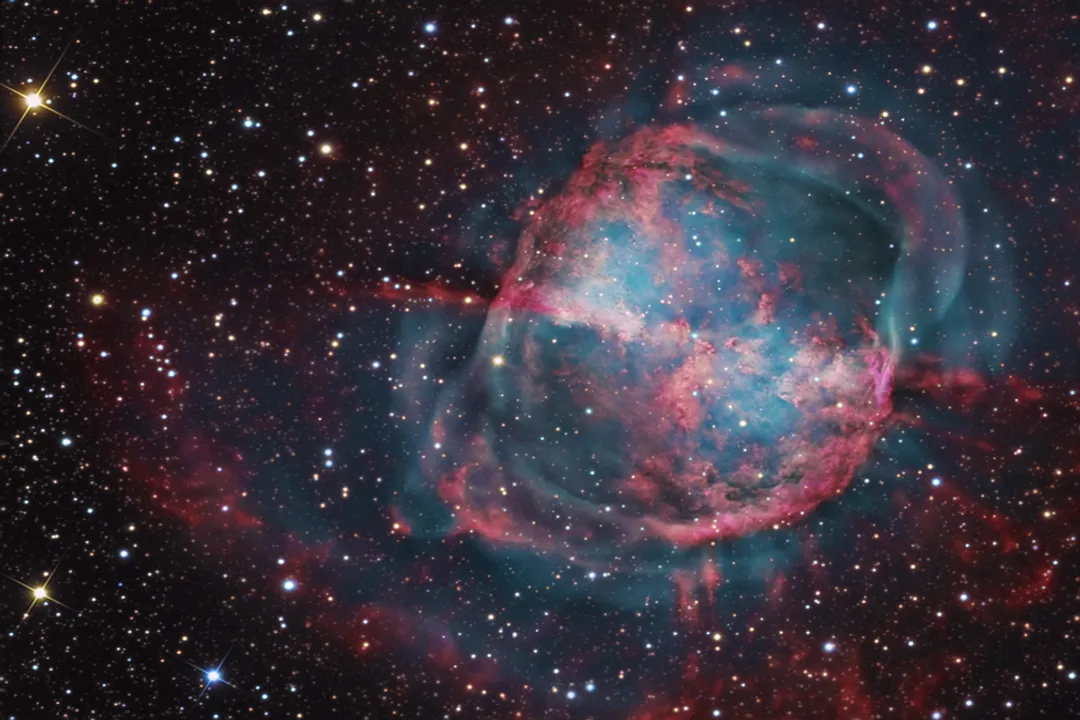
What observational effect can cause a truly elliptical or bipolar planetary nebula to appear spherical?
The orientation of the structure relative to our line of sight, where elongation is obscured if pointed toward or away from Earth.
Observational geometry plays a critical role in how we classify the shapes of planetary nebulae. Phenomena like ellipticity or bipolarity are inherently three-dimensional structures projected onto the two-dimensional plane of the sky. If a structure that is intrinsically elliptical or bipolar happens to be oriented so that its longest axis is perpendicular to our line of sight (i.e., pointed nearly directly toward or away from Earth), the elongation will be visually minimized or entirely obscured. In such cases, the nebula will appear much rounder or more circular than its actual geometry dictates, leading to misclassification as spherical based solely on visual appearance.