What advantage does data from the James Webb Space Telescope provide in analyzing nebula structure?
Answer
It allows for much better characterization of the warm dust components that trace older, slower ejection events.
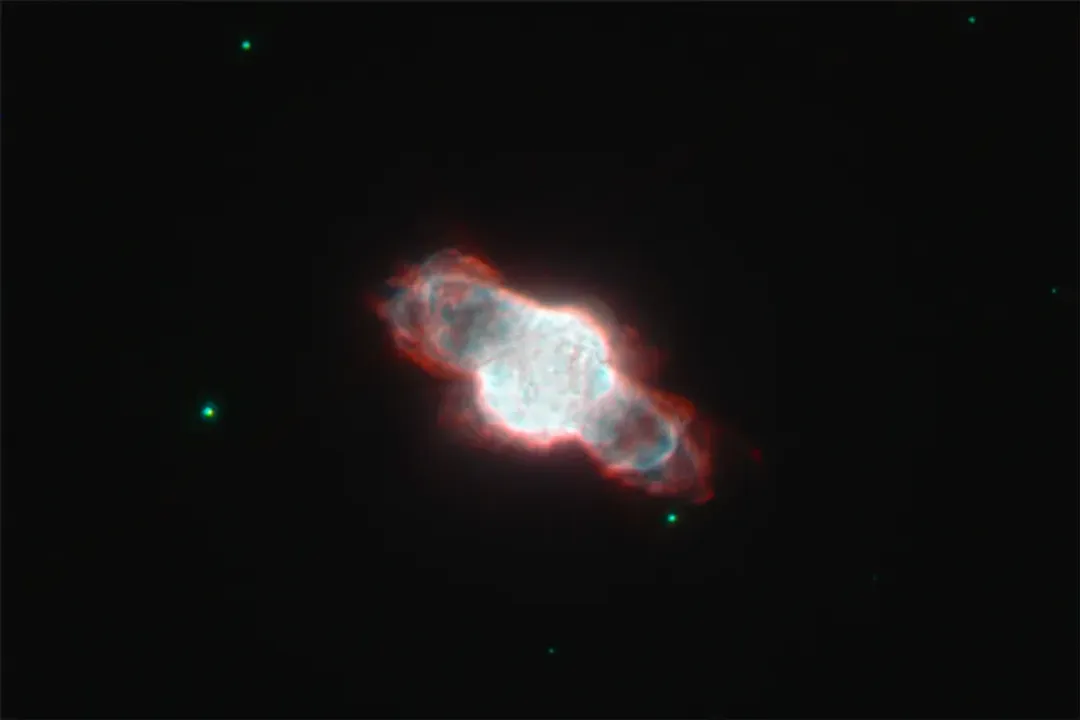
The James Webb Space Telescope (JWST) utilizes its capabilities, particularly in capturing infrared light, to enhance the study of planetary nebulae structure. By observing in different light spectra, astronomers can distinguish between layers of ejected material that formed at different epochs. Specifically, JWST data is crucial for characterizing the warmer dust components. This dust traces the material ejected during the earlier, slower wind phase, which forms the outer boundaries of the nebula, helping to reconstruct the full timeline of the star's mass loss history.
Related Questions
Why is the name Planetary Nebula considered slightly misleading?What illuminates the expanding gas cloud comprising a planetary nebula?Compared to other observed forms, how frequently are truly spherical planetary nebulae detected?What visual characteristic defines the commonly observed Bipolar planetary nebulae?Which historical figure first cataloged planetary nebulae in the late 18th century?What is the primary process creating the visible glowing shell after mass loss occurs?What external influence is considered a leading candidate for explaining common bipolar shapes?How can a strong, rotating magnetic field influence the morphology of escaping gas?What intricate structures were revealed in NGC 3132 by the Hubble Space Telescope?What advantage does data from the James Webb Space Telescope provide in analyzing nebula structure?