What is the white dot in the center of a planetary nebula?
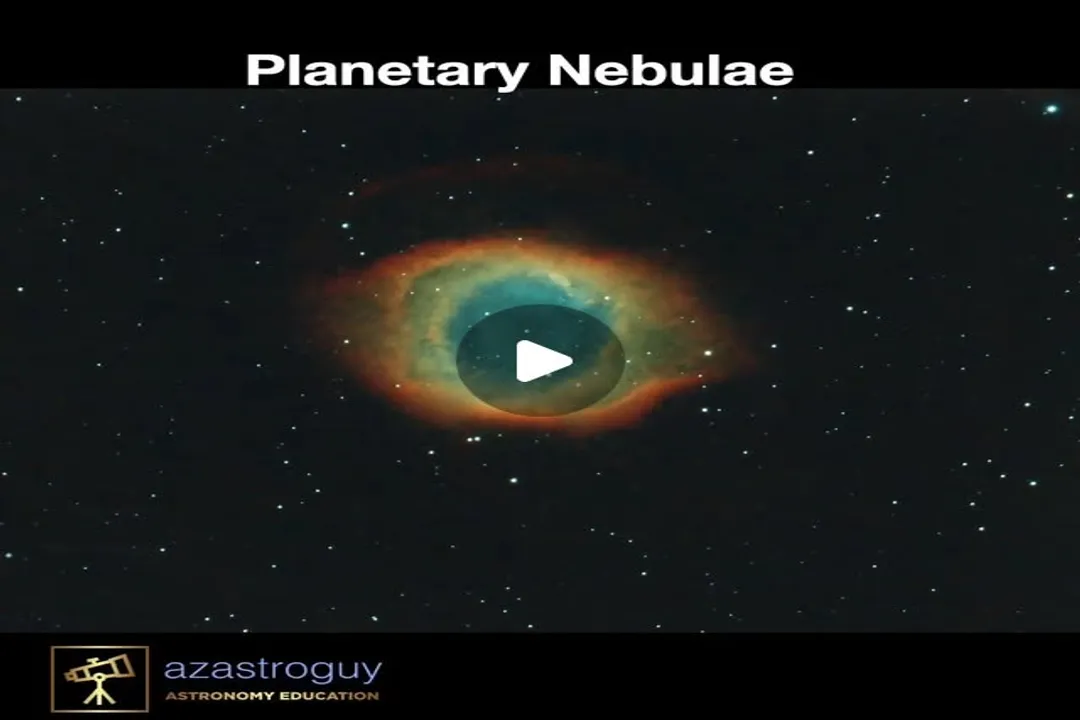
When observing a planetary nebula through a telescope, the most striking feature is often a bright, singular point of light sitting right in the center. This object might appear small and unassuming, yet it represents the final stages of a star similar in mass to our Sun. [2][9] This central point is not a planet, despite the name "planetary nebula" suggesting otherwise; instead, it is a white dwarf, the hot, dense core left behind after a star has ejected its outer gaseous layers. [1][4]
The confusion regarding the name dates back to the 18th century. When early astronomers looked through their primitive, low-resolution telescopes, these round, glowing clouds of gas appeared visually similar to the gas giant planets in our solar system. The name stuck, even though modern science has clarified that these objects have nothing to do with planets. The "dot" is the engine that drives the entire display, acting as the primary source of illumination for the surrounding cloud. [1][5]
# Stellar evolution
To understand why this white dot exists, one must look at the life cycle of stars. Stars like our Sun spend the vast majority of their existence, millions or billions of years, in a stable phase called the main sequence. During this time, they fuse hydrogen into helium in their cores. This process creates outward pressure that balances the inward pull of gravity, keeping the star stable.
As the star begins to run out of hydrogen fuel, it undergoes a dramatic transformation. It expands into a red giant, increasing significantly in size and cooling down on the outside. Eventually, the star becomes unstable. It can no longer hold onto its outer envelope of gas and dust. In a relatively short period, the star sheds these outer layers, blowing them out into space. This escaping gas forms the colorful, expanding shell that we see as the planetary nebula. [1][2][3]
Once these outer layers have been cast off, the only part of the original star that remains is the core. This core is what we see as the white dot. It is incredibly dense—often containing about half the mass of the original star packed into a volume roughly the size of Earth. Because it has stopped fusion, it is no longer generating energy through nuclear processes. It is simply a hot, cooling ember drifting through space. [5][9]
# White dwarf
The white dwarf at the center is the defining feature of the nebula. It is not just a remnant; it is the catalyst for the visual spectacle. Without this hot core, the surrounding gas would be invisible to us.
The temperature of a young white dwarf is extraordinary, often exceeding 100,000 degrees Celsius. This intense heat causes the core to emit massive amounts of ultraviolet radiation. As this ultraviolet light streams outward from the white dwarf, it slams into the expanding gas cloud that the star previously ejected. This energy strips electrons from the gas atoms, a process known as ionization.
When these ionized atoms recombine with electrons, they release energy in the form of visible light. This is why planetary nebulae glow in such vibrant colors—the specific elements in the gas, such as oxygen, hydrogen, and nitrogen, emit specific wavelengths of light when excited by the white dwarf's radiation. [2][9] The dot is, in effect, the light source for the entire lamp.
| Star Stage | Physical Characteristic | Visual Appearance |
|---|---|---|
| Main Sequence | Stable Fusion | Steady brightness |
| Red Giant | Expanding Atmosphere | Large, cooler, reddish |
| Planetary Nebula | Ejecting Outer Shell | Colorful glowing gas |
| White Dwarf | Cooling Dense Core | Small, hot, white dot |
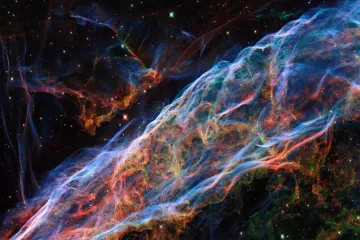
# Light mechanics
Understanding why the central dot appears "white" is a matter of blackbody radiation physics. Because the surface temperature of the white dwarf is so high, its peak emission shifts toward the blue and violet end of the spectrum. When a human eye perceives this broad spectrum of light from such a hot object, it registers as a sharp, intense white point.
It is worth noting that not all central stars in planetary nebulae look the same. In some cases, the nebula is so thick or dense that it obscures the central star from view. In other instances, the white dwarf may have cooled slightly or be positioned such that its light is scattered before reaching us. However, in clear, high-resolution imagery, the contrast between the diffuse, colorful gas of the nebula and the sharp, bright dot of the white dwarf is almost always distinct. [4][8]
# Observation tips
For amateur astronomers or those curious about identifying these features, distinguishing the white dwarf from the surrounding background of the galaxy can be a challenge. If you are looking at a planetary nebula through a telescope, the central dot is often quite faint compared to the brightness of the nebula itself.
A helpful technique involves using an Oxygen-III (OIII) filter. This filter allows only specific wavelengths of light associated with ionized oxygen to pass through, which helps make the glowing shell of the nebula stand out against the star field. Once the nebula is isolated, identifying the central star becomes easier because the filter suppresses the background light of ordinary, cooler stars. Keep in mind that a white dwarf will often look "colder" or more distinct than the surrounding background stars because of its intense UV-spectrum signature, which sets it apart from the typical red or yellow main-sequence stars scattered in the sky.
Another reality to consider is the timescale of this phenomenon. The planetary nebula phase is merely a brief interlude in the life of the star, lasting only about 10,000 to 20,000 years. In the context of a star's billion-year lifespan, this is an incredibly rapid transition. The gas shell expands outward at speeds of tens of kilometers per second and eventually dissipates into the interstellar medium, becoming too thin to be visible. Once the gas disperses, only the white dwarf remains, slowly cooling over billions of years until it becomes a black dwarf—a cold, dark, inert remnant. [1][9]
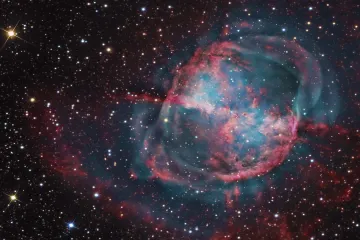
# Cosmic cycle
The white dot is the survivor of a violent cosmic event. By studying these central stars, astronomers gain insights into the future of our own Sun. The Sun is not massive enough to explode in a supernova, so it will eventually follow a similar path. Roughly 5 billion years from now, it will expand into a red giant, cast off its layers to create its own planetary nebula, and leave behind a white dwarf that will glow in the center of the solar system.
The white dot is essentially a cosmic time capsule. It tells the story of the star's past while dictating the structure of its surrounding nebula. Every shade of red, green, or blue seen in images of these nebulae is a direct result of the intense energy emanating from that central core. When we look at the white dot, we are looking at the final, quiet state of a star that once burned with the fury of nuclear fusion, now reduced to a compact, dense ball of matter that will endure long after the colorful clouds have vanished into the vacuum of space. [2][5]
Related Questions
#Citations
Planetary nebula - Wikipedia
Decoding Nebulae - NASA Science
This Hubble Space Telescope photo shows a planetary nebula ...
This Hubble Space Telescope photo shows a planetary nebula ...
What is the star left at the core of a planetary nebula? - Quora
Third in my series on Nebulae - Instagram
Star cluster in a nebula. In the center of the image there are arcs of ...
Planetary Nebulae
Planetary Nebula - ESA/Hubble