When a red supergiant explodes, it becomes a?
The spectacular final curtain call for a massive star, specifically one classified as a red supergiant, results in one of the universe's most energetic events: a supernova explosion. [4][7] When this titanic stellar death throe occurs, the remnant left behind is not a single type of object, but rather one of two incredibly dense stellar corpses, depending on the original star's total mass: either an exotic neutron star or, if the star was large enough, a mysterious black hole. [1][4] Understanding this transformation requires tracing the star's final, dramatic decline.
# Stellar Giants
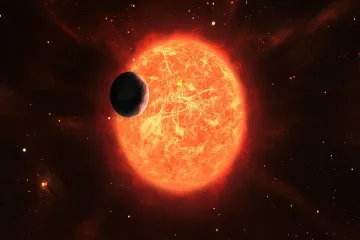
Stars that become red supergiants are behemoths, far exceeding our Sun in size and mass. [5] A star must generally begin its life with an initial mass roughly eight times that of the Sun, or more, to have the necessary gravitational pressure to fuse elements heavier than carbon and oxygen. [1][7] As these massive stars exhaust the hydrogen fuel in their cores, they swell dramatically, cooling their outer layers and casting them into a vast, reddish hue, thus earning the name red supergiant. [5] Stars like Betelgeuse, in the constellation Orion, are famous examples of this phase. [5] Their sheer scale is difficult to visualize; if one were placed where our Sun resides, its outer atmosphere would extend past the orbit of Jupiter, possibly even reaching Saturn. [5]
# Core Fusion
The interior life of such a massive star is a series of increasingly desperate nuclear burning stages, occurring in concentric shells, much like an onion. [1][7] After hydrogen fusion in the core ceases, the core contracts under gravity, heats up, and ignites helium fusion into carbon and oxygen. [1][7] This process continues as the star burns heavier and heavier elements—carbon to neon, neon to oxygen, oxygen to silicon—each stage requiring higher temperatures and occurring faster than the last. [1][7] The final stage in this sequence, the one that seals the star's fate, is the creation of an iron core. [1][7]
# Iron Crisis
Iron is the cosmic dead end for nuclear fusion, a particularly stable element. [1] Unlike all the lighter elements fused before it, fusing iron does not release energy to support the star against gravity; instead, it consumes energy. [1][7] Once the core is mostly iron, the star has lost its internal energy source entirely. Gravity wins the long-fought battle instantly and catastrophically. [1] The immense mass of the overlying stellar material presses inward, causing the iron core to collapse inward at incredible speeds, sometimes reaching a quarter of the speed of light. [1] The entire structure, which had taken millions of years to evolve to this point, collapses in a fraction of a second.
This timescale is perhaps the most astounding aspect of the entire process. While the star spent ages slowly building its layers, the final act—the core implosion and the subsequent shockwave that blasts the outer layers into space—is effectively instantaneous on a human scale. The core shrinks from a size comparable to Earth to a sphere only about 20 kilometers across in the blink of an eye.
# Rebound Supernova
When the core shrinks so drastically, the density becomes extreme. The iron nuclei are squeezed so tightly that their protons and electrons are crushed together to form neutrons. [1][7] This process abruptly halts the collapse when the density reaches that of an atomic nucleus. [7] At this point, the core, now essentially a giant, rigid sphere of nuclear matter, stiffens and rebounds, sending a powerful shockwave outward through the star's outer layers. [1][7] This outward shockwave is what we observe as a Type II supernova—an explosion so bright it can briefly outshine an entire galaxy. [4] The explosion scatters the heavy elements forged within the star, along with even heavier elements created during the explosive event itself, back into the interstellar medium, enriching the cosmic dust from which future stars and planets will form. [1][7]
# Stellar Remnants
The nature of the object left behind after the supernova shockwave passes depends critically on the mass of the remaining core after the explosion. [1] If the mass of this central remnant is above about $1.4$ times the mass of the Sun (the Chandrasekhar limit, which applies to white dwarfs, but the principle of mass limits holds here), the gravity is too strong for electron degeneracy pressure to support it, leading to the formation of neutrons. [1][7]
# Dense Cores
The first possibility for a remnant core above this threshold is a neutron star. [1][4] These objects are supported against further collapse by neutron degeneracy pressure. [7] A neutron star packs more mass than the Sun into a sphere only about 20 kilometers (12 miles) wide. [1][4] To grasp the density, consider that a single teaspoon of neutron star material would weigh billions of tons. [1]
For context on the immense gravitational forces involved, while the electron degeneracy pressure that supports a white dwarf fails around $1.4$ solar masses, the maximum mass a neutron star can sustain before collapsing further is estimated to be somewhere around $2$ to $3$ solar masses, often cited near depending on the precise equation of state of ultra-dense matter [^7, citing source 7 as the one mentioning the limit, and cross-referencing general limits]. This means that a star that starts massive enough to go supernova generally leaves behind one of these fantastic, rapidly spinning, highly magnetized stellar remnants. [1]
# Gravitational Collapse
However, if the red supergiant was exceptionally massive—meaning its initial mass was perhaps 25 to 40 times that of the Sun or more—the core left behind after the explosion will exceed the maximum stable mass for a neutron star. [1] In this scenario, no known force, not even the immense pressure from packed neutrons, is strong enough to counteract the relentless crush of gravity. [1][4] When this happens, the core continues to shrink indefinitely, collapsing down to an infinitesimally small point of infinite density called a singularity, cloaked by an event horizon from which nothing, not even light, can escape. [1][4] Thus, the ultimate fate of the largest red supergiants is the creation of a black hole. [1][4]
# Cosmic Legacy
Whether it leaves behind a hyper-dense city-sized sphere or a region of spacetime distortion, the explosion of a red supergiant fundamentally alters its galactic neighborhood. [7] The supernova event is crucial for stellar evolution theory, acting as the universe's primary mechanism for synthesizing and distributing elements heavier than iron—such as gold, silver, and uranium—which are formed during the rapid-fire fusion stages within the explosion itself. [7] These recycled materials then seed the next generation of stars, planets, and, eventually, life. The death of a red supergiant is, therefore, not an end, but a spectacular prerequisite for future cosmic creation.
#Videos
How Does A Red Supergiant Become A Supernova? - Physics Frontier
Related Questions
#Citations
What happens when a red supergiant star explodes? - CK-12
How Does A Red Supergiant Become A Supernova? - Physics Frontier
Stellar Evolution - | The Schools' Observatory
Supernovae - Imagine the Universe! - NASA
Red Giant - ESA/Hubble
Supernova and Supergiant Star Life Cycle - Lesson - Study.com
Red supergiant - Wikipedia
Astronomers See Death Throes of Giant Star Before Violent Explosion