If a progenitor star was among the most massive (exceeding 20 to 25 solar masses), what remnant forms after the supernova explosion?
Answer
A black hole.
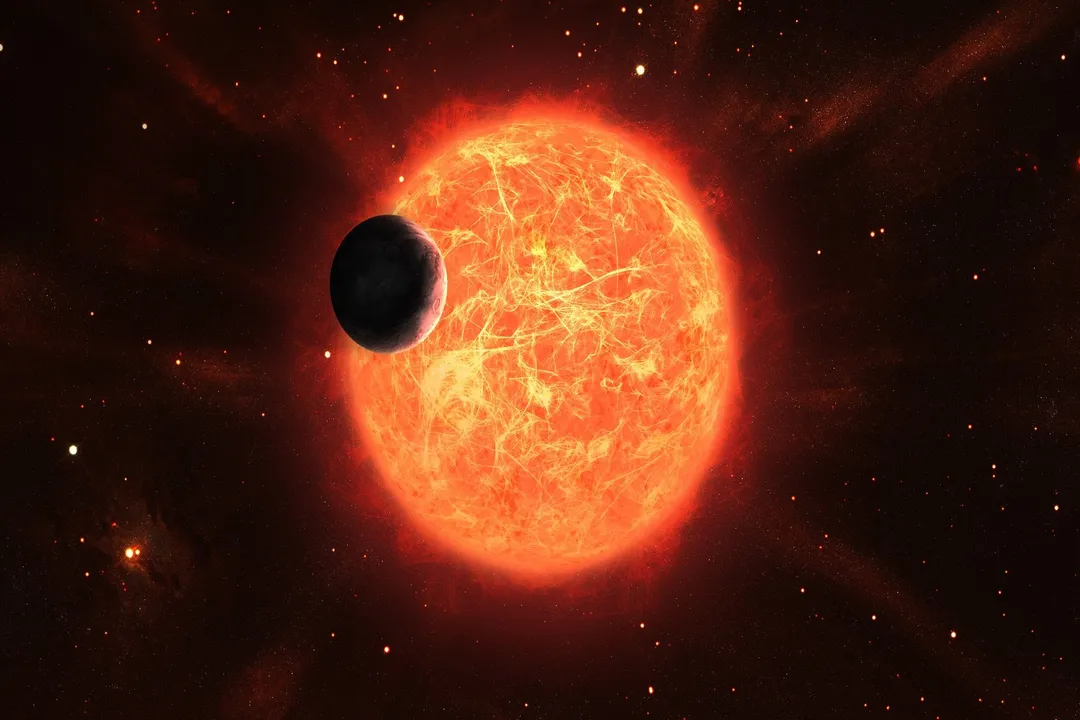
The ultimate fate of a star that has undergone the red supergiant phase is determined by the initial mass of that progenitor star. While moderately massive stars that collapse might leave behind an incredibly dense neutron star—a city-sized sphere of neutrons—the very largest stars overcome even the neutron degeneracy pressure. If the initial mass exceeded approximately 20 to 25 solar masses, the subsequent core collapse results in the formation of a singularity, an object possessing gravity so intense that nothing, including light, can escape: a black hole.
Related Questions
What initial mass range ($M_{\odot}$) qualifies a star to become a Red Supergiant?What fusion event triggers the expansion phase away from the main sequence for massive stars?What causes the surface cooling responsible for imparting the 'red' color to a red supergiant?What is the typical surface temperature range for a red supergiant on the H-R diagram?How long does the transient existence of a red supergiant phase typically last relative to its main sequence lifetime?Which elements are fused in the successive, nested shells surrounding the core of a very massive red supergiant?What final element forms in the core that causes the star to instantly lose its primary energy source?If a progenitor star was among the most massive (exceeding 20 to 25 solar masses), what remnant forms after the supernova explosion?What is the primary difference between a star evolving into a Red Giant versus a Red Supergiant?How does the energy output from shell hydrogen fusion compare to the star's previous core fusion rate?