For stars in the low-to-intermediate mass range (up to $\approx 8 M_\odot$), what process follows the exhaustion of core helium fusion?
Answer
Initiating fusion of helium in a shell around a carbon-oxygen core, leading to the AGB phase
Low-mass stars lack the gravity to ignite carbon fusion. After helium depletion, they contract again and fuse helium in a shell around the inert carbon-oxygen core, entering the luminous Asymptotic Giant Branch phase.
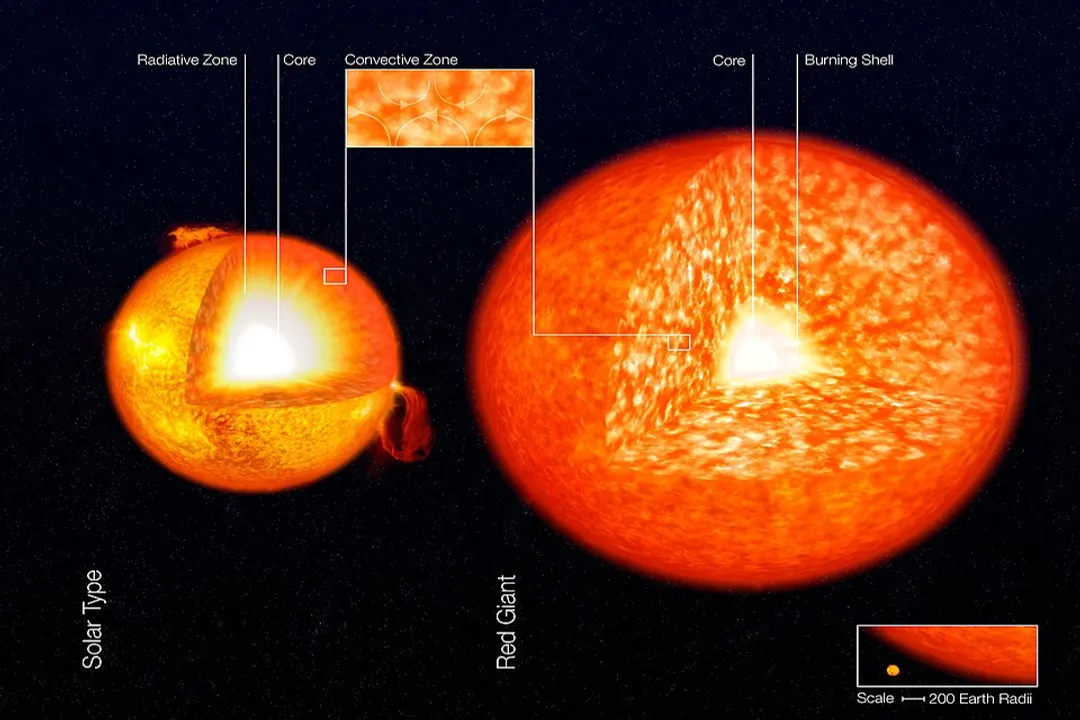
#Videos
How Do Stars Become Red Giants Or Supergiants? - Physics Frontier
Related Questions
What is the primary factor determining whether a star evolves into a Giant or a Supergiant?What physical state maintains stability for a star during the vast majority of its existence?Why do stars with greater initial mass consume their hydrogen fuel much faster than solar-mass stars?What process initiates the rapid expansion characteristic of the Red Giant phase in a Sun-like star?What is the approximate minimum initial mass threshold that generally designates a star as destined for the Supergiant classification?Which element forms in the core of a massive star immediately preceding the catastrophic loss of thermal pressure?For stars in the low-to-intermediate mass range (up to $\approx 8 M_\odot$), what process follows the exhaustion of core helium fusion?What is the ultimate fate of a Sun-sized star because its residual core mass falls below the Chandrasekhar limit?What term is used for the hottest giants that are spectral types O, B, or early A?How does the radius of a Red Supergiant, like Betelgeuse, generally compare to the maximum expansion of a Red Giant like the future Sun?What is the core temperature requirement for helium fusion via the triple-alpha process in a Sun-sized star?