What structural feature characterizes stars significantly more massive than the Sun?
Answer
A large convective core surrounded by a radiative envelope
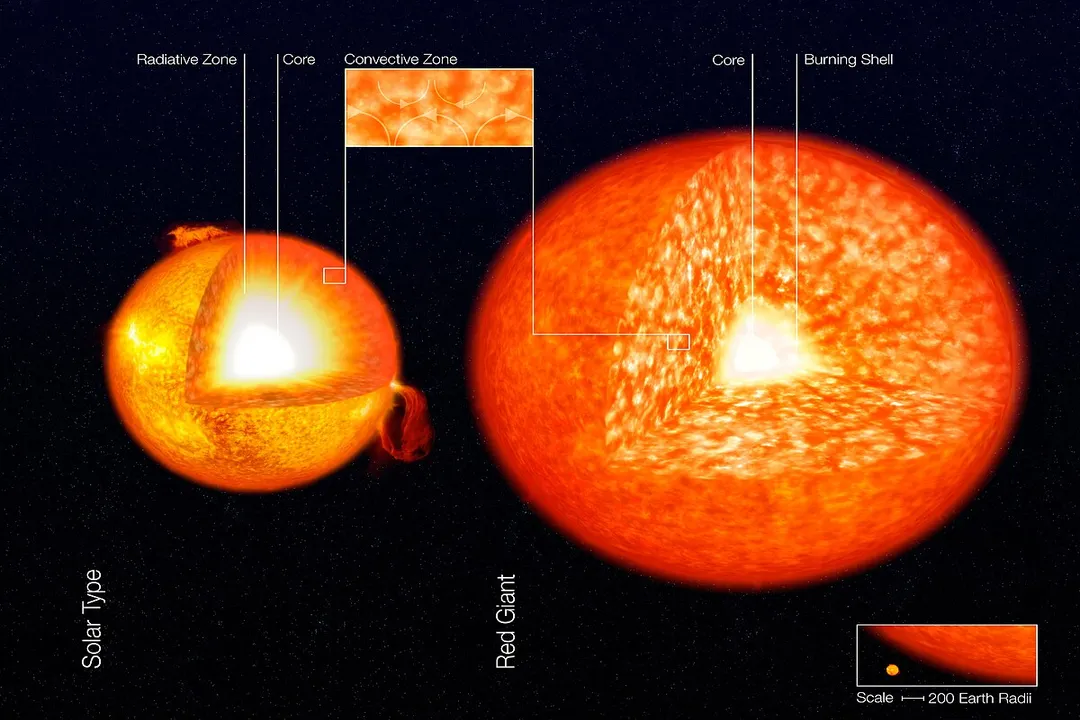
Stars significantly more massive than the Sun, typically ten times the solar mass or greater, exhibit an inverted internal structure compared to solar-type stars. Due to their extremely high core temperatures and increased plasma transparency (less opacity), radiation becomes highly effective near the center. Therefore, these massive stars develop a central region where fusion occurs, immediately surrounded by a large, churning convective core. This convective core is then enveloped by an extensive radiative envelope that persists all the way out to the visible surface of the star.
Related Questions
What is the approximate starting depth of the Sun's convective zone?How is energy primarily transported in the radiative zone?What structural feature characterizes stars significantly more massive than the Sun?What observable feature on the Sun's photosphere is the visible top of a convective cell?How does energy transit time compare between the convective zone and the radiative zone in the Sun?What structural feature is true for very low-mass stars like red dwarfs?When does the physical principle of convection become dominant over radiation for energy transport?What is the approximate temperature difference between the base and the surface of the Sun's convective zone?What process generates the star's magnetic field due to motions within the convective zone?Why is the precise boundary of the convective zone critical input for stellar evolution codes?What physical principle defines the energy transfer in the convective zone?