What structural feature is true for very low-mass stars like red dwarfs?
Answer
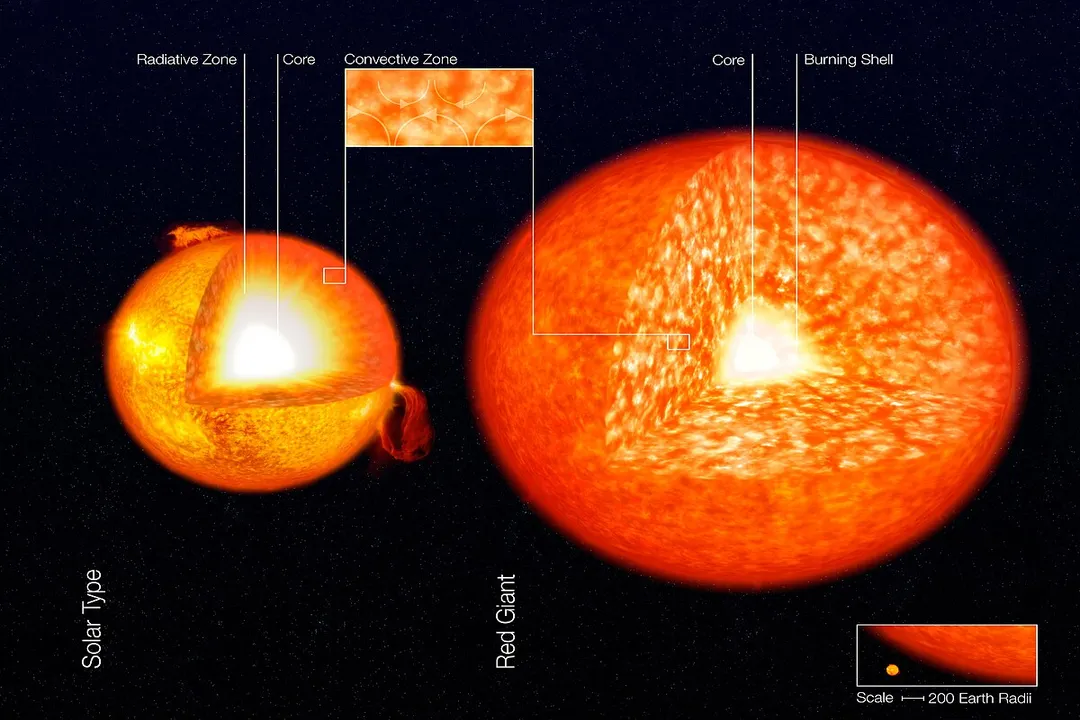
The entire interior, from core to surface, is convective
Very low-mass stars, such as red dwarfs possessing masses less than approximately 0.3 solar masses, maintain such steep temperature gradients throughout their entire volume that the radiative transfer mechanism is insufficient everywhere. Consequently, these stars are fully convective, meaning the plasma motion extends continuously from the central fusion core all the way to the visible surface. This complete mixing ensures that the helium ash produced in the core is constantly circulated outward, and fresh hydrogen fuel is transported inward, allowing the star to consume virtually all its hydrogen supply before evolving, granting them exceptionally long main-sequence lifetimes.
Related Questions
What is the approximate starting depth of the Sun's convective zone?How is energy primarily transported in the radiative zone?What structural feature characterizes stars significantly more massive than the Sun?What observable feature on the Sun's photosphere is the visible top of a convective cell?How does energy transit time compare between the convective zone and the radiative zone in the Sun?What structural feature is true for very low-mass stars like red dwarfs?When does the physical principle of convection become dominant over radiation for energy transport?What is the approximate temperature difference between the base and the surface of the Sun's convective zone?What process generates the star's magnetic field due to motions within the convective zone?Why is the precise boundary of the convective zone critical input for stellar evolution codes?What physical principle defines the energy transfer in the convective zone?