How long does a blue star live?
The stars we observe in the night sky present a common visual, but beneath that shared backdrop lies a vast diversity of stellar types, each with a fate dictated by a single, overwhelming factor: mass. When we consider the blazing, intense light of a blue star, we are looking at the cosmos’s most extravagant spenders. These giants and supergiants are defined by their scorching temperatures, their incredible output of energy, and, most notably, their dramatically brief existence when stacked against their cooler, dimmer neighbors.
# Hottest Fire

The blue hue of a star is a direct signature of its surface temperature. Unlike everyday visual cues where red might signify heat, in the spectrum of stellar radiation, blue light carries more energy, meaning it requires a source far hotter than those producing red light. A star must achieve an immense temperature to radiate predominantly in the blue end of the spectrum. For context, stars that possess three or more times the mass of our Sun will typically present as blue when they are actively fusing hydrogen on the main sequence. This categorization covers stars with spectral classes O, B, and sometimes the early A types, often boasting temperatures exceeding .
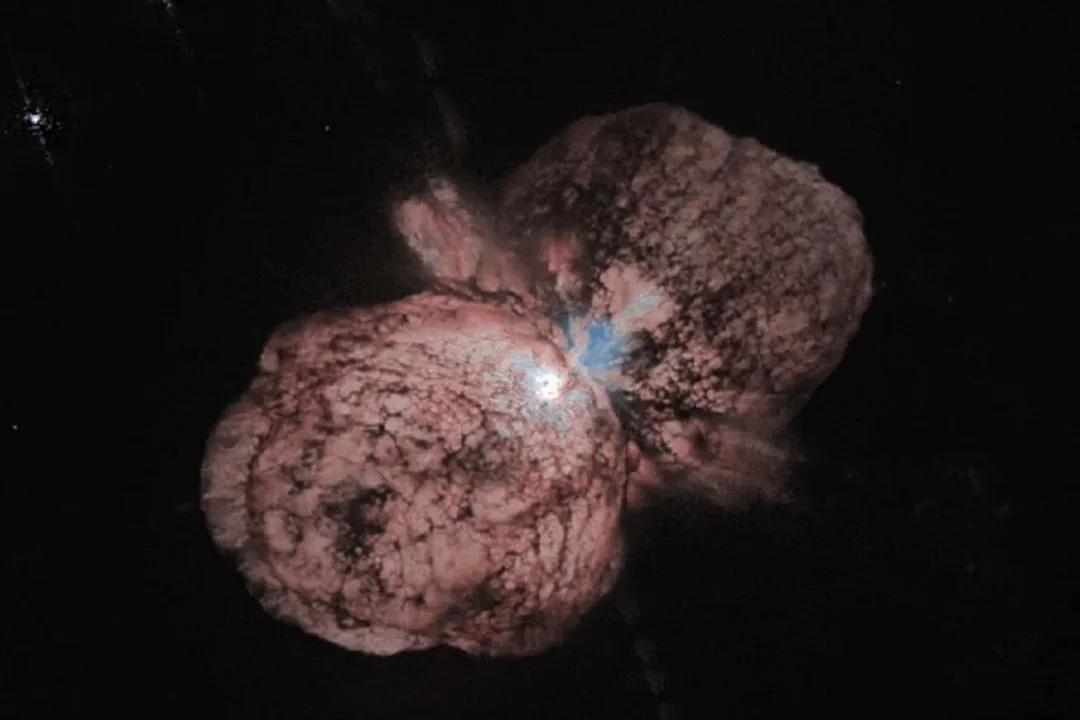
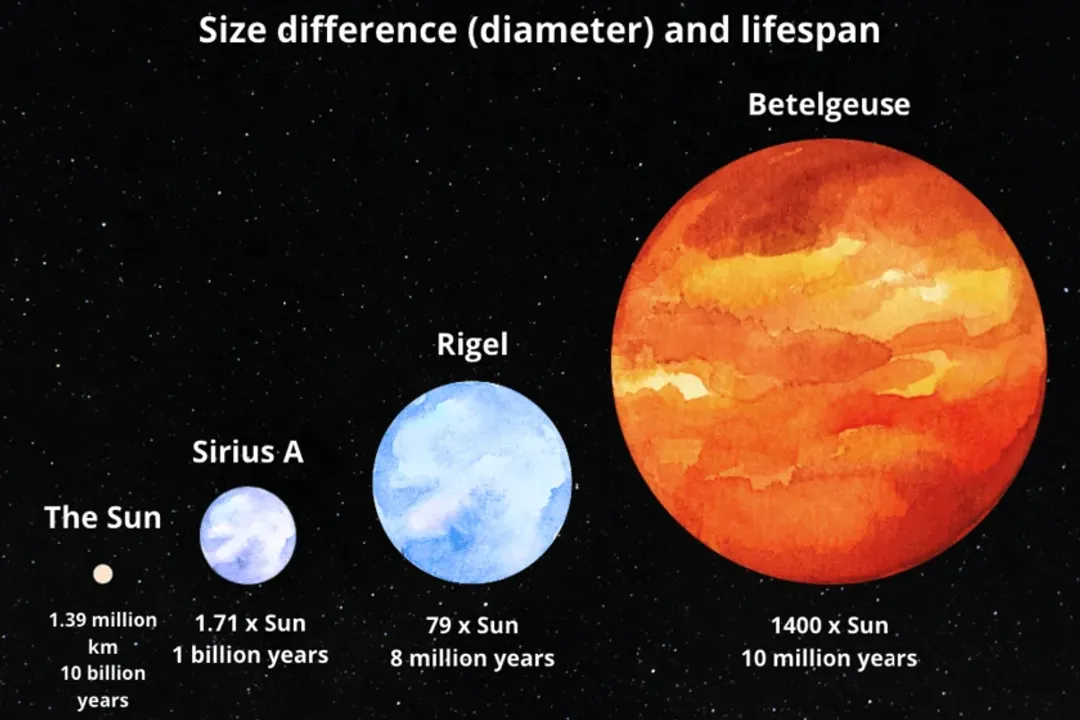
This extreme temperature is coupled with massive physical size and, crucially, extraordinary luminosity. Blue stars are the biggest and brightest stars in the galaxy. Even stars with 'only' three times the mass of the Sun are significantly brighter than less massive stars. When mass increases further, the energy output skyrockets. For example, the blue supergiant Rigel, located in Orion, emits roughly $40,000$ times the energy of our Sun. Even more extreme is Eta Carinae, a blue supergiant residing about $8,000$ light-years away, which blasts out about $1,000,000$ times the energy of the Sun, with a surface temperature around . To put this energetic output into perspective, Rigel, despite being hundreds of light-years distant, appears almost as bright to us as Sirius, which is vastly closer.
# Fuel Consumption Rate
The fundamental relationship between a star's mass and its lifespan can be summarized by observing how quickly it depletes its hydrogen fuel supply. Because blue stars are far more massive and luminous, they must sustain nuclear fusion at an astronomical rate to counteract the immense inward crush of gravity. This ravenous energy demand means they burn through their core hydrogen supply much faster than any other type of star.
For the average star, like our Sun, the main-sequence lifespan is projected to be around $10$ billion years, with the Sun currently at about $4.5$ billion years old and expecting another $5$ billion years of stability. Stars even smaller than the Sun, the low-mass red dwarfs, are the universe's marathon runners, capable of lasting for tens of billions, hundreds of billions, or even trillions of years due to their slow, efficient fuel burning. Barnard's Star, a red dwarf, is estimated to have a main-sequence lifespan of about $10$ trillion years.
In stark contrast, the massive blue stars live fast and die young. Their main-sequence phase—the time they spend fusing hydrogen in their core—is compressed into a blink of an astronomical eye. Stars exceeding three solar masses exhibit this pattern. Specific, well-studied examples highlight this extreme brevity:
- Rigel, a blue supergiant, has a main-sequence lifespan estimated around . Its total lifespan, including its post-main-sequence phase, is only about $10.1$ million years before it concludes as a supernova.
- Eta Carinae A, possessing roughly $100$ times the Sun’s mass, has a main-sequence life of only about . Its entire expected existence is estimated at a mere $3.1$ million years. In fact, based on its current state, it is expected to detonate as a supernova within the next $100,000$ years.
The general consensus derived from stellar evolution models suggests that various kinds of blue stars exist for lifetimes ranging from $10$ to $100$ million years. This timescale is incredibly short in the context of galactic history, which is why these luminous blue stars are almost always found near the star-forming regions where they were recently born.
# Evolutionary Sprint
The path of a blue star is an accelerated version of stellar evolution, marked by rapid changes in luminosity class. When a high-mass star exhausts the hydrogen in its core, it moves off the main sequence, transitioning first into a relatively brief stage as a blue subgiant and then a blue giant. During this phase, the star expands, becoming both cooler and more luminous.
As the star progresses, the core temperature climbs until it is hot enough to ignite the fusion of helium into heavier elements like carbon and oxygen. This transition pushes the star into an even more luminous state, becoming a blue supergiant. For the most massive stars, this evolutionary path across the Hertzsprung-Russell diagram is swift, moving horizontally through the blue giant, bright blue giant, and blue supergiant classes before potentially becoming a yellow supergiant and finally a red supergiant. The classification depends on subtle spectral line analysis related to the star's degree of expansion and surface gravity. This entire evolutionary sprint from birth to supernova is measured in mere millions of years, a stark contrast to the $12$-billion-year expected total lifetime of a solar-mass star like our Sun.
# The Rarity Paradox
If massive stars live such short lives, why are blue stars visible at all? The answer lies in their overwhelming brilliance. Although star-forming regions generate many more low-mass stars than high-mass ones, and the high-mass stars die quickly, the few blue stars that do form shine so intensely that they remain visible across vast interstellar distances. Stars like Regulus, Spica, and Rigel are all visible from Earth, yet they lie at very different distances—$79$, $250$, and $860$ light-years, respectively—a testament to the sheer energy they radiate. This inherent luminosity is what allows these fleeting entities to dominate the night sky for the brief period they exist.
# Old Blue Puzzles
While the physics dictates that blue stars should be short-lived, astronomers have observed an interesting phenomenon that defies this expectation: blue stragglers. These are hot, blue stars found within star clusters that are known to be extremely old, clusters where stars of that mass should have long since evolved into giants or supergiants. The most compelling explanation for these outliers is that they are not originally born massive. Instead, they are likely older, cooler stars that have been rejuvenated by receiving new material—perhaps hydrogen—from a companion star in a binary system. This effectively resets their clock, allowing them to burn blue on the main sequence far longer than their initial mass would predict, representing an interesting astrophysical anomaly to the standard lifespan narrative.
A key aspect to consider when contemplating these extreme stellar lifetimes is the concept of the habitable zone (HZ). Because blue stars are so incredibly hot, the region around them where liquid water could theoretically exist—the HZ—must be located much farther out than it is for a Sun-like star. If a planet orbits at a distance equivalent to Earth's orbit around the Sun (), it would be incinerated by the intense energy, high UV rays, and X-rays emitted by the blue star. While moving the planet hundreds of Astronomical Units away might place it in a temperature-stable HZ, the overriding issue remains the star's lifespan.
If we use the conservative high estimate for a blue star's life—say $100$ million years—this presents a profound challenge for abiogenesis and evolution. On Earth, it took approximately $3$ to $4$ billion years just for non-photosynthetic single-celled life to appear after liquid water formed. A planet orbiting a blue star has, at best, $100$ million years before its sun becomes a red giant or explodes in a supernova. To achieve even microbial life before the star dies, evolution would need to occur on a timescale nearly $30$ to $40$ times faster than it did on Earth. This leads to a fascinating hypothetical scenario: life around a blue star would necessitate an incredibly high-energy, high-metabolism biosphere, favoring small, fast-breeding organisms that can complete entire evolutionary cycles in mere days or weeks, rather than millennia, just to keep pace with their host star’s rapid decline.
When observing the evolutionary track of stars, one might assume that any star currently classified as a Blue Giant (Luminosity Class III or II) is inherently older than a Main Sequence star of the same temperature, having exhausted its core hydrogen. However, the term "blue giant" covers stars in very different developmental stages. Some are intermediate-mass stars burning helium in their cores after having passed through a red giant phase, while others are the direct, rapid descendants of the most massive stars that have just left the main sequence. This distinction is critical: two stars shining blue might have vastly different ages; one could be a star barely beginning its brief existence above , while the other might be an evolved, helium-burning core nearing its final collapse. For the most massive O-type stars, their transition from the main sequence to supergiant status is so rapid that their sizes and temperatures barely change, making classification difficult and their lifetimes extremely short, often only a few million years. This compressed timeframe essentially means that for any planet hoping to evolve life, the "safe" zone, temperature-wise, may only be transiently available before the star enters its final, terminal phases.
# Color and Chronology
It is important to separate the color of the star from its evolutionary status when estimating its age. A star’s mass determines its spectral class and color, but its evolutionary phase dictates its luminosity class (the Roman numeral in its classification). For instance, the Sun, a G-type star, will become a red giant, expanding its surface area while its surface temperature drops, causing it to appear red, despite its initial yellow-white state. A blue star, being so much more massive, follows a path where it becomes a blue giant and then a blue supergiant. While a red giant might expand to $300$ times the radius of the Sun, a blue giant is often only $5$ to $10$ times the Sun's radius, though its energy output dwarfs that of a red giant. This means the blue supergiant phase is less about extreme physical puffing up (like its red counterpart Betelgeuse, which is $1,400$ times the Sun's diameter) and more about radiating an enormous quantity of energy per square meter of surface. The sheer energetic output is the hallmark of the blue phase, which is why their lifetimes are so aggressively short, regardless of whether they are labeled 'giant' or 'supergiant'.
Related Questions
#Citations
Blue giant - Wikipedia
How Long Do Stars Live? - Label Stars
Blue stars: The biggest and brightest stars in the galaxy - Space
What adaptations would be needed for life and water around a blue ...
Stars
Blue Stars - Universe Today
What would be the implications of a habitable earth-like planet that ...