How long do K-type stars last?
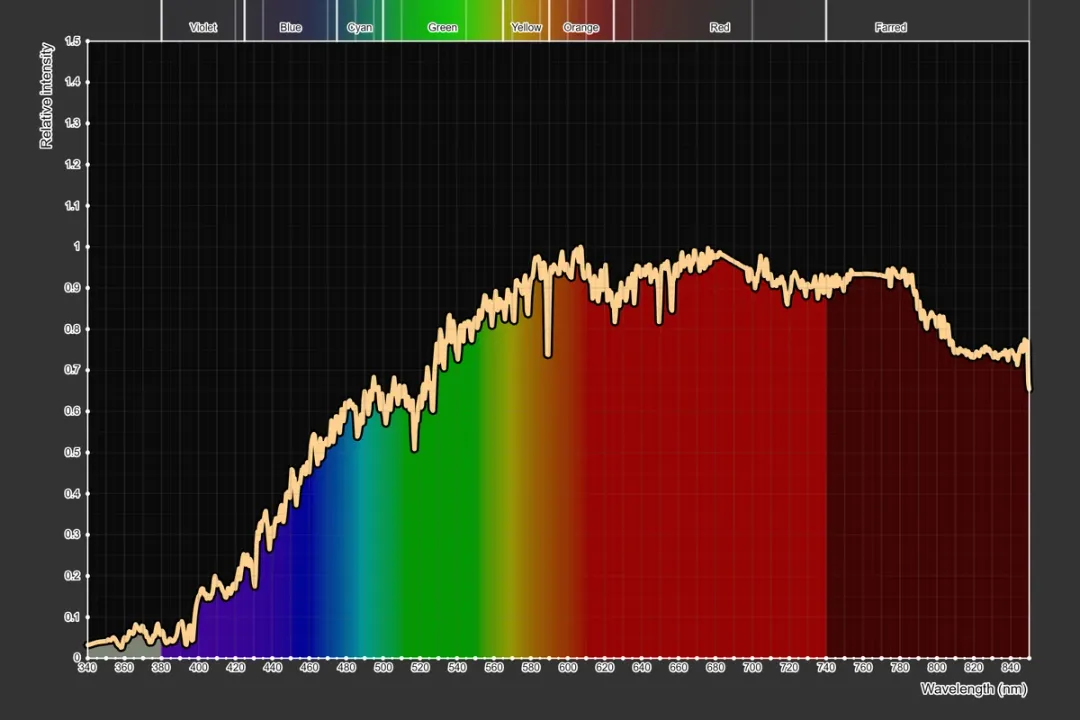
The designation K-type main-sequence star often brings to mind the term orange dwarf, a common type of star that occupies a fascinating middle ground in the stellar population. [2][8] They are visibly cooler and dimmer than our own Sun, which is classified as a G-type star. [7] To the naked eye, the light they emit trends toward the orange or even reddish-orange end of the visible spectrum. [2] Astronomically, these stars are defined by their spectral classification, placing them between the hotter, brighter G-type stars and the cooler, dimmer M-type red dwarfs. [1] They are stars diligently burning hydrogen in their cores, occupying their stable phase on the main sequence, much like the Sun is now. [1]
# Stellar Characteristics

These stars are fundamentally smaller and less massive than the Sun. [7] Their typical mass range is cited as being between $0.5$ and $0.8$ times the mass of our Sun. [1] Correspondingly, their energy output—their luminosity—is also scaled down, generally falling between $0.08$ and $0.6$ times the luminosity of the Sun. [1] This lower output directly correlates with their lower surface temperatures compared to G-type stars. [7] Understanding this relationship—lower mass means lower core pressure and temperature—is the key to understanding their most remarkable trait: their duration of life.
K-type stars are often grouped with M-type stars when discussing long-lived stellar systems, but they possess a distinct advantage over their smaller, far more numerous counterparts. While M-dwarfs burn their fuel incredibly slowly, K-stars offer a slightly higher luminosity, which expands the potential habitable zone around them compared to the very dim M-stars. [9]
# Fusion Duration
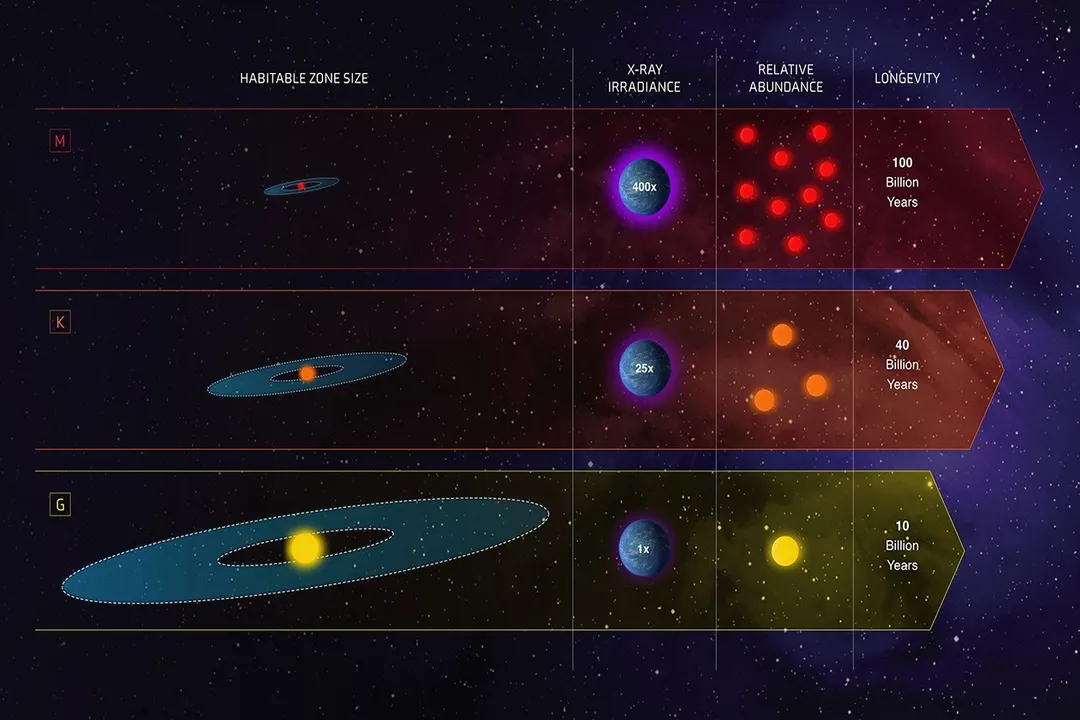
The central question regarding any star is its lifespan, and for K-type stars, the answer is measured in the tens of billions of years, vastly exceeding the expected total life of the Sun. [4] While the Sun is expected to last about $10$ billion years on the main sequence, K-type stars often enjoy lives stretching for $20$ to $70$ billion years. [4][9] Some sources even estimate lifespans significantly longer, pushing into the realm of trillions of years for the lowest-mass examples near the K/M boundary. [4]
This incredible longevity stems directly from their lower mass and the resulting slower rate of nuclear fusion in their cores. [1] For a star like the Sun, the relatively high core temperature drives fusion at a rapid pace, consuming its hydrogen fuel supply in roughly $10$ billion years. K-type stars, having less mass to begin with, cannot generate the same core pressures, leading to a much more sedate fusion process. [7]
Think of it as fuel efficiency in a vehicle. A high-performance engine (like a massive, hot star) burns fuel quickly for maximum power, while a small, economy engine (like a low-mass K-star) sips its fuel incredibly slowly, making a small tank last exponentially longer. [4] Because the K-star has a lower mass, it possesses less total fuel, but the rate at which it burns that fuel is disproportionately slower than the reduction in its fuel supply, resulting in a net gain of billions of extra years of stability. [9]
# Habitable Systems
The extended, stable lifetime of K-type stars is why they are frequently highlighted as excellent candidates for supporting complex life, often earning them the moniker "Goldilocks Stars". [6][9] They offer the necessary environment for life to arise and evolve over geological timescales without the existential threat of a rapidly evolving or expiring host star. [9]
Planets orbiting within the habitable zone—the orbital band where liquid water could exist on a planet's surface—of a K-type star benefit from this stellar stability. [9] The environment is generally less prone to the intense, high-energy flares that plague smaller, magnetically turbulent M-dwarfs, yet they provide warmth for a much longer duration than a Sun-like star. [6]
Consider the specific case of a K1-class star, which sits toward the hotter, more massive end of the K-type spectrum. It has been postulated that such a star could sustain complex, surface-dwelling life on a terrestrial planet, such as a super-Earth with $2.0$ Earth masses, even if that planet were $7$ billion years old. [5] This scenario is compelling because $7$ billion years is already past the estimated total main-sequence life of our Sun. For a K1 star, $7$ billion years is merely a fraction of its expected operational time, suggesting that life has ample time not just to begin, but to fully develop complex structures and societies. [5] This deep time available for biological and perhaps even technological evolution sets K-stars apart from G-stars like the Sun, whose window for supporting Earth-like surface life is substantially tighter.
# Observational Context
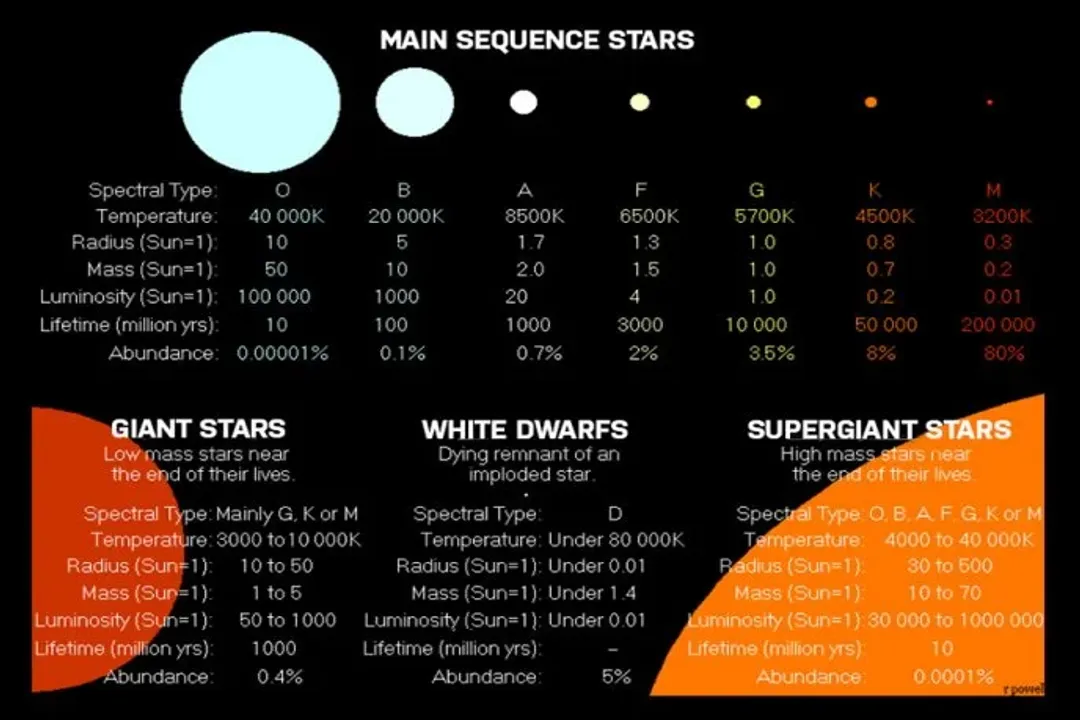
While K-type stars are less luminous, they are still relatively bright compared to the vast population of M-type red dwarfs. [1] This difference has practical implications for astronomers searching for exoplanets. The habitable zone around a K-star is farther out than for an M-star, but closer than for a G-star, making transit detections potentially easier or at least providing a higher-energy environment that might be more conducive to the early formation of complex molecules. [6]
When we look at the general stellar census, G-type stars like the Sun are statistically common, and M-dwarfs vastly outnumber both. [7] K-stars occupy a crucial niche in between. [1] Their combination of moderate temperature, lower flare activity, and extreme lifespan presents a statistically significant target pool for astrobiology. If we are seeking life that requires substantial time—say, multiple eons—to arise from simple beginnings, the sheer duration these stars offer acts as a powerful selection factor in our search, suggesting that K-stars might offer the highest probability of finding technologically mature civilizations simply because their habitable eras stretch so far into the future. [4]
For an observer on an Earth-like world orbiting a K-star, the primary difference in the sky would be the star's color—a distinct orange hue—and its apparent brightness, which would be less intense than sunlight, perhaps requiring less adaptation for surface life compared to the blinding intensity of a younger, hotter star. Given the estimated lifespan, the star would appear virtually unchanged in brightness or color for the entire duration of any conceivable civilization's existence. [9]

# Spectral Positioning
The classification system helps place K-stars precisely in the sequence of stellar evolution. [1] The sequence runs from hottest (O, B, A, F, G, K, M) to coolest (M). [7] K-type stars have surface temperatures generally falling between approximately $3,700$ and $5,200$ Kelvin. [1]
Here is a quick look at how the most common types compare in terms of temperature and mass:
| Spectral Class | Approximate Color | Temperature (Kelvin) | Mass (Solar Masses) |
|---|---|---|---|
| G (Sun) | Yellow | $5,200 - 6,000$ | $0.8 - 1.0$ |
| K | Orange | $3,700 - 5,200$ | $0.5 - 0.8$ |
| M | Red | $< 3,700$ | $< 0.5$ |
| [1][7] |
It is worth noting that while the K-class is well-defined, there is sometimes overlap or ambiguity, particularly near the boundary with M-types, where the stars become significantly dimmer and their evolutionary timescales lengthen dramatically. [1] Understanding the exact mass bracket—$0.5$ to $0.8$ solar masses—is critical because mass dictates the star's entire fate and duration. [1] A star slightly below $0.5$ solar masses is firmly in the M-dwarf category, with a lifespan potentially measured in trillions of years, while one slightly above $0.8$ solar masses is a G-star with a main sequence life measured in the billions. [1][4]
The consistency offered by the K-type star, sitting perfectly in the middle ground, ensures that planetary systems around them benefit from conditions that are simultaneously long-lived and energetic enough to perhaps drive the necessary chemistry for abiogenesis and subsequent biological complexity. [9] They avoid the extreme energy fluctuations of hotter stars while still providing enough heat and light that their habitable zone is reasonably far out, reducing the tidal locking issues that plague planets orbiting very close to smaller, cooler stars. [6]
# Evolutionary Outlook
Since K-type stars are main-sequence stars, they will continue fusing hydrogen into helium in their cores until that hydrogen fuel is exhausted. [1] At that point, their evolution diverges from the Sun's path only in timing. When a K-star exhausts its core hydrogen, it will begin to expand into a subgiant phase, eventually becoming a red giant, though a much less luminous and less destructive one than the giant phase of a G-star like the Sun. [1]
Because they are less massive, the evolutionary transitions are slower and less violent. While a Sun-like star's expansion might engulf Mercury and Venus, an expanded K-star might pose a smaller direct threat to its innermost planets, though the total energy output will certainly increase dramatically, boiling off any surface water in the former habitable zone. [1] The sheer length of their main-sequence life—tens of billions of years—means that any civilization on an orbiting planet has an immense stretch of stable time to contend with, making their eventual transition to the red giant phase a problem for the distant, distant future. [4]
This extended main sequence phase is perhaps the most compelling feature of these stellar types. For scientists contemplating the search for life, the focus is often on finding biomarkers in the atmospheres of exoplanets orbiting G- or M-stars. However, the K-star offers a compelling, potentially superior alternative: a star that has already been burning steadily for billions of years before the Sun even began its transition away from the main sequence, offering a mature, stable stellar environment for life to flourish for timespans we can barely comprehend in our own solar system's context. [9]
Related Questions
#Citations
K-type main-sequence star - Wikipedia
Class K star | Verse and Dimensions Wikia - Fandom
Are Main-Sequence K-type Stars the "Goldilocks" Stars for Hosting ...
'K' stars (orange dwarfs) last much longer than stars like our Sun ...
Can a k-type main sequence star in the k1 class support complex life ...
Goldilocks Stars Are Best Places to Look for Life - NASA Science
K-type main-sequence star Facts for Kids
K-Type Star Have you ever looked up at the night sky and wondered ...
Goldilocks stars: Just right for habitable planets | Space - EarthSky
Types of Stars | Stellar Classification, Lifecycle, and Charts