What type of energy are stars?
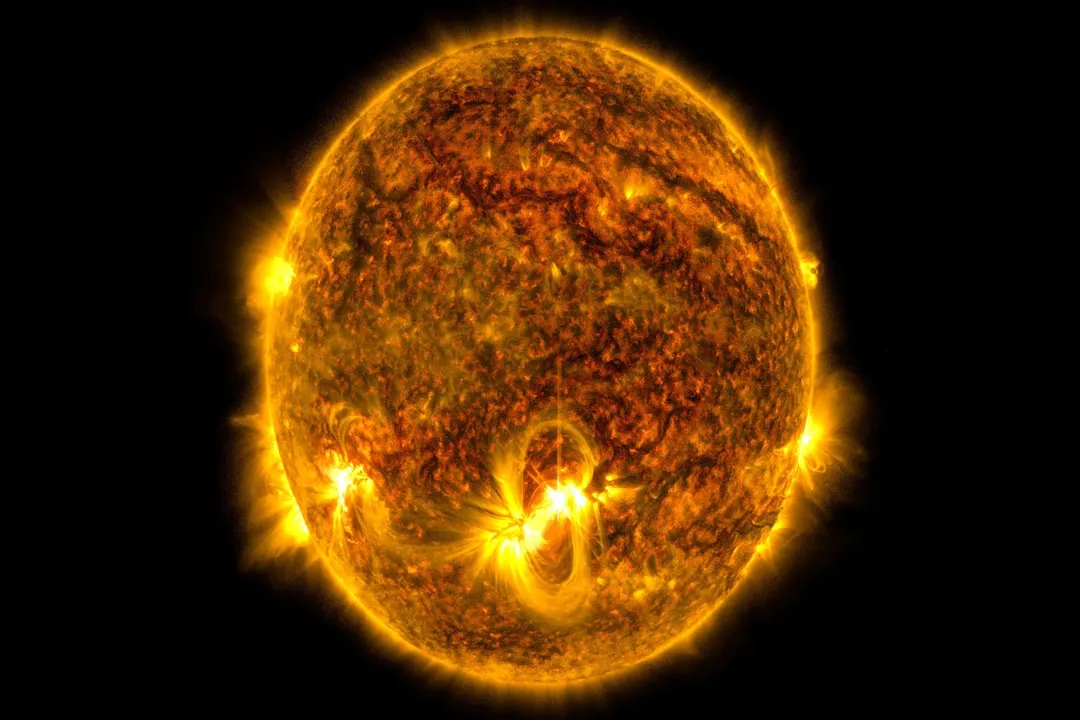
A star is fundamentally a massive, self-luminous ball of plasma held together by its own gravity, primarily generating energy deep within its core through nuclear fusion. [1][2] This process transforms matter into the immense energy that allows the star to shine across the cosmos for billions of years. [4][5] Unlike planets, which only reflect light, or brown dwarfs, which are sometimes called "failed stars" because they cannot sustain core hydrogen fusion, a true star possesses sufficient mass to ignite this thermonuclear reaction. [1][6]
# Self Luminous Bodies
To be classified as a star, an object must meet stringent criteria regarding its mass and resulting internal temperature. [2] Generally, an object must have a mass greater than about $0.08$ times the mass of our Sun, or $80$ times the mass of Jupiter, to achieve the necessary core pressure and heat required for sustained hydrogen fusion. [1][2] Stars exist in a state of hydrostatic equilibrium, a delicate, perpetual standoff between the crushing force of gravity pulling all the material inward and the outward pressure generated by the heat of the nuclear reactions occurring in the core. [4][6]
This state of balance is what defines a star's main sequence lifetime, which accounts for the majority of its existence. [4] Our own Sun, a G-type main-sequence star, has been in this phase for about $4.6$ billion years and is expected to remain there for another $5$ billion years or so, steadily converting hydrogen into helium in its core. [1][6]
# Core Conversion
The actual type of energy stars produce is radiant energy—light and heat—which originates from the conversion of mass into energy within the plasma-hot core. [5] This transformation relies on the laws of nuclear physics, specifically the principles laid out in Einstein’s famous equation, , which shows that a small amount of mass () multiplied by the speed of light squared () yields a tremendous amount of energy (). [5]
For most of a star's life, this energy comes from thermonuclear fusion, where lighter atomic nuclei are forced together under extreme conditions to form heavier nuclei. [5][7] In the context of stellar energy, this means fusing hydrogen atoms into helium atoms. [4][5]
Consider the scale: the Sun outputs energy at a rate equivalent to detonating hundreds of billions of megatons of TNT every second. [4] While the total energy output of a major terrestrial power plant might be measured in gigawatts, the Sun produces about watts. [4] To sustain such an output, the Sun converts approximately $600$ million tons of hydrogen into helium every second. [4] It is this steady, ongoing conversion that defines stellar energy production.
# Fusion Pathways
The specific nuclear reaction pathway used to fuse hydrogen into helium depends heavily on the star's mass and, consequently, its core temperature. [4][5] Stars are not all running the exact same internal engine.
# Proton-Proton Chain
For smaller stars, like the Sun and those less massive than about $1.5$ times the Sun's mass, the primary process is the Proton-Proton (P-P) Chain. [5] This chain is a multi-step process where hydrogen nuclei (protons) are fused together, ultimately resulting in the creation of a helium nucleus () from four initial protons. [5] This method is relatively slow and efficient for less-dense, cooler cores. [5]
# CNO Cycle
In stars significantly more massive than the Sun (generally those over about $1.3$ to $1.5$ solar masses), the core temperatures and pressures are much higher. [4][5] These hotter conditions allow a different process, the Carbon-Nitrogen-Oxygen (CNO) Cycle, to dominate energy generation. [5] This cycle uses carbon, nitrogen, and oxygen atoms as catalysts—they are consumed and then regenerated during the reaction sequence. [5] Because the CNO cycle has a much steeper temperature dependence than the P-P chain, these massive stars burn through their fuel much faster, leading to much shorter, brighter lives. [4][5]
| Star Type (Mass Relative to Sun) | Primary Fusion Process | Core Temperature Range (Approximate) | Stellar Lifetime (Relative) |
|---|---|---|---|
| Sun-like (approx. ) | Proton-Proton Chain | $15$ million K | Long (Billions of years) |
| Massive () | CNO Cycle | $>17$ million K | Short (Millions of years) |
What is fascinating is how the star's structure adapts to the energy production method. A high-mass star utilizing the CNO cycle produces energy much closer to its center than a Sun-like star, resulting in a larger central radiative zone where energy is transported by photons struggling to escape. [4]
# Radiant Output
The energy born in the core as kinetic energy from colliding particles and high-energy gamma-ray photons must travel outward to be released as the visible light and heat we experience. [4] This transfer takes a substantial amount of time—it can take tens of thousands, or even hundreds of thousands, of years for a photon created in the Sun's core to reach the surface, or photosphere. [4]
As the energy moves through the star's layers—the radiative zone and often a convective zone closer to the surface—it is repeatedly absorbed and re-emitted by the plasma, losing energy and shifting its spectrum to longer wavelengths, eventually emerging as visible light, infrared radiation (heat), and other forms of electromagnetic radiation. [4] Therefore, the type of energy that finally escapes the star and travels across space is electromagnetic radiation, stemming originally from the mass converted during fusion. [5]
# Fuel Depletion
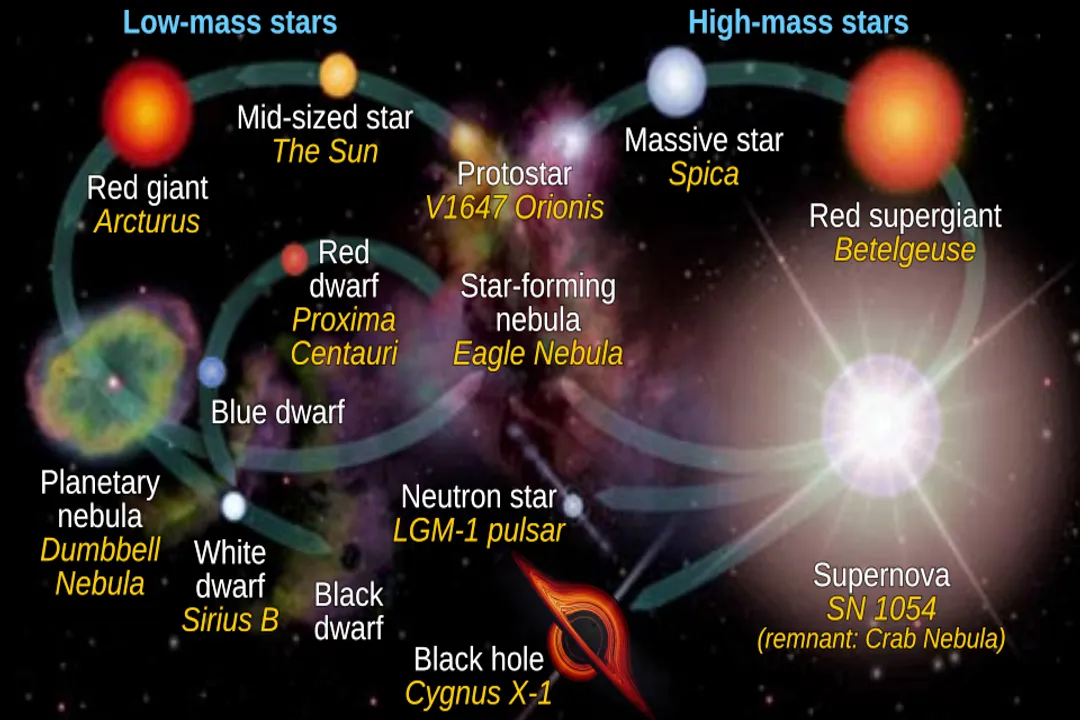
The energy source is not static throughout a star's entire existence; it changes as the star evolves after exhausting its primary fuel supply. [6] Once the hydrogen in the very center of the core is depleted and converted to helium, the primary source of outward pressure vanishes, and gravity begins to win the long battle. [6]
For stars similar in mass to the Sun, this leads to the core shrinking and heating up until the helium itself becomes hot enough to fuse into carbon and oxygen—a process called the triple-alpha process. [6] This new energy source causes the outer layers of the star to swell dramatically, transforming it into a red giant. [6] In the later, more extreme stages of evolution for very massive stars, fusion can continue in shells, creating heavier and heavier elements, sometimes all the way up to iron. [6] Once iron is formed, however, fusion stops, as fusing iron actually consumes energy rather than releasing it, leading to catastrophic collapse. [6]
In these later phases, the energy generation mechanism shifts from controlled, sustained nuclear fusion to more violent or transient processes, such as helium burning or, in the case of stellar remnants like white dwarfs, the slow release of gravitational energy as the remnant cools over eons. [6] A star's ultimate fate—whether it becomes a white dwarf, a neutron star, or a black hole—is determined by the mass it has left after its fusion-powered life ends and what residual energy processes might dominate its final cooling phase. [6] This transition from hydrogen burning to helium burning represents a fundamental shift in the physics governing the star's energy output.
For a small, low-mass star, the transition is far gentler. It may never get hot enough in the core to fuse helium, instead slowly shrinking and dimming over trillions of years after exhausting its hydrogen, eventually becoming a faint white dwarf. [6] The energy source in a white dwarf is not active fusion, but rather the stored thermal energy slowly radiating away into space. [6]
# Stellar Diversity
It is crucial to recognize that while the mechanism—fusion—is consistent across all actively burning stars, the quantity of energy varies wildly based on mass. [2] A star about $10$ times the mass of the Sun shines thousands of times brighter because its core burns fuel at an exponentially higher rate. [2] This relationship means that while massive stars offer spectacular celestial light shows, they burn through their fuel supply so quickly that their entire active lives are comparatively brief, on the order of millions of years, whereas a small red dwarf might shine steadily for trillions of years, its low-energy output allowing for incredible longevity. [2][6]
This contrast in longevity based on fuel consumption rate offers an interesting point of comparison: a very small red dwarf might spend its entire active life generating less total energy than a massive star releases in just the first few thousand years of its main sequence existence. [2] The star's size dictates not just how it makes energy, but how long it gets to shine.
Related Questions
#Citations
Star Basics - NASA Science
Star - Wikipedia
Nuclear Fusion Energy: the energy of the Stars
Star Energy | Physical Geography - Lumen Learning
Star - Fusion, Hydrogen, Nuclear | Britannica
How do stars create and release their energy? - Astronomy Magazine
Stars | Research Starters - EBSCO
Stars and their life-cycle (article) | Khan Academy
The energy of the stars on Earth - ERT
stars | AMNH