What is the critical mass known as the Chandrasekhar Limit for a stable white dwarf?
Answer
About 1.4 times the mass of the Sun ($1.4 M extregistered extsuperscript{ extcircled}O$).
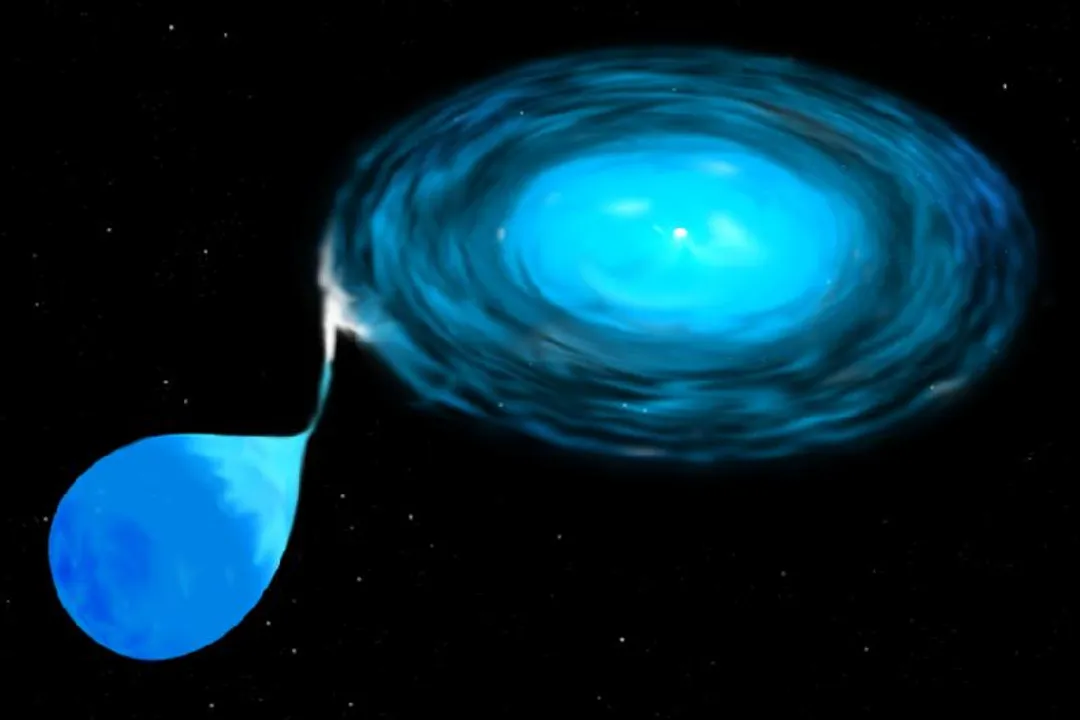
The Chandrasekhar Limit defines the maximum stable mass a white dwarf can possess, supported only by electron degeneracy pressure against gravitational collapse. This limit is precisely quantified at approximately $1.4$ times the mass of the Sun ($1.4 M_{ extregistered extsuperscript{ extcircled}O}$). When a white dwarf in a binary system accretes enough mass from its companion star to surpass this threshold, the degeneracy pressure is overwhelmed by gravity. The resulting imbalance leads to the ignition of runaway thermonuclear reactions within the white dwarf's carbon and oxygen core, causing it to detonate completely in a Type Ia supernova.
Related Questions
What is the approximate initial mass threshold for a star to undergo a core collapse supernova?What is the final stellar state for low-mass stars like our Sun?What is the energy consequence when a massive star's core fuses iron (Fe)?What stellar configuration is required for a Type Ia supernova explosion?What is the critical mass known as the Chandrasekhar Limit for a stable white dwarf?How are elements heavier than iron, such as gold and uranium, primarily created?What speed can the inward stellar collapse reach just before core rebound in a core-collapse supernova?What remnant, if any, is left after a Type Ia thermonuclear supernova explosion?What transient structure do low-mass stars shed before becoming a white dwarf?Why are Type Ia supernovae considered invaluable for measuring cosmic distances?What are the possible final stellar states following a core collapse supernova of a massive star?