How long does it take to fly around UY Scuti?
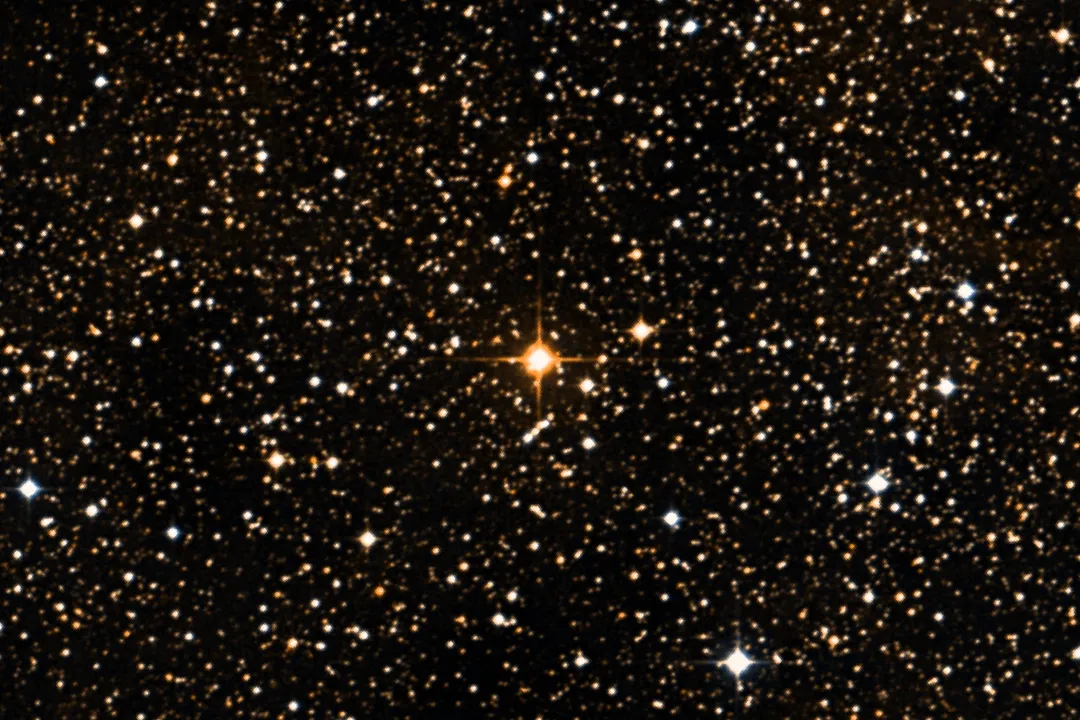
The sheer scale of the cosmos often defies easy comprehension, yet few celestial objects illustrate this better than UY Scuti. When one asks how long it would take to travel around this stellar behemoth, the answer depends entirely on the chosen vehicle, immediately revealing the vast gulf between our terrestrial understanding of distance and the reality of a hypergiant star. [2] UY Scuti, residing in the constellation Scutum, has long held the title, or at least a top spot, among the largest stars known by radius.
# Monumental Stature

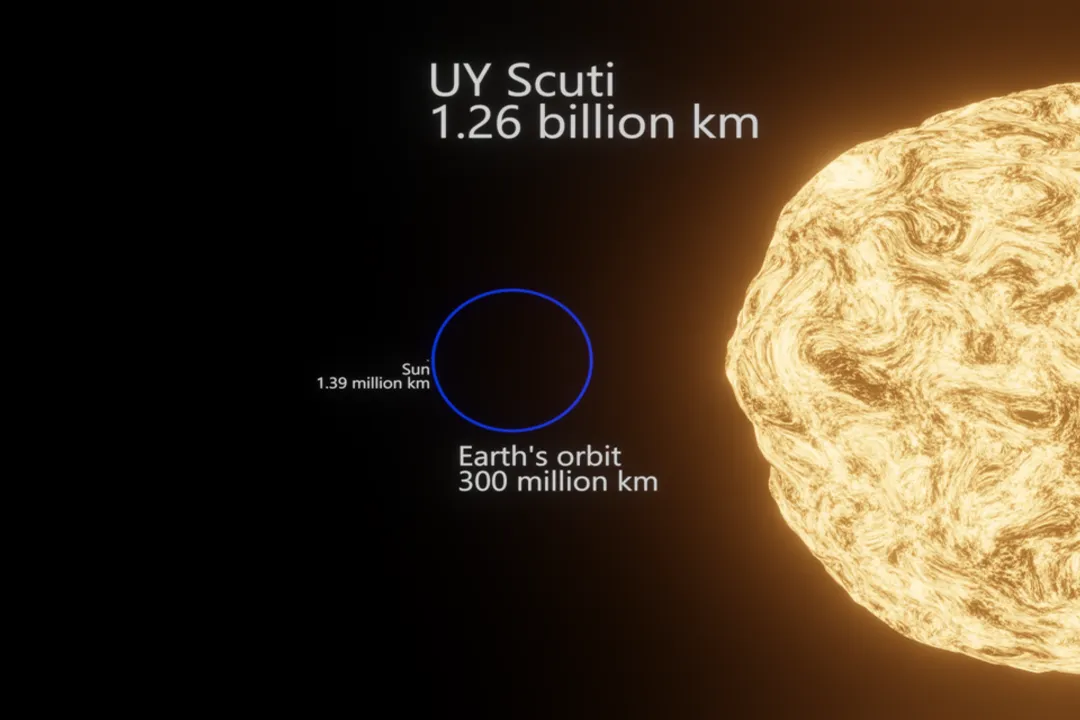
To truly grasp the size of UY Scuti, we must first establish its dimensions. While direct measurement of a star's "surface" is complex due to its diffuse atmosphere and surrounding gas, modern observations have converged on a size that dwarfs anything in our solar system. A common modern estimate places its radius at about $909$ times that of our Sun (). Other historical or less precise figures suggested it was perhaps $1,700$ times the Sun's radius. Even using the more conservative , this translates to a radius of approximately $632$ million kilometers.
If we extrapolate this size to a circumference—the distance needed to circumnavigate its equator—the number becomes staggering. Based on these radii, the equatorial distance is estimated to be around $7.46$ billion kilometers. [2] To put that in perspective, one source noted that this distance is nearly fifty times the separation between the Earth and the Sun. [2] If UY Scuti were to swap places with our Sun, its outer boundary, the photosphere, would extend well beyond the orbit of Mars, possibly reaching the asteroid belt. However, as noted by commentators discussing the physics, a stable, Earth-like object of this size is physically implausible due to self-gravity, requiring exotic materials or a hollow structure—so we must treat this circumnavigation as a purely geometric calculation of its photosphere's perimeter. [2]
# Speed of Light Limit
The fastest anything can possibly travel is the speed of light, often denoted as . When calculating the absolute minimum time to circle UY Scuti, we use this theoretical barrier. At , the journey around the star's immense circumference would take a little under seven hours. [2] This figure serves as the cosmic speed limit for this thought experiment. For context, light takes a mere $14.5$ seconds to circle the Sun. [2]
# Terrestrial Analogies
To make the $7.46$ billion kilometer circumference relatable, we can substitute slower, more familiar forms of transport, though we must acknowledge that no conventional vehicle could withstand the environment near a hypergiant star. [2]
For example, considering the fastest air-breathing aircraft ever built, the SR-71 Blackbird, which cruises at three times the speed of sound (approximately ), the calculation yields a time spanning centuries. [2]
| Vehicle/Speed | Approximate Speed | Time to Circumnavigate UY Scuti |
|---|---|---|
| Light Speed () | Under 7 hours [2] | |
| SR-71 Blackbird | [2] | |
| Car (Highway Speed) | [2] |
The comparison to a modern jetliner traveling for 241 years vividly illustrates the scale of the star's perimeter compared to Earth’s size, where Magellan's entire voyage took only three years. [2] Pushing the speed down to a steady journey on a theoretical highway around the star pushes the time frame back to over eight millennia, a period that stretches beyond the entirety of recorded human civilization. [2]
# Spacecraft Performance Benchmarks
While terrestrial vehicles illustrate the size, actual space travel speeds offer a different perspective on interstellar challenges versus intra-stellar tours. The fastest robotic spacecraft humanity has launched provides a stark benchmark. [2] Voyager 1, for instance, has reached speeds around . [2]
If we apply the speed of a fast probe—one calculation mentioned a speed of —to the circumference of UY Scuti, we get an astonishingly long, yet relatively short, duration for a spacecraft: nearly 16 years. [2]
This figure, while massive by human standards, is drastically different from the time needed to reach UY Scuti. The star is located approximately 5,900 light-years away, though estimates range up to . [2] At the speed of Voyager 1, reaching the star would take tens of millions of years. [2]
This difference highlights an interesting distinction: traveling around a giant object is one thing, but crossing the interstellar void to reach it is another entirely. A spacecraft traveling at the proposed (which takes 16 years to circle the star) would still require tens of thousands of years, perhaps longer, to close the gap between the star system and our own. [2] To achieve travel times measurable in decades, like $19,000$ to $47,500$ years for a trip to UY Scuti, speculative propulsion like fusion or antimatter drives would need to achieve speeds between and . [2]

# Deep Time and Civilization Scales
The time required to travel around UY Scuti at slow speeds begins to overlap with geological and anthropological timescales, offering a final, sobering realization of its size. For instance, consider the car journey of over $8,500$ years. [2] If we consider human civilization, the circumnavigation would begin in the Stone Age, specifically before the formation of Ancient Egypt. [2]
It is worth noting that the hypothetical lifespan of UY Scuti itself is short on a cosmic scale, perhaps only $10$ million years before it explodes as a supernova, which is a mere blink compared to the Sun’s projected $10$ billion-year existence.
This comparison suggests a unique way to benchmark the star's size: its circumference is approximately the same length as the minimum time required for a technologically advanced society to rise, spread, and thoroughly map a planetary surface similar in size to UY Scuti's (if it were a hollow megastructure). [2] One analysis, speculating on settling a hollow, Earth-sized surface, suggested that even with exponential population growth doubling every 25 years, it would take about 1,000 years to achieve a comparable population density to modern Earth, suggesting that mapping a structure that large is a multi-millennia endeavor even with internal settlement. [2] This provides a measure of intrinsic complexity that mirrors the external travel time calculation.
Ultimately, the time to fly around UY Scuti is constrained by the laws of physics and the capabilities of our imagination. While light can make the trip in a single work day, any physical traveler—even the fastest probe we have conceived—requires years for a single lap, placing the task firmly in the realm of futuristic engineering rather than near-term exploration. [2] The journey around the star’s equator is a testament to the sheer volume these red supergiant worlds occupy, demanding consideration across timescales far exceeding human history. [2]
Related Questions
#Citations
TIL about UY Scuti, the largest-known star by radius. It is 1700 times ...
How long does it take to get to UY Scuti? - Quora
UY Scuti - Wikipedia