Can we see Uy Scuti in the night sky?
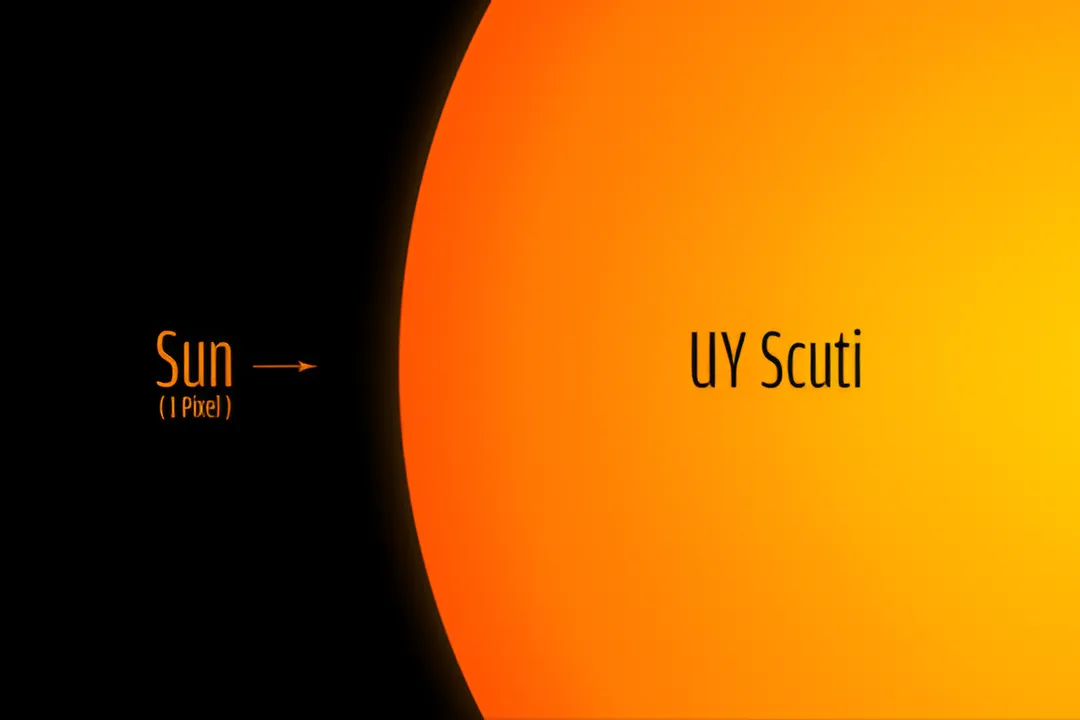
The star UY Scuti captures the imagination instantly, primarily because it frequently appears in lists claiming the title of the largest star currently known in the universe. [2][8] This distinction naturally leads to the most fundamental question for any sky enthusiast: if it is so incredibly massive, can we spot this red supergiant in our own night sky? The short answer, perhaps disappointingly for those hoping to simply glance up and see a true celestial giant, is generally no, not with the unaided eye. [1] The reality of viewing such a distant behemoth is governed not by its immense physical size, but by the laws of light travel and perception.
# Giant Proportions
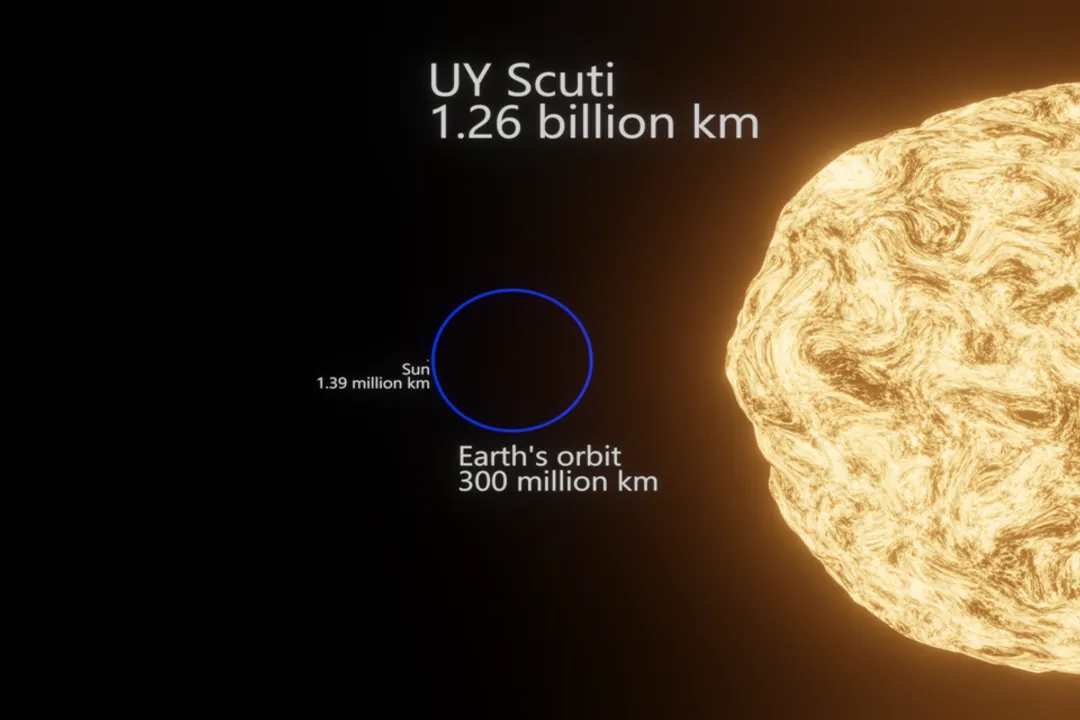
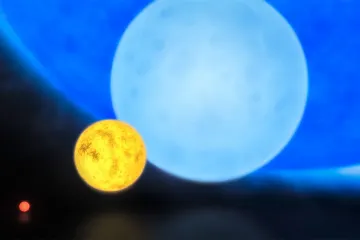
To appreciate why spotting UY Scuti is difficult, one must first grasp its sheer scale. [2] UY Scuti resides in the constellation Scutum, the shield. [5] It is classified as a red supergiant, a late evolutionary stage for a massive star. [8] While there is always uncertainty in measuring the outer atmospheres of distant, variable stars, UY Scuti's estimated radius clocks in at a staggering figure, often cited near times the radius of our Sun (). [2]
Consider what this truly means in astronomical terms. If this red supergiant were to replace the Sun at the center of our Solar System, its outer layers—its photosphere—would easily extend past the orbit of Jupiter. [2] Some calculations suggest its edge could reach almost to the orbit of Saturn. In sharp contrast, our own Sun, which seems so vast to us, would appear as a tiny speck if placed next to UY Scuti. [8] This incredible physical dimension is what earns it its fame. [2]
# Immense Distance
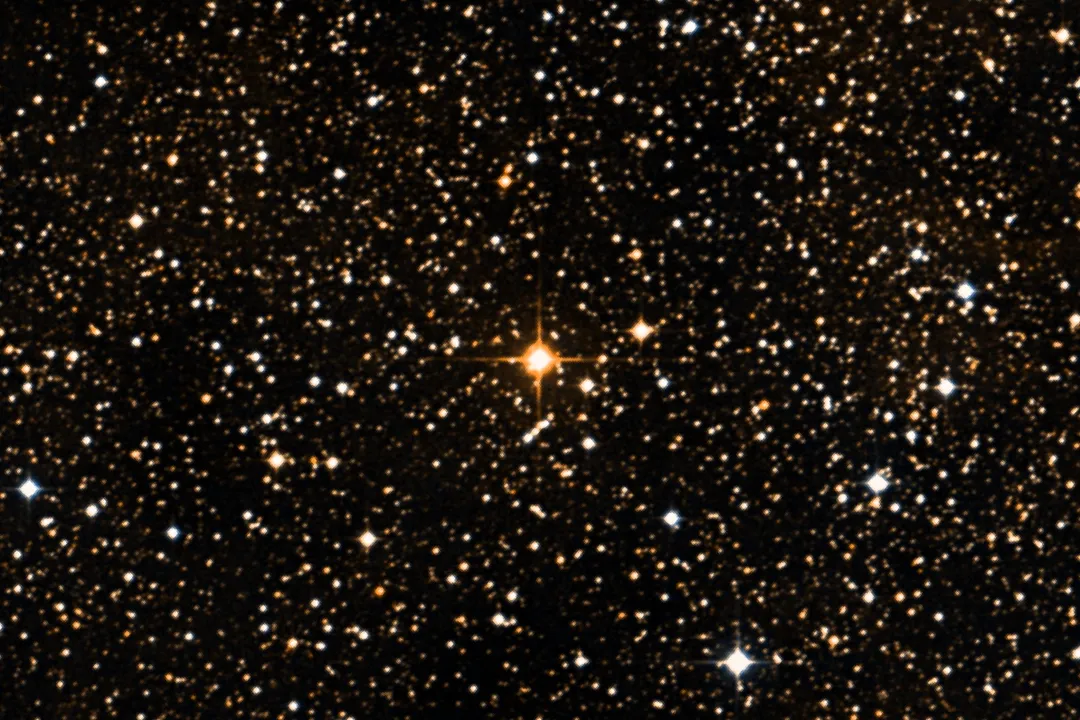
The primary obstacle to observing any star is its distance from Earth. Light takes time to travel across the vastness of space, and the farther away an object is, the dimmer it appears to us on the ground. [1]
UY Scuti is located approximately 9,500 light-years away from our planet. [2][5] To put that into perspective, light from our Sun takes only about eight minutes to reach us. Light from UY Scuti has been traveling for nearly ten millennia just to reach our telescopes and eyes. [5] This extreme separation means that despite radiating an enormous amount of energy overall, the fraction of that light that actually reaches Earth is tiny. [1]
# Faint Appearance
The visibility of a star to the naked eye is quantified by its apparent magnitude. This scale is counter-intuitive: the smaller the number, the brighter the object appears from Earth. [1] Stars brighter than the Sun have negative magnitudes, while the faintest stars visible under perfect, dark skies usually sit around magnitude $6.0$. [1]
UY Scuti’s apparent magnitude fluctuates, but it generally hovers between $6.8$ and $7.1$. [5][2] Since the limit for easy naked-eye observation is around magnitude $6.0$, a star at magnitude $7.0$ is noticeably dimmer than what the average person can perceive without assistance. [1] While someone with exceptional vision in an absolutely pitch-black location might occasionally detect something near the $6.5$ limit, a star at $7.0$ is reliably beyond that threshold. [1]
| Object | Classification | Approximate Radius () | Approximate Apparent Magnitude (V) |
|---|---|---|---|
| The Sun | Yellow Dwarf | 1 | -26.74 (Apparent) |
| Sirius (Brightest Star) | Main Sequence | $-1.46$ | |
| UY Scuti | Red Supergiant | $6.8 - 7.1$ |
This comparison table highlights the core issue: UY Scuti is a true physical giant, yet its appearance to us is that of a relatively faint, dimmer star, overwhelmed by the sheer effect of its distance. [2][5]
# Optical Aid Needed
Because its visual magnitude falls below the standard $6.0$ cutoff, seeing UY Scuti requires optical enhancement. [1] You will need a telescope or, at the very least, a good pair of binoculars. [1]
Binoculars might reveal it as a faint, star-like point, especially if you are viewing under very dark skies away from city light pollution. [1] For a more satisfying observation, a small amateur telescope will certainly resolve it. Even through optical aid, however, the star will not look like a massive disk; it will appear as a point of light, albeit a point of light coming from one of the most physically enormous objects known to exist. [1] Observing it is more an exercise in locating an object known for its size than in visually perceiving that size.
# Observing Constraints
Furthermore, where you are located on Earth significantly impacts your ability to even try for this star. UY Scuti is situated in the southern constellation Scutum. [5] For observers in the mid-to-high northern latitudes (such as most of the continental United States, Canada, or Europe), Scutum never rises very high above the southern horizon, if it rises at all, depending on the time of year. [5] This low altitude means that the light from the star must pass through a much thicker layer of Earth’s atmosphere, further dimming its already faint signal due to atmospheric extinction. Therefore, even if you have a telescope, finding the window to observe it requires patience and a clear, unobstructed view toward the southern horizon. [5] A casual backyard observer might struggle more with the location of the constellation than the faintness of the star itself, particularly during summer when Scutum is best placed for viewing in the evening sky. [5]
# Size Contrast
The fascination with UY Scuti often centers on the unbelievable discrepancy between its physical size and its visual dimness. It is a fascinating lesson in astronomy: an object can be immensely powerful and physically huge, yet remain almost invisible to us due to the geometry of the cosmos. [1][2] While other stars like Betelgeuse or Antares, which are physically smaller than UY Scuti but vastly closer, easily rank among the brightest stars in our sky, UY Scuti serves as a humbling reminder of the scale of the galaxy—there are titans out there, simply too far away for our eyes to register their true glory. [2][8] Our Sun, which governs all life here, is the brightest light we see, not because it is inherently the largest, but because it is our immediate neighbor in the cosmic sea. [8]
Related Questions
#Citations
Is it possible to see UY Scuti from Earth? - Quora
UY Scuti - Wikipedia
Is there a chance JWST will observe UY Scuti? : r/jameswebb - Reddit
The Universe's Biggest Star: UY Scuti - Facebook
Star UY Scuti - Stellar Catalog
UY Scuti ZWO ASI 071 Pro - Imaging - Deep Sky - Stargazers Lounge
What Is the Largest Star in the Universe? - Kids Answers
UY Scuti is a red supergiant. Compared to this star, our Sun would ...
Meet the Largest Star Ever Discovered