What color would an astronaut see the sky?

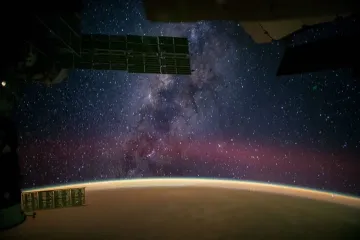
Astronauts looking up from orbit report a view dramatically different from what we experience on the ground: the sky is overwhelmingly black or dark when viewed away from the planet. [1][2][4][8] This observation immediately challenges the everyday experience, as the very mechanism that paints our terrestrial sky blue is conspicuously absent when one leaves the protective blanket of our atmosphere. [3]
# Earth Blue
The familiar, soothing blue canopy we see above us during the day is an optical illusion created by physics happening close to the ground. [3] This phenomenon is known scientifically as Rayleigh scattering. [3] Essentially, as sunlight passes through Earth's atmosphere, it encounters countless tiny molecules of air—primarily nitrogen and oxygen. [3] These molecules are far more efficient at scattering the shorter, higher-frequency wavelengths of light (violet and blue) than the longer, lower-frequency wavelengths (red and orange). [3] Because the blue light is redirected and diffused across the entire dome above us, that is the color our eyes perceive when looking up. [3] If Earth possessed no atmosphere, like the Moon, the sky would appear just as black during the day as it does at night. [3]
# Void Appearance
When an astronaut gazes outward, past the bright orb of Earth, the surrounding environment is described as deep black. [2][5][8] This is because space itself is a near-perfect vacuum; there are virtually no particles or gas molecules present to intercept the incoming photons from distant stars or the Sun and scatter them toward the observer. [4] Without this scattering medium, the light travels in a straight line from its source, rendering the background void completely dark. [4] Even though the Sun is still shining, the area between the stars remains invisible until light directly enters the eye. [1] For anyone on the International Space Station (ISS), if they are in the Earth's shadow, the sky is entirely black. [1] This lack of ambient light is a key differentiator between the orbital experience and the ground experience.
# Atmospheric Band
Despite the vast blackness, astronauts do witness the color blue, but it is confined to a very specific, delicate feature: the Earth’s atmosphere itself. [1] When looking toward the planet's limb—the visible edge where the planet meets space—the blue we are accustomed to seeing is visible as a thin, brilliant band wrapped around the sphere. [2][4] This glowing layer is the visual manifestation of the scattering process occurring within the atmosphere. [1] It is a visual reminder that the protective layer is finite, thinning rapidly as altitude increases, before abruptly yielding to the infinite blackness of space. [4] An astronaut's view is thus a dramatic dichotomy: a finite blue envelope contrasted against an endless, dark expanse. [1]
# Light Intensity Contrast
While the overarching color of the sky is black, the astronaut's visual experience of light is defined by extreme intensity variation. When the ISS is in direct sunlight, the contrast between the illuminated parts of the spacecraft or the Earth's sunlit surface and the surrounding void is profoundly stark. [1] The direct solar glare is incredibly intense, yet the sky immediately adjacent to that brightness offers absolutely zero scattered light to soften the edges. [1] This sharp juxtaposition—brilliant, unfiltered daylight next to absolute darkness—is something rarely encountered in terrestrial settings, where even the darkest night sky retains some residual illumination from moonlight, distant city lights, or faint atmospheric glow. [1]

# Perception Adjustment
The required recalibration of the visual system for an astronaut is fascinating. On Earth, our brains interpret the consistent blue background as the default, neutral setting for daylight vision—a phenomenon known as color constancy. [4] In orbit, however, the visual processing must constantly toggle between two extremes: the overwhelming brightness of the illuminated sphere below and the utter blackness of the vacuum surrounding it. [4] This forces the eye to process the blue atmospheric layer not as the "sky," but as a distinct, luminous object that happens to be adjacent to the planet. It becomes a visible, measurable shell separating the livable surface from the void, rather than an infinite ceiling. [1] The color observed is thus less about a constant background and more about observing a specific, vibrant physical layer against the ultimate absence of light. The color of the sky, as seen from space, is fundamentally black, punctuated only by the luminous blue of our home world's protective shell. [2][9]
Related Questions
#Citations
Can We Really See Colors in Space? What Astronauts Say
What colour does the sky appear to an astronaut? - Quora
Why is the sky blue on Earth, but black in space or on the Moon?
Why is the sky not blue as seen from space?
What is the color of the sky? A) Red B) Blue C) Green D) Yellow
My daughter just asked me “If outer space is black, how is the sky ...
Why sky is blue but space is black? - YouTube
Why does the sky appear dark instead of blue to an astronaut?
The colour of the sky is ______ that an astronaut will see in space.