Does Venus appear in the eastern sky?
Venus certainly appears in the eastern sky, but whether you can see it there depends entirely on the time of year and the time of night you are looking. This planet, second from the Sun, is infamous for its brilliant light, often shining brighter than any star, making it a standout feature in our sky when visible. [3][6] However, its visibility is governed by its orbit, which keeps it relatively close to the Sun as viewed from Earth. [3]
# Inferior Planet Status

Because Venus orbits inside Earth's orbit—making it an inferior planet—it never manages to wander very far from the Sun's glare in our view. [3][6][7] This orbital configuration forces Venus into two primary viewing roles: the "morning star" or the "evening star". [1] When Venus is on the near side of the Sun from our perspective, it becomes visible in the west shortly after sunset. When it is on the far side of the Sun, it appears in the east before the Sun rises. [7] You will never see Venus high overhead in the middle of the night, unlike planets such as Mars or Jupiter, which orbit outside of Earth. [5]
# Morning Visibility East

When Venus is situated to the east of the Sun in the sky, it graces the morning hours. [1] This appearance is why it earns the moniker the morning star. [1] Observers looking toward the eastern horizon before sunrise can spot it gaining altitude as dawn approaches. [8] For instance, current observational windows might place Venus firmly in the east before sunrise through specific seasons, such as during the fall of 2025, though this viewing geometry is constantly changing. [8] If you catch it as the morning star, you are seeing Venus moving away from the Sun in the sky as viewed from our perspective, preparing for a period where it may disappear from view altogether as it passes behind the Sun (superior conjunction). [1]
# Evening Star West
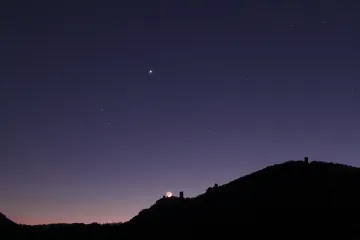
Conversely, Venus is famous for appearing in the west after the Sun has set, earning it the title of the evening star. [1] This happens when the planet trails the Sun across the sky. While the question centers on the east, understanding the west helps define the cycle. Its position dictates its visibility windows; if it's the evening star one month, it will eventually transition to being the morning star several weeks later. [2][9] Regardless of whether it is morning or evening, the general apparent motion of all celestial objects across the sky is still east to west due to the rotation of the Earth. [9] The key difference is when it crosses the horizon line relative to the Sun—dawn or dusk. [7]
# The Shifting Cycle
Venus is not a constant presence in either the eastern or western sky; its visibility waxes and wanes over a cycle determined by the synchronization of Earth's and Venus's orbits. [7] When Venus passes between the Earth and the Sun (inferior conjunction), it is too close to the Sun to be observed safely or clearly, often being lost in the solar glare. [3][7] During this period, it is completely absent from our view, regardless of whether we look east or west. [7]
We can think about its visibility in terms of elongation, which is the maximum angular distance Venus achieves from the Sun in the sky as seen from Earth. [3] When its elongation is maximal in the morning direction, it is a brilliant eastern object. When its elongation is maximal in the evening direction, it shines in the west.
For example, if you know Venus is currently shining brightly in the western sky as the evening star, a rough estimate suggests that within about six to eight weeks, it will have moved behind the Sun from our vantage point and will begin appearing in the eastern sky before dawn, signaling its transition into the morning star phase. This predictable lag is crucial for planning observations.
This entire cycle, moving from evening star to morning star and back again, takes about 584 Earth days. [3] This means that for significant chunks of time, an observer will not see Venus in the east, because it is either too close to the Sun or currently positioned in the west after sunset. [7]
# Observing Guidance
To confirm if Venus is currently appearing in the eastern sky, one must consult real-time sky charts or astronomical resources specific to the present date and the observer's latitude. [2] Knowing when to look is as important as knowing where. Since Venus is so bright, it usually only requires a clear, unobstructed view of the eastern horizon shortly before sunrise. [6][8]
When Venus is visible in the east, timing is critical. Looking too early means the sky background is too bright, washing out the planet against the deeper blue of twilight, or the planet may still be below the horizon. [8] Looking too late means the Sun is already coming up, creating dangerous glare and severely reducing visibility. [8] If you are trying to catch it as the morning star, aim to start scanning the eastern horizon about 45 to 60 minutes before the predicted time of sunrise for your location. [8]
A practical note for dedicated observers involves managing atmospheric interference. Because Venus is visible low on the horizon when it is in the east (just before sunrise), the light has to pass through the thickest, most turbulent layers of Earth's atmosphere. This often causes the planet to scintillate (twinkle) more noticeably than when it is higher up, even though it is inherently brighter than any true star. Positioning yourself where the eastern horizon view is geographically clear—away from city lights or tall buildings blocking the view of the ground just above the horizon—can help minimize atmospheric distortion right at the critical moment of emergence. [1]
Venus's presence in the eastern sky is a guaranteed, recurring phenomenon, but it is transient, lasting only for segments of its multi-month orbit before it transitions to its western appearance or disappears entirely during solar conjunction. [1][7]
Related Questions
#Citations
Visible planets and night sky guide for December - EarthSky
Where is Venus? How to Find Venus in the Sky - TheSkyLive
Venus - Wikipedia
Venus visible in eastern sky before sunrise - Facebook
Jupiter and Venus Are Currently Very Close Together in our Sky ...
Venus: Facts - NASA Science
Do we see planet venus everyday? - Astronomy Stack Exchange
How to see Venus light the sky as the bright 'morning star' through ...
Does Venus travel east to west across the night sky looking ... - Quora