How to tell if it's Jupiter or Venus?

Spotting a brilliant, unwavering light in the twilight sky and wondering if you're looking at Earth's closest neighbor or the Solar System's giant is a common celestial puzzle. Both Venus and Jupiter are magnificent beacons, frequently putting on spectacular shows, especially when they appear close together near the horizon. Differentiating them isn't always straightforward, particularly when they stage a dramatic conjunction, but a few key observational techniques, based on inherent characteristics and orbital mechanics, will settle the debate.
# Magnitude Difference

The single most reliable initial check you can perform involves pure brightness—the apparent magnitude of the object. Venus, often termed the "Morning Star" or "Evening Star," is famous for being the brightest object in the night sky after our own Moon. It outshines Jupiter significantly when both are visible. While Jupiter is certainly brilliant, ranking as the second brightest planet visible from Earth, Venus possesses a dazzling intensity that often makes it appear almost too bright to be a natural object, sometimes leading observers to mistake it for a low-flying aircraft or even a bright street lamp.
When you see a truly brilliant pinpoint of light just after sunset or before sunrise, odds are high that you are witnessing Venus. Jupiter, while bright enough to catch the eye easily, will usually appear noticeably dimmer than its dazzling counterpart. If you can see two extremely bright "stars" near the horizon at the same time, the overwhelmingly brighter one is almost certainly Venus, with the slightly less brilliant one being Jupiter. This differential in magnitude remains true across most orbital configurations, even if Jupiter is near opposition (its closest approach to Earth), though the difference will be less pronounced then.
# Steady Light
A fundamental rule for identifying any planet over a distant star is observing its tendency to twinkle. Stars, due to their immense distance, appear as near-perfect point sources of light. This light path is easily disrupted by the minor turbulence in our atmosphere, causing the characteristic scintillation or twinkling effect. Planets, however, are close enough that they appear as tiny disks, even to the naked eye. While the atmosphere still affects their light, the effect averages out across the disk, resulting in a much steadier glow.
This non-twinkling quality is a shared trait between Jupiter and Venus, making them easy to distinguish from a nearby first-magnitude star like Sirius. However, this rule has a nuance that can trip up novice observers. When either planet is very low on the horizon—close to setting or rising—its light has to pass through the maximum amount of turbulent atmosphere. In these conditions, even Jupiter or Venus can exhibit noticeable twinkling, making the steady light test less effective until the object has climbed higher into the sky. If you see a very bright light that is twinkling vigorously, you are likely looking at a star, not one of these two planets. If it’s steady, it’s one of the two giants, and you must rely on brightness or position to differentiate them.
# Orbital Paths
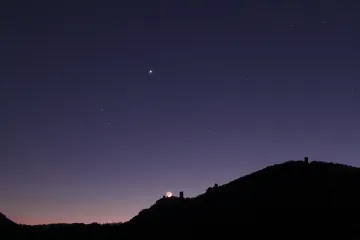
The position of the object in the sky provides the next critical clue, dictated by the orbits of these two worlds relative to Earth and the Sun. Venus is an inferior planet, meaning its orbit is entirely contained inside Earth's orbit around the Sun. This fundamental geometric constraint means that Venus can never be seen high in the sky at midnight. It is tethered to the Sun's position, appearing only low in the west shortly after sunset (as the Evening Star) or low in the east shortly before sunrise (as the Morning Star). If you are looking up around 10:00 PM and see a very bright point of light near the zenith (straight overhead), it cannot be Venus; it would have to be Jupiter or another planet further out, or a star.
Jupiter, conversely, is a superior planet—its orbit lies outside Earth's orbit. This allows Jupiter to be visible at various times throughout the night, often appearing much higher in the sky than Venus ever could. For instance, Jupiter can be visible high in the south during the middle of the night when it is opposite the Sun in the sky. When identifying a bright object, check the time of observation and its altitude. A very bright object near the horizon at twilight strongly suggests Venus, while a bright object high in the dark sky suggests Jupiter. Both planets, however, tend to stick close to the ecliptic, the imaginary path the Sun traces across the sky, which is a shared characteristic with other naked-eye planets.
If you observe a planet in the eastern sky before dawn, and it is significantly brighter than everything else visible except perhaps the Moon, you are looking at Venus. If it is the brightest object, but noticeably dimmer than Venus would be at its peak, or if it is visible in the middle of the night, you are looking at Jupiter. Considering that a typical Venus maximum magnitude hovers around $-4.6$, while Jupiter's is around $-2.9$, the roughly two-magnitude difference means Venus shines over six times brighter, a visual distinction that is often quite easy to spot if both are present.
# Close Encounters
Sometimes, the simplest identification clue is removed when the planets appear right next to each other during a conjunction. These events, where Venus and Jupiter align closely from our perspective, are stunning celestial spectacles, often visible as a "stunning dawn display" or a post-sunset pairing. When they are visually separated by only a few degrees, you must rely heavily on the brightness difference described above.
In a conjunction scenario, the rule remains constant: the brighter object is Venus, and the slightly dimmer one is Jupiter. You might even be able to faintly make out Jupiter’s presence right next to Venus’s superior glare. If a conjunction happens very low on the horizon, both objects might exhibit some twinkling due to atmospheric interference, making the steady light test unreliable for separation, forcing you back to the magnitude comparison. These close alignments often prompt the question in the first place, as their proximity naturally leads to confusion if one isn't familiar with their relative inherent brightness.
# Confirmation Tools
While visual inspection using brightness and position is effective for most casual observations, for absolute certainty, particularly when they are not in conjunction or when the sky conditions are poor, using simple astronomical tools remains the best practice. Modern smartphones offer numerous sky mapping applications. These tools use your phone’s gyroscope and compass to show you precisely what you are looking at in real-time. By simply pointing your phone at the bright object, the app will overlay labels identifying the object as "Venus" or "Jupiter," confirming your initial assessment based on the orbital constraints and magnitude.
Another helpful, non-digital confirmation involves looking up the ephemeris—the predicted positions of celestial bodies—for the date and time you are observing. Specialized astronomical websites or even simple search queries for "Visible planets tonight" often provide current visibility data. This information, combined with knowing which planet must stay close to the Sun (Venus) and which can roam high in the midnight sky (Jupiter), provides a factual cross-check against your naked-eye observation. For instance, if you see a bright object at 2:00 AM and the online data says Jupiter is currently in that part of the sky but Venus is not even visible until 5:00 AM, the bright object must be Jupiter. This reliance on published data, which is derived from accurate orbital mechanics, moves the identification from educated guessing to established fact.
#Videos
How to Find the Planets in the Night Sky - YouTube
Related Questions
#Citations
How can I differentiate between Jupiter and Venus in the sky?
How To Identify Planets In The Night Sky - Adler Planetarium
Are these Venus and Jupiter? : r/space - Reddit
How to identify which one is Jupiter or Venus - Quora
Venus and Jupiter: how to spot them - The Guardian
Venus and Jupiter alignment observed - Facebook
Visible planets and night sky guide for December - EarthSky
Venus and Jupiter put on a stunning dawn display - WMTV
How to Find the Planets in the Night Sky - YouTube