Why does Io display more geological activity than Jupiter's other moons?
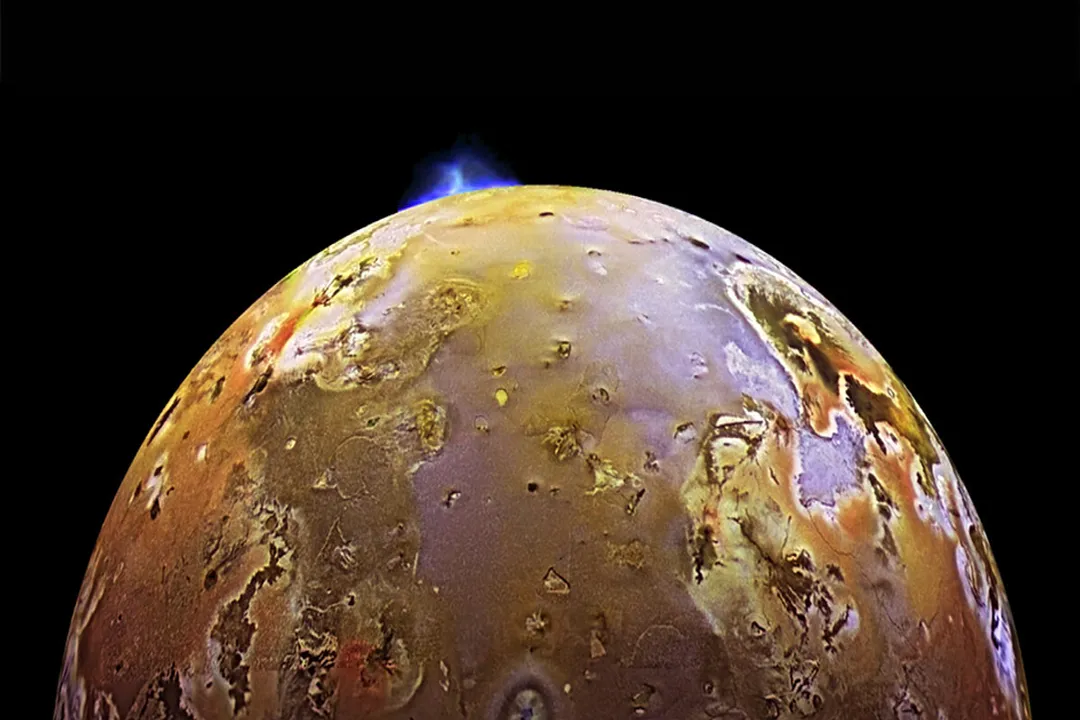
The innermost of Jupiter’s four massive Galilean moons, Io, is in a state of perpetual, violent turmoil, unlike its more placid siblings. While its companions Europa, Ganymede, and Callisto intrigue scientists with promises of subsurface oceans, Io stands alone as the most volcanically active world discovered anywhere in the entire Solar System. This constant geological chaos, marked by hundreds of active volcanoes, towering plumes that reach hundreds of kilometers high, and lava fountains spanning hundreds of miles, suggests a world perpetually stuck in an early, energetic state, resembling what Earth might have looked like billions of years ago.
# Tidal Engine
Io’s extreme geological nature is not due to internal radioactive decay, as might be the case for Earth, but to a fierce, external gravitational "meatgrinder". Io is locked in a complex orbital dance with the Sun, Jupiter, and its two outer Galilean neighbors, Europa and Ganymede. Because Io orbits closest to the colossal mass of Jupiter, it experiences an immensely strong gravitational pull.
This pull is amplified because Io’s orbit is not perfectly circular; it is slightly eccentric, meaning its distance from Jupiter changes over the course of one orbit. At its closest approach, Jupiter’s gravity deforms the moon significantly, and as Io moves farther away, the gravitational pressure lessens, allowing the moon to "relax" back to its original shape. This constant stretching and squeezing, often described as tidal flexing, is the primary source of Io’s internal energy.
The flexing motion creates tremendous internal friction between the layers of rock beneath the surface, generating enough heat to melt solid rock into magma. This process is not merely a slight warming; it generates a geothermal heat flux that far surpasses that of Earth or any other rocky body in the Solar System. Estimates suggest Io’s volcanic activity could be as much as one hundred times greater than that of Earth when comparing the total surface output. For context, if Earth experienced Io’s level of volcanism, it would likely suffer a runaway greenhouse effect, ending up more like Venus.
# Orbital Dynamics
The mechanism that sustains this internal furnace is intrinsically tied to Io's relationship with Europa and Ganymede. Tidal dissipation naturally tends to circularize an orbit over time, dampening the flexing and allowing the heat source to diminish. However, Io’s orbit remains eccentric because its orbital periods—Io completes two orbits for every one Europa makes, and four orbits for every one Ganymede makes—are in a resonant relationship.
This resonance ensures that the gravitational tug from the neighboring moons acts at specific, recurring points in Io’s orbit, constantly kicking the orbit back into an eccentric shape rather than allowing it to circularize and dissipate the tidal energy. The energy being dissipated as heat in Io’s interior is essentially drawn from the orbital energy of this inner three-moon system.
If Europa and Ganymede were not present, Io’s energy source would eventually either slow its rotation until it was perfectly tidally locked (as Earth’s Moon is) or the orbit would become circularized, halting the flexing mechanism. Because the other moons actively work to maintain the orbital eccentricity, Io is trapped in a continuous cycle of tidal stress that perpetually fuels its geological activity.
# Heat Conversion Physics
The conversion of gravitational potential energy from the tidal forces into internal heat is a physical consequence of this constant deformation. When Io flexes, the friction generated by the movement of its internal rock—sometimes by as much as 100 meters vertically, far exceeding Earth’s ocean tides of around 18 meters—creates thermal energy.
While the heat is generated internally, the energy that drives the process is orbital energy lost due to the internal friction, a process known as tidal dissipation. What is "lost" to space is not the gravitational pull itself, which remains constant as long as Jupiter's mass doesn't change, but the kinetic energy associated with the temporary distortion of the orbit. As the moon flexes, the resulting bulge is not perfectly aligned with the line connecting Io and Jupiter; the slight misalignment causes Jupiter’s gravity to pull the bulge "backward" ever so slightly each orbit. This effect is what saps the orbital energy, converting it into the friction that produces magma.
Current models generally suggest that most of this heating occurs in a relatively shallow layer beneath the crust called the asthenosphere, where rock deforms like putty under the stresses. One long-standing question revolves around where the volcanoes appear relative to the predicted heating maximum; some analysis suggests a systematic eastward offset, possibly hinting at a missing component in the models, such as fluid tides generated by a global subsurface magma ocean.
# Volcanic Scale and Style
The sheer scale of Io’s output dwarfs anything seen on Earth in modern history, giving it a surface that appears more like a chaotic early planet than a modern satellite. Io is estimated to host around 400 active volcanoes. While Earth might see about 50 eruptions in an entire year, Io has hundreds erupting simultaneously. The resulting lava flows are massive; while terrestrial flows might extend 10 to 100 kilometers, flows on Io commonly spread out over hundreds of kilometers, with some ancient channels suggesting potential single flows of thousands of kilometers.
Ionian volcanism manifests in several distinct styles:
- Lava Lakes and Seas: Io possesses the largest known lava lakes in the Solar System, some comparable in size to small terrestrial states or large islands, such as Loki Patera, which is 230 kilometers wide. These can be placid, with surfaces that crust over, periodically overturning in massive resurfacing events, or active, like Pele Patera, which shows persistent, intense fountains.
- Slow Tube-Fed Flows (Promethean Style): These are comparable in morphology to Earth’s pahoehoe flows seen in Hawaii, but on a vastly larger scale, sometimes resurfacing hundreds of square kilometers in months.
- Fast Fissure Eruptions (Pillanian Style): These are the most violent events, involving massive, short-lived lava fountains driven by the rapid depressurization of volcanic gas in Io’s near-vacuum environment. These outbursts release enormous volumes of magma very quickly, sometimes releasing 100 cubic kilometers of lava in a single week, rates that rival or exceed Earth’s prehistoric flood basalt events.
It is an incredible testament to the power of tidal heating that such voluminous, low-viscosity silicate magmas can be continuously sourced from Io’s interior, possibly from a global magma ocean existing within the asthenosphere.
# Chemical Separation
When comparing Io's eruptions to Earth's, a striking chemical difference emerges, primarily relating to the dominant volatile gases. Terrestrial volcanism is dominated by water vapor () and carbon dioxide (), with sulfur dioxide () playing a secondary role. On Io, the volcanic gases are dominated by . There is a notable absence of water and as major components in Io's volcanic output.
This disparity is rooted in Io's formation location, which was beyond the water "frost line" of the early solar system, meaning it accumulated less volatile ice initially. Furthermore, Io is the innermost Galilean moon, receiving significant radiative energy from Jupiter—about 37% of what Io receives—which would have blasted apart any ices or lighter molecules like water early in their history, with lighter elements like hydrogen being lost to space. Over billions of years of recycling through volcanism, the crust lost its water and carbon dioxide to space, while the heavier sulfur dioxide remained, accumulating as a dominant volatile component in the magma.
The surface color vividly illustrates this chemical concentration. While the lava itself is low-silica, hot basaltic material, similar to Earth's basalt, the surface is coated in sulfur compounds. As hot gases escape into the vacuum, they freeze, forming sulfur snow that blankets the landscape in shades of yellow and orange. Fresh, hot basalt appears dark gray or black because it is too hot for the snow to settle, but as it cools, it passes through green (pyrite frost) before being covered by the characteristic yellow sulfur frost. This contrasts sharply with worlds like Mercury or Mars, which have basalt-dominated surfaces because they formed closer to the Sun where volatiles were already driven off.
# Surface Evolution Versus Interior Clues
Io’s relentless resurfacing, which effectively erases its entire surface every million years or so, means that its young surface records little of its long-term history. This lack of surface record forces scientists to rely on interpreting the interior structure, a task complicated by observational discrepancies.
A detailed analysis comparing predicted tidal heating patterns with the actual global map of volcanoes revealed a systematic eastward offset in where the most intense volcanic activity is observed relative to where models predict the most internal heating should occur. This suggests that magma is traveling significant horizontal distances—tens of degrees east—from the hottest interior point to the surface vent, or that the current solid-body tidal heating models are incomplete. The possibility of a global, low-viscosity magma ocean is one explanation that could allow heat and melt to migrate more freely and erupt in these displaced locations.
If we look at the fate of the other Galilean moons, we can appreciate the critical difference in Io’s energy budget. Europa is thought to have liquid water oceans sustained by some tidal heating, but not enough to melt its entire interior or boil off its surface water. Ganymede and Callisto have even less tidal heating. Io's experience represents the extreme upper bound of what this mechanism can achieve; it is tidally heated just enough to keep its silicate rock molten and volatile-rich, but not enough to vaporize all its materials away into Jupiter’s magnetosphere.
The sheer magnitude of Io's lava production offers a unique, if dangerous, window into planetary evolution that is otherwise only accessible through deep Earth studies. While Earth's interior activity is modulated by the complexity of plate tectonics and mantle plumes driven by its own internal heat, Io's activity is simpler in cause—pure tidal friction—yet vastly greater in output. If one could model the Earth’s output during its own flood basalt eras, which are often attributed to massive mantle upwellings, the constant, large-scale basaltic flows observed on Io might offer a more sustained, albeit externally driven, analogue than any terrestrial geological event in the last few hundred million years. This implies that the process of tidal dissipation, when sufficiently amplified by multiple close massive bodies, is fundamentally a more efficient, long-term energy source for mantle convection and melting than the steady decay of primordial heat and radioactive isotopes alone.
Furthermore, the chemical makeup provides an important lesson in planetary differentiation driven by location within a protoplanetary disk. The observation that Io is completely dry of its initial water content, while its neighbor Europa retained significant ices, demonstrates a stark thermal gradient in the early Jovian system. The intense radiation and proximity effectively scrubbed the inner moon clean of light volatiles, leaving behind a body overwhelmingly composed of silicate rock and sulfur compounds. This effectively seals Io’s fate as a world of fire and sulfur, while its siblings, formed just a bit further out, were able to sequester water ice, paving the way for potential subsurface oceans today.
Related Questions
#Citations
Scientists to Io: Volcanoes are in the Wrong Spot
How is gravitational pull converted to heat on Jupiter's moon Io ...
Io, Jupiter's chaotic volcano moon | The Planetary Society
Why is Io's volcanism chemically so different from Earth's?
A ”quick” tour of volcanism on Io - VolcanoCafe