What explains hot Jupiter?
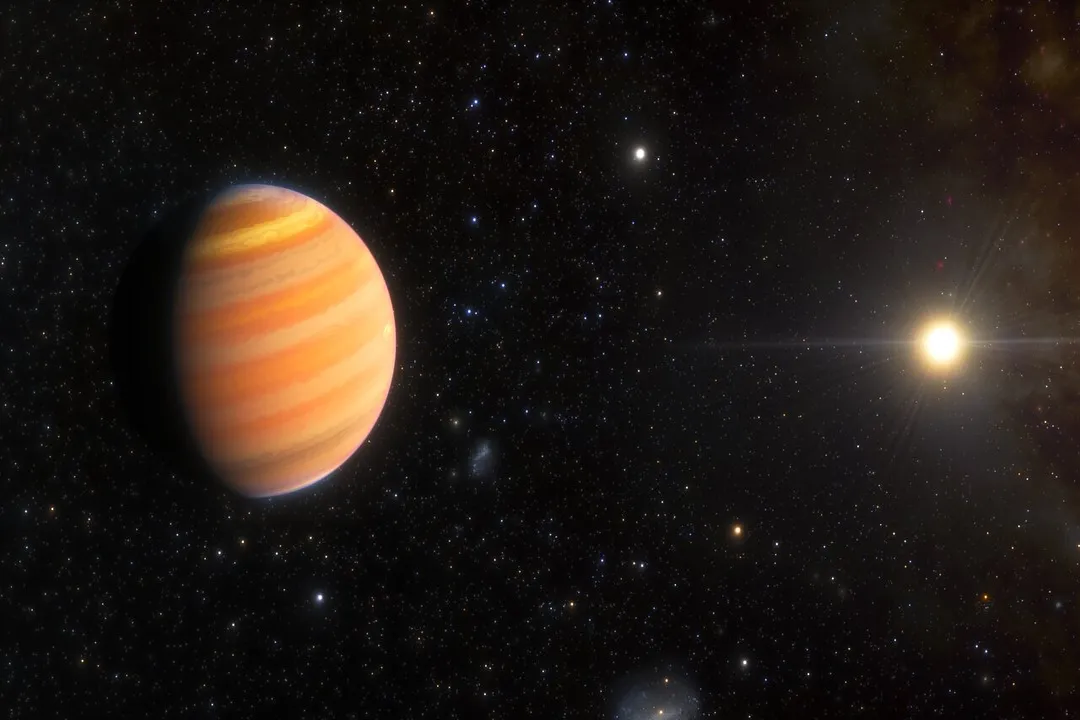
The sheer existence of a "Hot Jupiter" challenges our comfortable, Earth-centric view of how solar systems should arrange themselves. We see our own Jupiter—a massive, gassy giant—residing comfortably in the outer reaches of our system, taking nearly twelve Earth years to complete one orbit. Then, astronomers began discovering exoplanets, and among the first, and certainly the most perplexing, were those dubbed Hot Jupiters: worlds with the mass and girth of Jupiter, yet orbiting their host stars so closely that their years last mere days or even hours.
This proximity is the central mystery. If these behemoths formed out in the cold, distant reaches where gas and ice accumulate, how did they manage the incredible inward journey to nestle right against their star? The very definition of a Hot Jupiter hinges on this bizarre placement: a gas giant orbiting inside the orbit of Mercury in our own solar system, often completing an orbit in less than ten days. The extreme heat generated by this proximity leads to scorching surface temperatures, dramatically different from the frigid environment where a planet of that size should logically coalesce from the protoplanetary disk.
# Defining Extremes
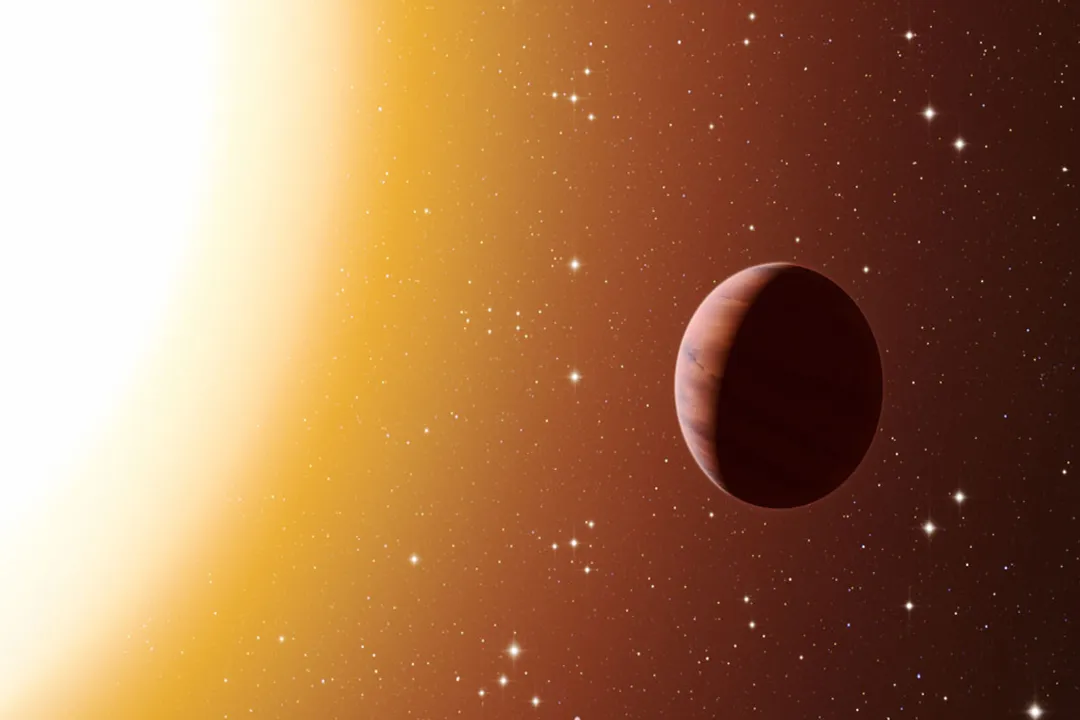
To appreciate the anomaly, one must grasp the scale. Jupiter is defined by its enormous mass, a behemoth composed mostly of hydrogen and helium. A Hot Jupiter shares this Jovian classification but has traded orbital distance for blistering proximity. Consider the orbital period: our Solar System’s Mercury takes about 88 Earth days to orbit the Sun. Many Hot Jupiters complete their circuit in less than five days.
This tight orbit subjects them to intense stellar radiation and gravitational influence. Astronomers use the orbital distance—how close the planet is to its star—as the primary defining characteristic. This closeness results in high surface temperatures, sometimes reaching thousands of degrees Fahrenheit.
| Feature | Solar System Jupiter | Typical Hot Jupiter |
|---|---|---|
| Mass | ~1.0 Jupiter Mass | Similar to Jupiter |
| Orbital Period | ~11.86 Earth Years | Less than 10 Earth Days |
| Orbital Distance | ~5.2 AU | Generally less than 0.5 AU |
| Temperature Implication | Very Cold | Extremely Hot |
# The Core Dilemma
The current leading theory for the formation of planets in our Solar System suggests that gas giants like Jupiter form far from their star, beyond the "ice line," where water, methane, and ammonia can freeze solid, providing abundant solid material for a core to accrete. Once this core is massive enough—perhaps ten times the mass of Earth—it can rapidly gather the vast amounts of hydrogen and helium gas available in the surrounding protoplanetary disk. This process requires distance and time.
Hot Jupiters break this model because they are found right where only small, rocky planets should reside. They could not have formed in their current locations; the stellar heat would have driven away the necessary gas envelope long before the planet could grow to Jovian size. This fundamental discrepancy is what drives the search for explanations—it points toward a dramatic relocation event after the planet formed.
# Inward Migration
The scientific consensus points overwhelmingly toward planetary migration as the mechanism responsible for plunking these giants into super-close orbits. Planetary migration refers to the process where a planet, formed in the outer regions of a stellar system, slowly spirals inward toward its host star. This movement is typically driven by interactions between the planet and the remaining gas and dust of the protoplanetary disk, or through gravitational encounters with other, massive bodies in the system.
There are a few primary ways this migration can occur:
Disk-Driven Migration: If the planet is still embedded within the original gas disk, the friction and gravitational torque exerted by the disk material can act like a brake, causing the planet to lose angular momentum and spiral inward. This process usually results in the planet ending up in a nearly circular, orderly orbit, because the disk naturally damps out large, chaotic variations in the planet's path.
Scattering Events: Another, much more violent scenario involves gravitational interactions between two or more massive planets. In a multi-planet system, a close encounter between two giant planets can slingshot one planet inward toward the star while ejecting the other from the system entirely. This process is chaotic and tends to inject high eccentricity—meaning the orbit becomes highly elliptical—into the surviving planet’s path.
When astronomers map the orbits of known Hot Jupiters, they see evidence supporting both processes. Some planets exhibit near-perfectly circular orbits, strongly suggesting the gentler, disk-driven migration. Others possess highly eccentric paths, whipping in close on one side of their star and swinging far out on the other, which strongly suggests they survived a turbulent, high-energy scattering event. The shape of the final orbit provides direct clues about the mechanics of its dramatic journey.
# Magnetic Influence
While migration explains how they move, a secondary puzzle emerges: why don't all gas giants migrate completely into their stars? A planet spiraling inward through a gas disk should eventually be tidally torn apart or absorbed by the star. The fact that so many Hot Jupiters exist in stable, close orbits suggests there must be a stopping mechanism.
Recent research has pointed toward the powerful influence of the host star’s magnetic field as a potential cosmic speed bump. Magnetic fields are incredibly complex, especially in active stars. The theory suggests that the magnetic field emanating from the star can interact with the surrounding environment—whether it's the residual gas disk or the planet’s own evolving atmosphere—and create a magnetic barrier.
This magnetic barrier essentially acts as a repulsive force or an effective "wall" that prevents the migrating planet from completing its inward plunge, forcing it to settle into a stable, relatively close orbit just outside this barrier zone. This refinement to the migration model helps explain the observed population distribution of Hot Jupiters—why we see them at $0.1$ AU, but rarely much closer. The interplay between stellar magnetism and orbital mechanics is turning out to be just as important as the initial planetary interactions.

# Formation Extremes and System Diversity
The quest to explain Hot Jupiters is continually refined by discovering systems that push the boundaries of what was thought possible. For instance, the mechanism of gravitational scattering, which explains high eccentricity, requires the presence of other massive planets to facilitate the encounter. The detection of a system where a giant planet orbits a star significantly smaller than our Sun—a massive world around a low-mass M-dwarf star—presents an acute challenge.
In our solar system, Jupiter formed around a star that is about $1$ solar mass. If a Jupiter-sized planet orbits a star only one-third the mass of the Sun, the amount of material available in the initial protoplanetary disk would have been much lower. Such a system might favor the formation of only small, rocky planets, not gas giants. The existence of these massive planets around small stars implies that either the core accretion process is far more efficient in low-mass disks than previously modeled, or that migration processes must be universally effective across all types of stars.
The discovery of planets on rare, wide orbits—those that might never migrate inward—also provides context, suggesting that migration is not the only outcome for giant planets, but rather a common pathway for those that end up in extremely close orbits. By studying these unusual, wide-orbit companions, astronomers gain insight into the initial conditions that could have led to a Hot Jupiter before it began its inward trek.
The overall picture emerging is one of dynamical violence and stellar influence. A Hot Jupiter is not merely a misplaced planet; it is a survivor of a chaotic adolescence. It formed far out, likely in concert with siblings whose gravitational tugs either ejected them or sent them hurtling toward their star. Upon reaching the inner system, it might have been slowed and stabilized by the star's magnetic field, settling into the scorching orbit we observe today. Understanding Hot Jupiters, therefore, is less about a single formation event and more about understanding the entire, long-term evolutionary history of a complex planetary system.
#Videos
What are Hot Jupiters? - YouTube
Related Questions
#Citations
Hot Jupiter - NASA Science
Colossal Planet in Rare Orbit Offers Clues to Origins of 'Hot Jupiters'
Bizarre 'Hot Jupiter' Planets Keep Surprising Astronomers
ELI5: What and how are Hot Jupiters formed, and what does ... - Reddit
What's the best explanation for the location of hot Jupiter? - Quora
Magnetic Barriers Might Explain Mysterious Hot Jupiters - Eos.org
A New Understanding of the Origin of Hot Jupiter Exoplanets
Hot Jupiters: Origins, Structure, Atmospheres - AGU Journals - Wiley
What are Hot Jupiters? - YouTube