What is the most geologically active of Jupiter's moons?

Jupiter's collection of natural satellites is fascinating, featuring a diverse group of worlds ranging from icy shells to intensely volcanic landscapes. Among the most prominent are the four largest moons, discovered by Galileo Galilei in the early 17th century, which orbit the giant planet in a manner reminiscent of a miniature solar system. [1][8] While some of these celestial bodies, like Europa, hold the promise of subsurface oceans, one moon stands head and shoulders above the rest in terms of sheer, ongoing geological violence: Io. [1][6] It is, without a doubt, the most active world in the entire solar system regarding volcanism and surface modification. [4]
# Galilean Moons
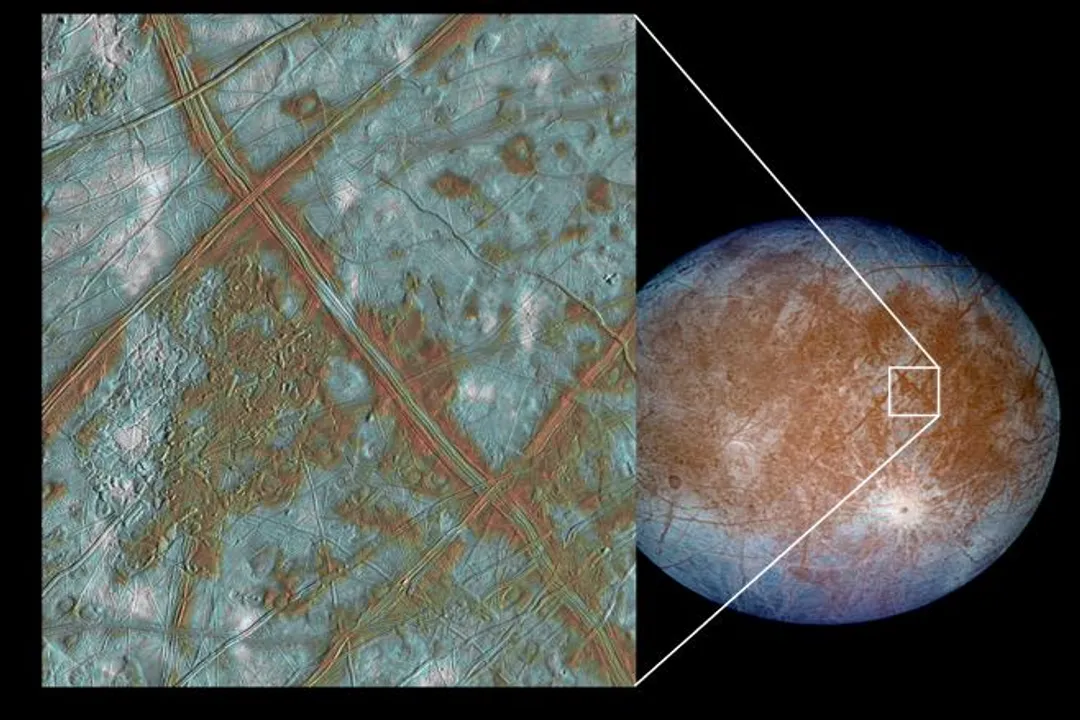
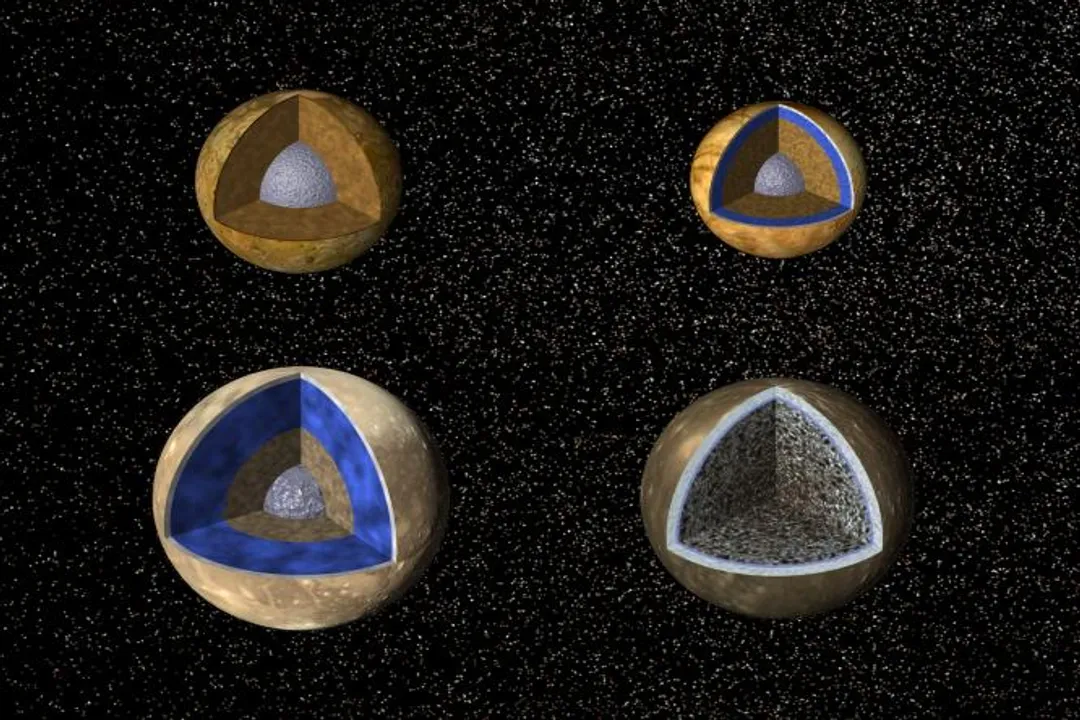
Jupiter boasts dozens of known moons, but the four largest—Io, Europa, Ganymede, and Callisto—are classified as the Galilean moons due to their discovery by Galileo. [1] These are not small, captured asteroids; they are substantial bodies, with Ganymede even being larger than the planet Mercury and the dwarf planet Pluto. [1] They all follow orbits relatively close to Jupiter, and their paths are significantly influenced by the massive gravitational presence of the planet itself. [3]
Io, the innermost of the four, orbits closer to Jupiter than the others. [1] This close proximity is the key to its extreme nature. The four moons are locked in a delicate gravitational dance, a phenomenon known as orbital resonance, which plays directly into the mechanism that keeps Io perpetually boiling. [1]
Jupiter’s system is complex, and the four major moons represent a spectrum of geological states. For context, here is a quick comparison of their general characteristics:
| Moon | Primary Feature | Activity Level | Key Composition |
|---|---|---|---|
| Io | Extreme Volcanism | Highest | Silicate rock, sulfur compounds |
| Europa | Subsurface Ocean | Medium (Ice tectonics/cracking) | Water ice, rock core |
| Ganymede | Largest Moon, Magnetic Field | Low/Moderate | Ice and rock |
| Callisto | Oldest Surface | Lowest | Heavily cratered ice/rock mixture |
| [1][6] |
# Volcanic World
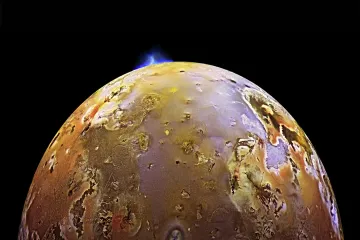
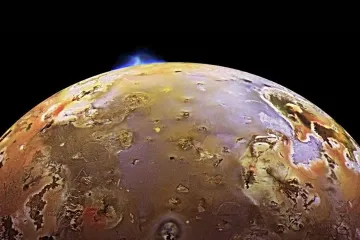
Io’s surface is a panorama of continuous, dramatic change driven by an astonishing level of volcanic output. [4] This moon is unique because it lacks impact craters; any new crater formed by an incoming meteoroid is rapidly erased by fresh lava flows or sulfur dioxide frost settling from volcanic plumes. [4] The entire surface is essentially geologically new, constantly being repaved by volcanic activity. [4]
The sheer number and intensity of the eruptions are staggering. Observations from missions like Voyager 1 and Galileo revealed dozens of active volcanoes spewing material high above the surface. [4] Some plumes, like those from the volcano Loki Patera, can extend hundreds of kilometers into space, sometimes reaching altitudes of up to 500 kilometers. [4] The lava flows themselves are incredibly hot, sometimes detected at temperatures approaching or even higher. [4] This heat is comparable to that of basalts on Earth, which is unexpected for a body so far from the Sun. [4]
One striking observation about Io is what it seems to lack. Despite the constant heat and eruption, Io is remarkably dry. Data suggests it is the driest known body in the solar system, containing virtually no water ice, which is a surprising counterpoint to its neighbors like Europa. [5] The material powering its surface activity seems to be primarily silicates and sulfurous compounds. [4]
# Driving Force

The energy source keeping Io molten and continually erupting isn't internal radioactive decay like on Earth, nor is it solar heating; it is the relentless gravitational squeeze exerted by Jupiter and its other large moons. [1][4] This process is known as tidal heating. [4]
Because Io is locked in a specific orbital resonance with Europa and Ganymede, its orbit is slightly elliptical rather than perfectly circular. [1] As Io whips around Jupiter, the immense gravitational pull varies slightly throughout its orbit. [1] When Io is closest to Jupiter, the gravitational tidal forces stretch the moon more forcefully, flexing its interior rock and ice structure. [1] As it moves farther away, the stretching lessens. [1] This constant flexing generates enormous internal friction, which generates heat deep within the moon's interior, effectively cooking it from the inside out. [4]
To visualize the scale of this process, consider the energy involved. If we were to quantify the power generated by tidal flexing and compare it to Earth’s internal heat flow (which stems primarily from radioactive decay), Io’s output is significantly greater. A quiet comparison reveals that the tidal heating energy generated within Io is roughly 100 times more powerful than the entire internal heat budget lost by Earth to space, all concentrated in a body smaller than Earth's Moon. [4] This sustained, powerful forcing mechanism ensures that Io remains the solar system’s most volcanically dynamic world. [4]
# Surface Resurfacing

The consequence of this intense internal engine is an almost unimaginable rate of surface renewal. Io’s surface is resurfaced completely in a time frame that, on a cosmic scale, is nearly instantaneous. [4] Estimates based on observed flow rates suggest that Io’s entire surface layer is completely replaced every one million years, or perhaps even less. [4]
This process constantly alters the landscape. We can observe features like volcanic plumes, lava lakes, and massive sulfur dioxide snowfalls that originate from these eruptions. [4] The colors visible on Io—the oranges, reds, yellows, and whites—are the result of various allotropes of sulfur and sulfur dioxide deposited by these vents. [4] Unlike the relatively placid, slow geological changes we witness on Earth over millennia, Io’s topography is being rewritten moment by moment by Jupiter’s gravity. [1]
# Other Moons
While Io dominates the activity charts, its siblings offer contrast, illustrating the different geological fates awaiting worlds under varying orbital stresses. [3]
Europa, the second Galilean moon out from Jupiter, is famous for being a prime target in the search for extraterrestrial life, not because of fire, but because of water. [1] Evidence strongly suggests a vast, salty liquid water ocean lies beneath its icy shell. [6][8] Its geological activity involves the cracking, fracturing, and rearrangement of this ice crust, likely driven by similar, though less extreme, tidal flexing. [1]
Ganymede, the largest, is significant because it is the only moon known to possess its own internally generated magnetic field. [1] Its surface shows signs of past tectonic activity, with younger, grooved terrain superimposed on older, heavily cratered regions, suggesting it was once more active but has since cooled down significantly. [1]
Callisto is the outermost and most heavily bombarded of the four. [1] Its surface appears ancient, preserving countless impact craters dating back billions of years. [3] This suggests that Callisto lacks significant geological processes like plate tectonics or pervasive volcanism to erase these ancient scars, indicating it has remained relatively cold and geologically inert for a very long time. [1]
# Comparative Scale
The sheer scale of Io’s activity puts it in a category of its own among the Galilean moons. [1] Europa, Ganymede, and Callisto all exhibit ice geology, driven by heating that manifests as surface fractures or subtle tectonic shifts. [1][3] Io, however, is fundamentally driven by silicate volcanism powered by tidal energy, making it a terrestrial-style geological engine operating under entirely different rules dictated by its extreme orbital proximity to Jupiter. [4]
When examining the broader solar system context, Io’s activity is sometimes compared to that of early Earth when it was young and very hot, though Io’s heat source is external rather than internal radioactive decay. [4] The perpetual churning means that Io is a truly unique laboratory for studying extreme planetary geology, allowing scientists to model how tidal forces can dominate a world's evolution, overriding the typical evolutionary path seen on rocky bodies like Mars or even Earth. [4] Understanding Io helps illustrate that proximity to a massive planet can be just as influential in shaping a moon's destiny as its initial formation or composition. [1][3]
Related Questions
#Citations
Galilean moons - Wikipedia
lo, Jupiter's innermost Galilean moon, is the most volcanically active ...
Jupiter's Large Moons - Astronomy Notes
TIL one of Jupiter's moon's, Io, is the driest thing in the Solar System ...
Jupiter Moons - NASA Science
Jupiter's Moons - Sagan Planet Walk
Geomorphic Features Of Europa - NMSU Astronomy