What is the deepest impact crater on the Moon?

The most colossal scar on the surface of our nearest celestial neighbor is the South Pole-Aitken (SPA) basin. This immense structure is not merely a large crater; it is the single largest and deepest confirmed impact feature on the Moon, easily qualifying it as the deepest hole punched into a planetary body in our solar system whose dimensions we can accurately measure. It dwarfs many other well-known features, covering a staggering portion of the lunar far side.
# Immense Scale
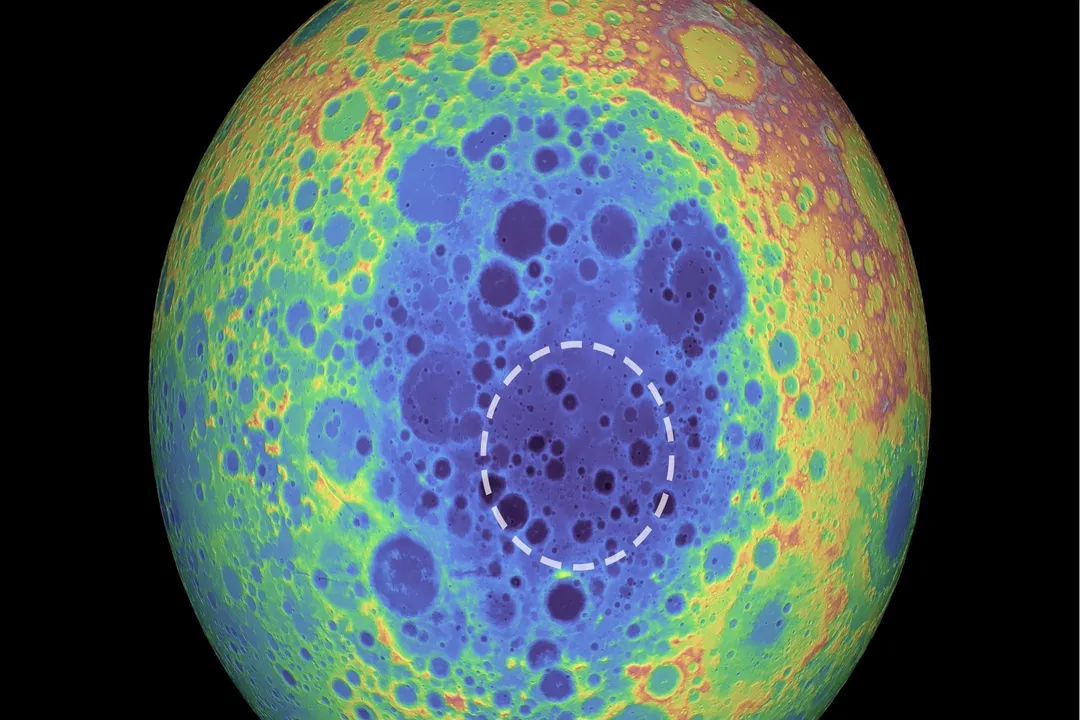
To truly grasp the sheer size of the SPA basin, one must visualize its dimensions. It stretches approximately 2,500 kilometers (or about 1,600 miles) across its widest extent. For context, this diameter is roughly equivalent to the distance from Los Angeles to the eastern edge of Texas, or spanning nearly half the continental United States. The basin itself is remarkably broad, covering about 20% of the Moon's entire surface area. Its depth is another defining characteristic; while its floor is uneven, it plunges several kilometers below the average lunar surface level, making it the lowest elevation on the Moon.
The combination of its vast diameter and significant depth means that the SPA basin is often classified as a basin rather than just a simple crater—a distinction that speaks to the catastrophic energy involved in its formation. While other impact features, like the Orientale basin, are also significant multi-ring structures, the SPA basin remains unparalleled in its dimensions on the Moon. Considering that the Moon’s radius is about 1,737 kilometers, the SPA basin effectively occupies a significant fraction of the entire sphere’s equatorial cross-section, illustrating the violence of the impact event that created it.
# Location and Visibility
The SPA basin is situated almost entirely on the lunar far side, which is a crucial detail for understanding why it remained relatively unknown to early terrestrial observers. Because the Moon is tidally locked with Earth, we never see this hemisphere directly, leading to its historical moniker, the "dark side of the Moon".
The basin is named for two features near its edges: the South Pole region and the Aitken crater, which sits near its northeastern rim. Its location near the Moon’s south pole is particularly relevant today, given the increased interest in exploring permanently shadowed regions there for potential water ice deposits. The sheer scale of the basin means its boundaries are complex, encompassing smaller impact structures that have formed later.
A fascinating byproduct of studying this massive impact is the subsequent geological layering. The basin's floor is relatively smooth compared to the surrounding terrain, indicating that material has been deposited or shifted over eons. Furthermore, the fact that it is an ancient, exposed feature on the far side provides scientists with a window into the Moon’s earliest crustal composition, unlike the heavily resurfaced nearside Maria.
# Age and Formation Debate
Determining the age of such a colossal feature is challenging, but scientific estimates place the impact event in the Noachian period, making it one of the Moon's oldest and most ancient large structures. Some estimates suggest it is around 4.5 billion years old. This places its formation very early in the solar system’s history, possibly during the Late Heavy Bombardment period, when planetary bodies were subject to intense bombardment.
Recent analysis, however, has brought the classic understanding of its formation into question. Traditionally, large basins were thought to be formed by a single, massive impactor creating an initial central peak structure that later collapsed. New research involving sophisticated modeling suggests that the SPA basin might not have formed through a simple, singular impact event as previously assumed. Instead, the data suggests a more complex process, perhaps involving a long-lasting "sloshing" or multiple subsequent collapses of the ejecta blanket, resulting in the broad, circular shape observed today.
This revised understanding moves away from the simple, one-and-done impact model for the solar system’s largest scars. If the impactor was large enough to excavate material to the depth of the lunar mantle, the resulting thermal and structural adjustments would have been prolonged, leading to the final topography we see. This complexity is precisely what makes the SPA basin so valuable—it preserves evidence of extreme impacts that shaped the early terrestrial worlds.
# Geophysical Anomalies Below
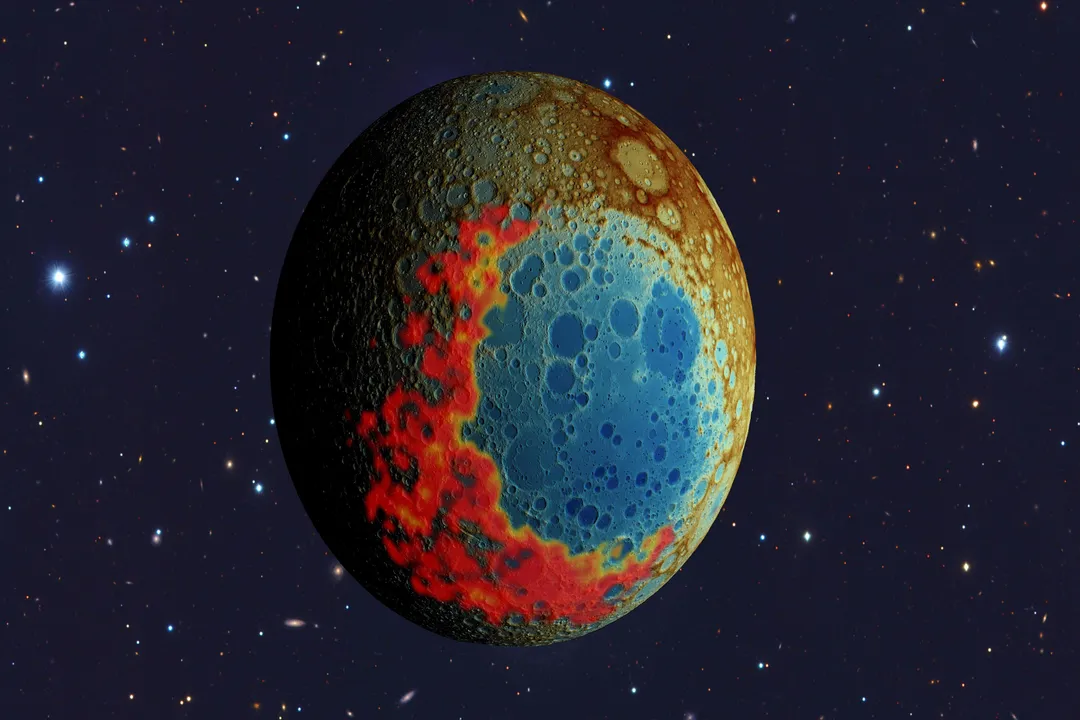
Perhaps the most intriguing aspect of the SPA basin is what lies beneath its surface: a significant mass anomaly. This anomaly indicates a substantial gravitational tug coming from deep within the Moon, directly under the basin floor.
Scientists using gravity data have detected a region of unusually high mass, or "mascon," situated beneath the far side basin. This is not unique—many large impact basins have mascons where dense material has settled post-impact—but the scale and depth of the SPA's anomaly are significant. The standard interpretation is that the impact excavated material, allowing the denser underlying mantle material to rise closer to the surface, which then pulled the orbiting spacecraft downwards.
One hypothesis regarding the source of this deep mass concentration is that the impactor may have punched so deeply that it disturbed the boundary between the lunar crust and mantle, allowing denser mantle material to upwell. Think of it like a cosmic punch through a thick crust layer, causing the underlying, heavier material to bulge upward in response. This upwelling is thought to be related to the initial, incredibly high heat flow across the Moon shortly after its formation.
# Compositional Clues
Because the SPA impact excavated material from such great depths, rocks brought back from or associated with this region are thought to contain material from the deep lunar interior, which is otherwise inaccessible. This makes studying the SPA basin vital for understanding the Moon’s overall bulk composition.
Research has focused on the presence of specific elements within the impact debris. For instance, scientists have found evidence that the impact delivered a radioactive splash across the region. Analysis of surface materials within the basin suggests an enrichment of certain elements like thorium. Thorium, being a radioactive element, is concentrated in the crust. Its relative abundance in the far-side crust compared to the nearside suggests that the impact event redistributed heat-producing material or exposed deep layers rich in these elements.
The detection of this enrichment is important because it hints at the Moon's thermal history. The early Moon was hot, and the movement of heat-producing elements like thorium is critical to understanding how the Moon differentiated into core, mantle, and crust. By studying the ejecta blanket—the material thrown out by the impact—scientists can indirectly sample the Moon's deep plumbing system.
# Shaping Modern Lunar Science
The SPA basin is more than just a record of an ancient collision; it is a present-day target for scientific missions aiming to unlock the Moon’s secrets. Its location near the south pole means future landers targeting water ice may find themselves near this colossal feature, allowing for integrated geophysical and compositional studies.
For instance, understanding the precise shape and subsurface structure—including that deep mass anomaly—is crucial for navigating and landing modern spacecraft accurately, especially those equipped with sensitive gravity meters. Moreover, the basin's influence on the Moon's global gravity field must be accounted for when modeling lunar tides or seismic activity.
The study of this basin also forces a re-evaluation of impact physics. If the formation process was not a simple excavation but involved complex collapse dynamics, it implies that the energy transfer in hypervelocity impacts is even more intricate than previously modeled, affecting our understanding of planetary accretion across the solar system.
# Comparing Nearside vs. Farside Crust
A useful way to contextualize the SPA basin's importance is by comparing the crusts of the near side and the far side. The Moon's near side is characterized by large, dark plains called maria, which are vast basaltic lava flows that flooded older, larger impact basins later in lunar history. This flooding obscures the original crustal structure.
The far side, where the SPA basin dominates, lacks these large maria. This means that the underlying, older, heavily cratered Anorthositic Highlands are much more exposed on the far side. Because the SPA basin impact penetrated down to or below the Moho discontinuity—the boundary between the crust and the mantle—it provides an unmatched cross-section of the pristine, ancient far-side crust.
| Feature | Nearside Crust | SPA Basin/Farside Crust |
|---|---|---|
| Dominant Surface | Large Maria (Basaltic Lava) | Ancient Highlands, heavily cratered |
| Structural Exposure | Lava flows cover original structure | Deep impact exposes mantle/deep crust |
| Gravitational Signature | More uniform, less extreme anomalies | Significant, deep-seated mass anomaly detected |
| Age of Surface | Geologically younger (post-heavy bombardment) | Extremely ancient, oldest exposed surface |
This distinction highlights why the SPA basin is the target for understanding the Moon's primordial state. The material composition found here, enriched with materials like thorium, likely reflects the average composition of the Moon's interior materials that were less able to migrate upward and spread out as they did on the near side.
# The View from Orbit
When viewed from orbit, the SPA basin is visually striking due to its sheer size and the way it interacts with other features. While the impact created a massive depression, subsequent impacts have peppered its floor and rim over billions of years. The Aitken crater, which lends its name to the basin, is itself a significant, younger crater situated on the northeastern edge, illustrating the continuous geological activity, even if slow, that modifies these ancient structures.
One of the more surprising recent findings is how circular the basin appears in high-resolution topographic data compared to earlier, lower-resolution measurements. While the sheer scale implies an incredibly violent event, the resulting morphology is often more regular than expected for such a massive impact, leading back to questions about the complex physics of transient crater formation and collapse.
It is a common misconception that the largest impact structures should appear as simple, deep bowls; in reality, the sheer volume of material excavated and subsequently slumped back into the depression results in a highly modified, often multi-ringed structure with a floor that is significantly elevated from the absolute lowest point that was initially excavated. The SPA basin stands as the ultimate testament to the power of impact mechanics in the early solar system.
# Insights on Impact Physics
The SPA basin serves as a natural laboratory that challenges our fundamental models of planet-scale collisions. When an object several hundred kilometers across strikes a planetary body, the resulting cavity doesn't just stay put; the ground rushes back in under gravity to form a central peak, which then collapses, or the entire structure undergoes complex modification.
If we apply the scale of the impactor—which must have been tens of kilometers wide to create a 2,500 km-wide basin—to the physics of rock mechanics, we realize that the Moon's crust behaved less like a brittle solid and more like a viscous fluid during the impact's immediate aftermath. The fact that this feature is preserved, albeit modified, for 4.5 billion years offers constraints on the early Moon's viscosity and thermal state.
An interesting thought experiment arises when comparing the expected depth of excavation versus the observed mass anomaly. If the impact had been purely kinetic, simply digging a hole, the gravity signal might have been less pronounced unless the impactor itself carried significant mass deep enough to disrupt the mantle boundary. The detection of a massive, deep-seated anomaly suggests the impact not only carved the surface but fundamentally altered the subsurface density profile of the Moon in that region. This implies that the transfer of energy into the deep interior was incredibly efficient—a critical piece of information for modeling collisions on other airless bodies like Mercury or Mars.
The Moon’s largest crater, therefore, is not just a geographical feature; it is a preserved snapshot of the Moon’s earliest, hottest, and most energetic phase, providing chemical tracers (like thorium) and geophysical evidence (the mascon) that tell a unified story about the differentiation of the entire body. No other single feature on the Moon offers such a deep look into its internal structure.
Related Questions
#Citations
South Pole–Aitken basin - Wikipedia
What is the South Pole-Aitken Basin? - NASA Science
The Biggest Crater on The Moon Is Much Bigger Than We Ever ...
Mass Anomaly Detected Under the Moon's Largest Crater
The moon's biggest impact crater made a radioactive splash
The Moon's Biggest and Most Ancient Crater Is More Circular Than ...
Nobody Knows What Made the Gargantuan Crater on the Dark Side ...
What is the name of the largest crater on the Moon? - Quora
5 incredible craters that will make you fall in love with the grandeur ...
The moon's largest crater didn't form in the way we thought