Did Galileo find craters on the Moon?
When we look back at the dawn of telescopic astronomy, the name Galileo Galilei is inseparable from profound cosmological shifts. One persistent question revolves around his initial scrutiny of our nearest celestial neighbor: Did Galileo find craters on the Moon? The answer requires a closer look at what he actually observed and the language he used to describe the seemingly barren, smooth orb that had existed in human imagination for millennia. [1][7] What Galileo confirmed, starting with his first careful observations in late 1609, was that the Moon was not a perfect, ethereal sphere as dictated by ancient Greek philosophy, but a world bearing features analogous to Earth: mountains and valleys. [1][5][8]
# New Sight
Before Galileo turned his rudimentary telescope skyward, the prevailing view, heavily influenced by Aristotle, held that the heavens were composed of perfect, unchanging, immutable spheres. [7][8] The Moon, being a celestial body, was assumed to be perfectly smooth, a crystalline orb reflecting light flawlessly. [8] Naked-eye viewing supported this notion, presenting the Moon as a uniform, bright disc. [1]
Galileo’s crucial advantage was the instrument itself. Though he did not invent the telescope, he significantly improved its magnification and was one of the first to turn it systematically toward the heavens. [4][9] His initial view, which he began around November 30, 1609, revealed a landscape immediately recognizable as rugged and imperfect. [9] This was not the smooth surface philosophers had described; it was decidedly terrestrial in appearance. [1]
# Lunar Shadows
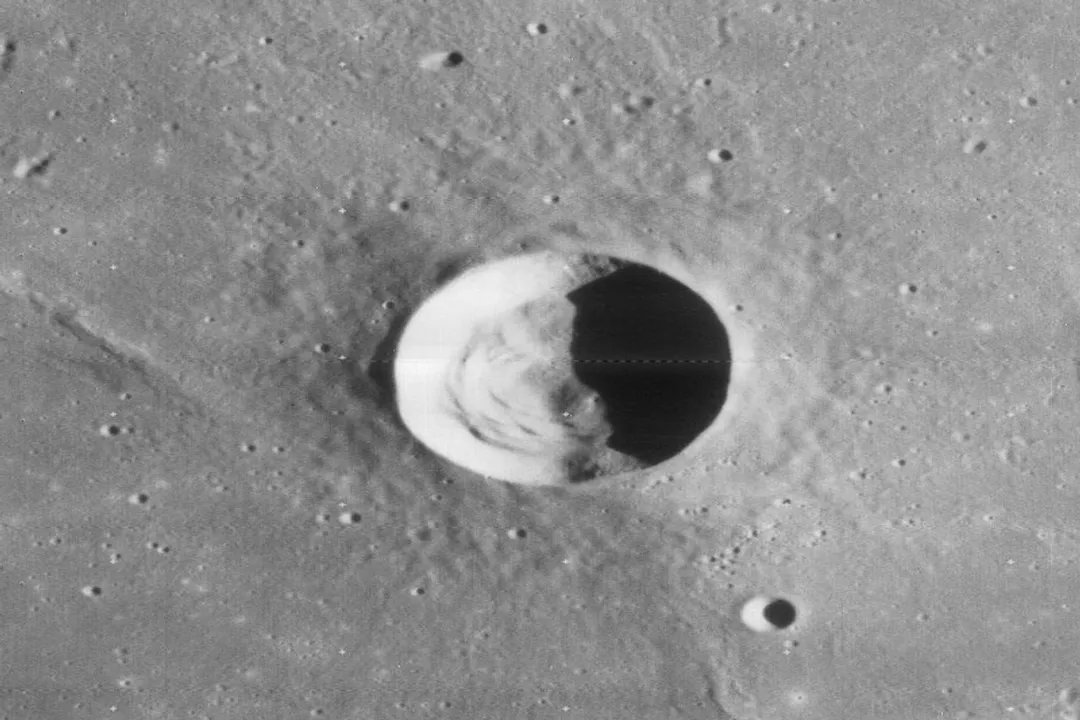
The key to Galileo’s discovery lay not in seeing deep holes directly, but in interpreting the way sunlight struck the Moon's surface. [1] He focused his attention near the terminator—the moving border between the sunlit and shadowed portions of the Moon. [1][7] When the Sun is low on the horizon, as it is during dawn or dusk on Earth, shadows become elongated and exaggerate the topography, making even modest hills appear as towering peaks. [1]
Galileo noticed bright spots sticking out of the shadow line near the terminator. [1] He correctly deduced that these were the sunlit peaks of mountains that had yet to be fully illuminated by the rising "sun" on the Moon. [1][7] Conversely, the dark areas extending into the light were the deep valleys and plains shadowed by these peaks. [1] He described these as "uneven and rough" and noted that they were "full of great prominences and depressions". [8] By meticulously sketching what he saw—the play of light and shadow across the lunar surface—Galileo provided irrefutable empirical evidence of this rugged topography. [7] This method of using shadow length to infer height was an early application of geometric reasoning to astronomical observation, a technique far more sophisticated than simply sketching what was visible under full illumination. [1]
# Surface Imperfections
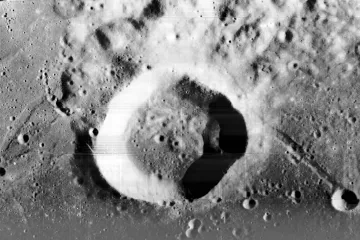
While Galileo documented mountains and valleys, the modern word "crater" implies a circular depression, often formed by impact. The features he observed—the numerous circular basins that pockmark the lunar surface and which we now definitively call impact craters—were certainly among the shadows he interpreted as valleys or depressions. [5] He concluded that these dark patches were the visual result of vast valleys and elevated terrain, essentially confirming the Moon was covered in features similar to Earth's geological structures, rather than being made of a pristine, smooth substance. [1][7]
His descriptions in Sidereus Nuncius (The Starry Messenger), published in 1610, clearly showed the Moon was "not perfectly round and smooth, but like the earth, uneven and full of cavities and protuberances". [4][9] Although he may not have used the specific term crater as we understand it today—the word's association with lunar impact features came later—the physical features he observed and documented were the precursors to, and included, what we now identify as craters. [3] The crater named Galilaei on the near side of the Moon serves as a lasting tribute to his initial breakthrough. [3]
# Celestial Shift
The implications of Galileo's lunar drawings were immediate and revolutionary, far surpassing mere cartography. If the Moon possessed mountains and valleys—features associated with geological processes like erosion or volcanism—it meant the Moon was not fundamentally different from Earth. [8] This directly contradicted the Aristotelian cosmology that had governed Western thought for nearly two millennia. [7]
The ability to prove that a celestial body was imperfect opened the door for a complete reassessment of the heavens. [8] It suggested that other planets might also possess Earth-like characteristics, paving the way for the modern understanding of the solar system where worlds are physical, varied places, not simply ethereal lights set in crystalline spheres. [5] The shift was from philosophical assertion to verifiable observation, a hallmark of the Scientific Revolution. [7]
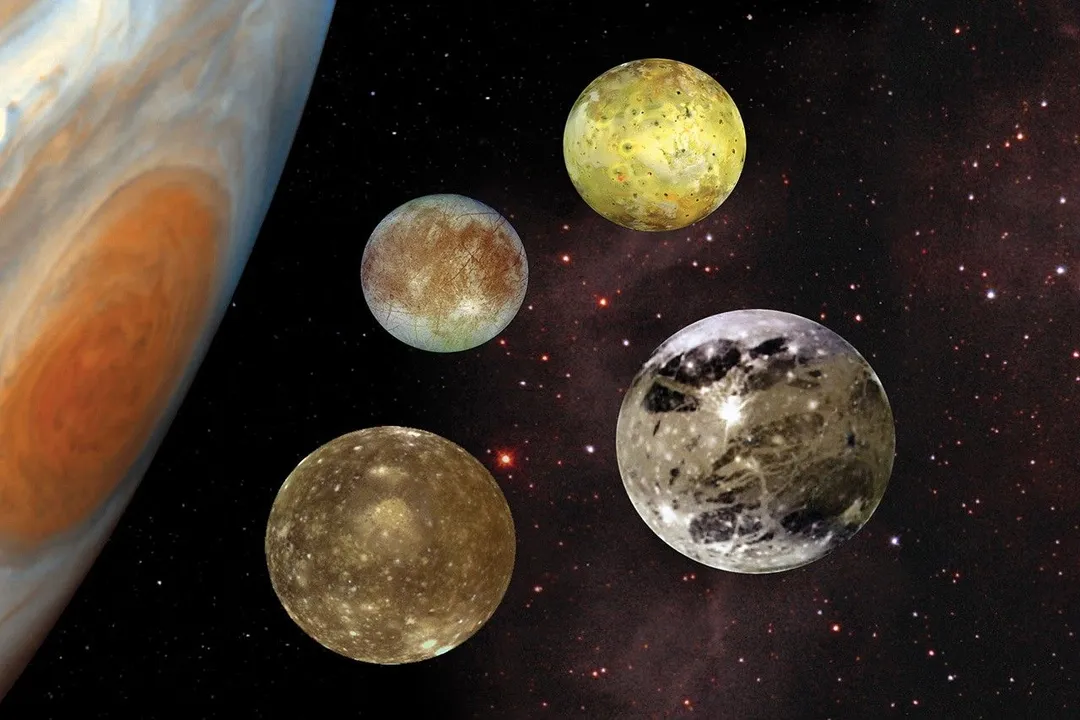
To appreciate the magnitude of this change, consider that for centuries, the smoothness of the Moon was a theological and philosophical certainty. Galileo’s telescope simply provided the first empirical tool to dismantle that certainty, forcing a paradigm shift where seeing became the ultimate arbiter of cosmic truth over ancient texts. [7] This acceptance of an imperfect cosmos, first demonstrated on the Moon, set the stage for his later, more controversial observations of Jupiter’s moons and the phases of Venus. [4]
# Documented Features
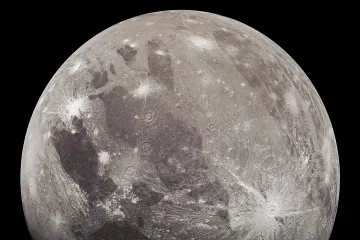
Galileo's published work included meticulous drawings illustrating the uneven surface, which he differentiated from the brighter, smoother maria (seas) that would later be accurately mapped. [7] While the maria appear relatively flat to us, Galileo noted irregularities even there, though his attention was clearly drawn to the stark contrast between the shadowed highlands and the relatively flat plains. [7]
| Feature Observed | Description/Implication | Historical Context |
|---|---|---|
| Shadows near Terminator | Indicated the presence of high relief objects blocking sunlight. [1] | Geometric proof of elevation. |
| Bright Spots | Interpreted as mountain peaks catching the first light. [1] | Contradicted the smooth sphere model. |
| Dark Areas | Identified as deep valleys or depressions. [1][8] | Suggested terrestrial-like geology on the Moon. |
| Overall Surface | Uneven, rough, possessing prominences and depressions. [8] | Dismantled Aristotelian celestial perfection. |
It is interesting to compare the clarity of Galileo’s initial sketches with the incredible detail available today. Modern lunar reconnaissance orbiters provide imagery with resolutions down to centimeters, allowing us to trace the exact origins of specific impact structures. [3] Galileo, working with lenses that introduced significant aberrations and limited magnification, was performing de facto high-contrast remote sensing with very primitive equipment. [4] His success lay in correctly interpreting the physics of light and shadow rather than resolving the fine details we now take for granted.
# Legacy Naming
The influence of Galileo's work is permanently etched onto the lunar surface, not just conceptually but literally. The naming conventions used by later astronomers acknowledged his foundational work in lunar observation. [3] The crater Galilaei, located in the southwestern quadrant of the visible face of the Moon, is a testament to this legacy. [3] Though this specific feature might have been better characterized by later observers like Hevelius or Riccioli, its designation honors the man who first proved the Moon was a world rather than a perfect light in the sky. [3]
Galileo's findings were revolutionary because they relied on observation over dogma. [8] His dedication to sketching the Moon, often recording his views on specific dates like that first key observation in late 1609, provided the visual evidence needed to persuade a skeptical scientific community that the heavens were governed by natural laws accessible through instruments, a concept that remains central to astronomy today. [9] He confirmed that the Moon had mountains and valleys—features that are, in essence, the ancient, weathered remains of impact craters and volcanic activity—making him the first person to confirm the Moon was not a flawless cosmic gem. [1][5]
Related Questions
#Citations
How Galileo Discovered Mountains On The Moon - Forbes
The View from Galileo's Telescope
Galilaei (lunar crater) - Wikipedia
Galileo's Observations of the Moon, Jupiter, Venus and the Sun
TIL Galileo was the first to confirm the Moon's rough and ... - Reddit
Galileo's Moon Observations and Cosmic Exploration - Facebook
01. Early Telescopic Observations - Linda Hall Library
The Galileo Project | Science | Moon
Galileo begins observing the moon | November 30, 1609 - History.com