What did NASA find on the far side of the Moon?
The far side of the Moon, perpetually hidden from direct view by Earth-bound observers, carries a mystique often clouded by misnomers. While popular culture frequently labels it the "dark side," this is astronomically inaccurate; the far side experiences the same duration of sunlight and darkness as the side we see. [4] The phenomenon that keeps it unseen is tidal locking, meaning the Moon takes the same amount of time to orbit the Earth as it does to spin once on its axis. This lock occurred over vast timescales as Earth's gravity slowed the Moon's rotation, fixing the orientation of the two sides relative to each other.
# First Glimpses
For millennia, the appearance of the far side was pure speculation. That changed in 1959 when the Soviet Union’s Luna 3 spacecraft successfully traveled around the Moon and transmitted the very first, albeit grainy, images of this hidden terrain back to Earth. [3] Fifty years later, our understanding has been dramatically improved by detailed observations from NASA assets like the Lunar Reconnaissance Orbiter (LRO), which has been orbiting the Moon since 2009 and collecting terabytes of data used to generate high-resolution topographic maps. [3]
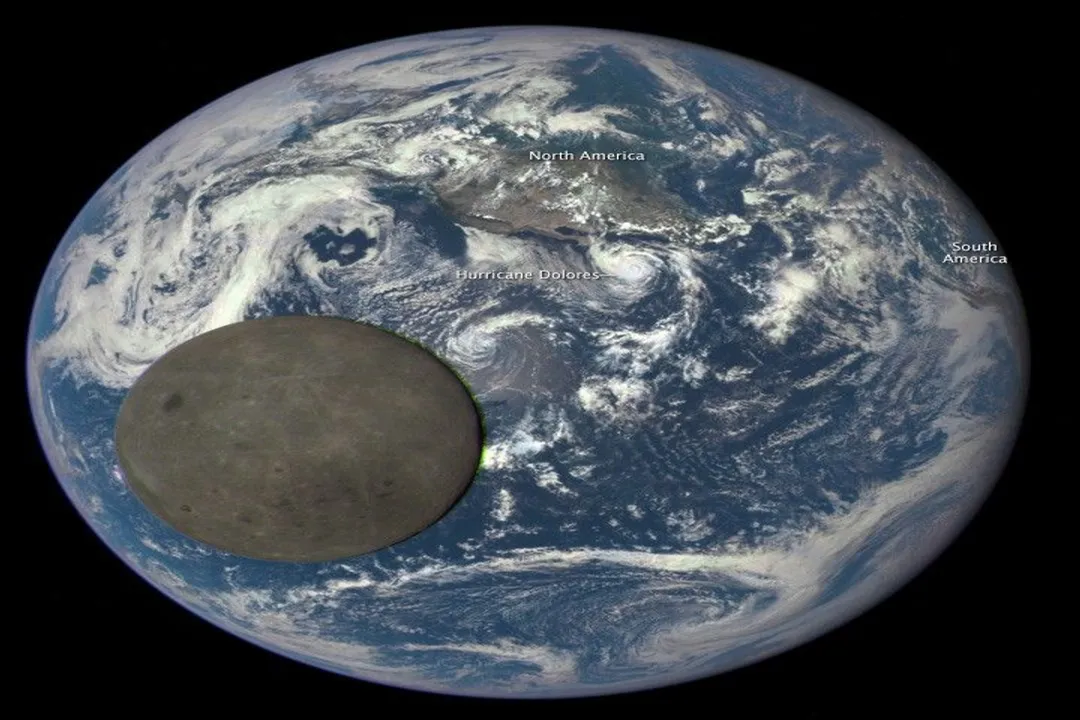
More recently, NASA has captured unique views from much farther out. In July 2015, the Deep Space Climate Observatory (DSCOVR) satellite, positioned about 1.6 million kilometers (1 million miles) from Earth, used its Earth Polychromatic Imaging Camera (EPIC) to image the Moon passing directly in front of the Earth, revealing a fully sunlit view of the far side. [2] These images, taken over several hours, demonstrate the Moon’s phases as seen from that distant vantage point. [2] It is worth noting that in these specific photos, the Earth appears disproportionately large because the camera system employs a long focal length lens, an optical trick that compresses perspective, making distant objects seem closer to the foreground subject.
# Surface Contrast
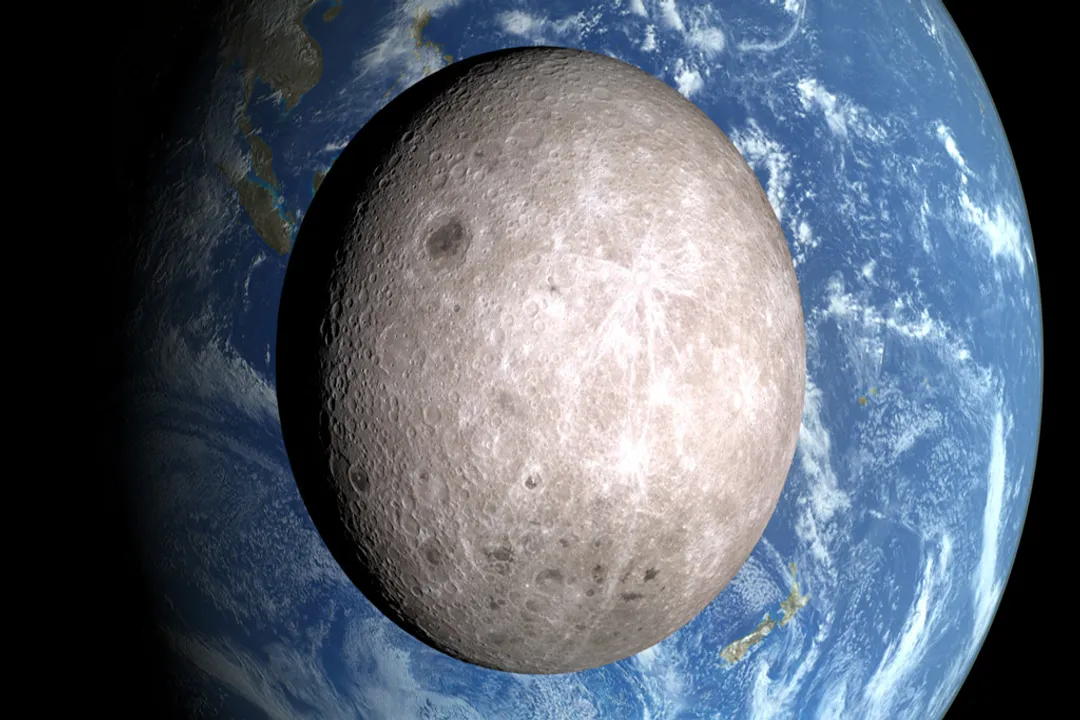
The most striking scientific finding revealed by these early and modern missions is the profound geological difference between the two hemispheres—a phenomenon known as the lunar dichotomy. [2] The side facing Earth is characterized by vast, dark, smooth plains known as maria (Latin for seas), which are solidified flood basalts. [2]
The far side, by contrast, is almost entirely devoid of these large dark plains. [2] Instead, the surface is dominated by brighter, heavily cratered terrain, typically referred to as the lunar highlands. [2] The crust on the far side is demonstrably thicker than that on the near side, a key factor scientists believe influenced this surface separation. While the near side boasts multiple large maria, the far side has only a few small ones, such as Mare Moscoviense, and perhaps the most notable circular feature, Tsiolkovskiy crater. [2]
The near side, being volcanically resurfaced multiple times, presents a geological record that is, in many respects, heavily edited. We can conceptualize the far side's highlands as a pristine, thick crust that effectively preserved the scars of the solar system's earliest, most violent bombardment periods. While the near side’s volcanism melted and covered most ancient evidence, the far side’s thicker crust resisted this resurfacing, creating a more stable, older record of events spanning billions of years.
# Impact Features
The surface of the far side is shaped heavily by impacts, and recent high-resolution data allows scientists to study the aftermath of these events with great precision. When a large impactor strikes the Moon, it excavates material from beneath the surface, throwing it outwards in bright streaks called ejecta rays. These rays are composed of fresh, bright rock fragments, often the lighter-colored anorthosite, which is a primary rock type of the highlands.
One well-documented example of this is the prominent ray system emanating from Jackson crater. Because the Moon lacks an atmosphere, there is no wind or rain to cause erosion; instead, craters and their rays degrade through a process called space weathering. This weathering involves bombardment by solar wind particles and micrometeorites, which gradually alter the surface minerals, causing bright ejecta to darken over millions of years by producing tiny, dark particles of nanophase iron. The presence of bright rays, therefore, acts as a geological clock; the brighter the rays, the younger the impact event. Jackson crater, for instance, is considered geologically young, estimated at around 150 million years old, whereas some lunar craters date back billions of years.
# Future Research Sites
NASA and other international space agencies continue to focus resources on the far side, driven by both scientific curiosity and practical advantages. The ongoing interest is fueled by the search for resources, such as potential deposits of frozen water ice, and the desire to study pristine geological formations that can unlock secrets about the Moon’s formation and evolution. [4]
However, perhaps the most unique advantage the far side offers is related to radio astronomy. Because the Moon itself acts as a massive physical shield, blocking all direct radio transmissions originating from Earth, the far side offers an unparalleled environment of radio silence. Terrestrial radio, television, and cell signals create significant background noise that pollutes observations from Earth. By placing radio telescopes on the far side, scientists can observe the universe at extremely low radio frequencies—frequencies that cannot penetrate Earth's ionosphere anyway—without interference from our own planet's electronic activity. This location is arguably the quietest spot in the inner solar system for such sensitive instruments, opening a new window to study the earliest structure formation in the universe that is simply impossible to access from our planet.
# Exploration Missions
The initial reconnaissance by Luna 3 has been followed by various other probes, including the crucial LRO. [3] As exploration ramps up, particularly with programs like NASA’s Artemis, the far side remains a primary target for both robotic and future crewed landings. [2] The technical challenges associated with landing on the far side—primarily the lack of direct line-of-sight communication with Earth—require the deployment of dedicated relay satellites, making successful missions there a testament to advanced engineering and coordination. A successful landing on this hemisphere means establishing an independent communications network, a major step toward sustained lunar presence.
#Videos
What Did NASA Find On The Far Side of the Moon? - YouTube
What Did NASA Discover On The Darkest Side of the Moon?
Related Questions
#Citations
What Did NASA Find On The Far Side of the Moon? - YouTube
The Moon's Far Side - NASA Scientific Visualization Studio
The Dark Side and the Bright Side - Earth Observatory - NASA Science
Photo taken of the dark side of the moon: what is this spiky pattern?