What technique did the Deep Space Climate Observatory (DSCOVR) employ using EPIC to show a fully sunlit view of the far side in 2015?
Answer
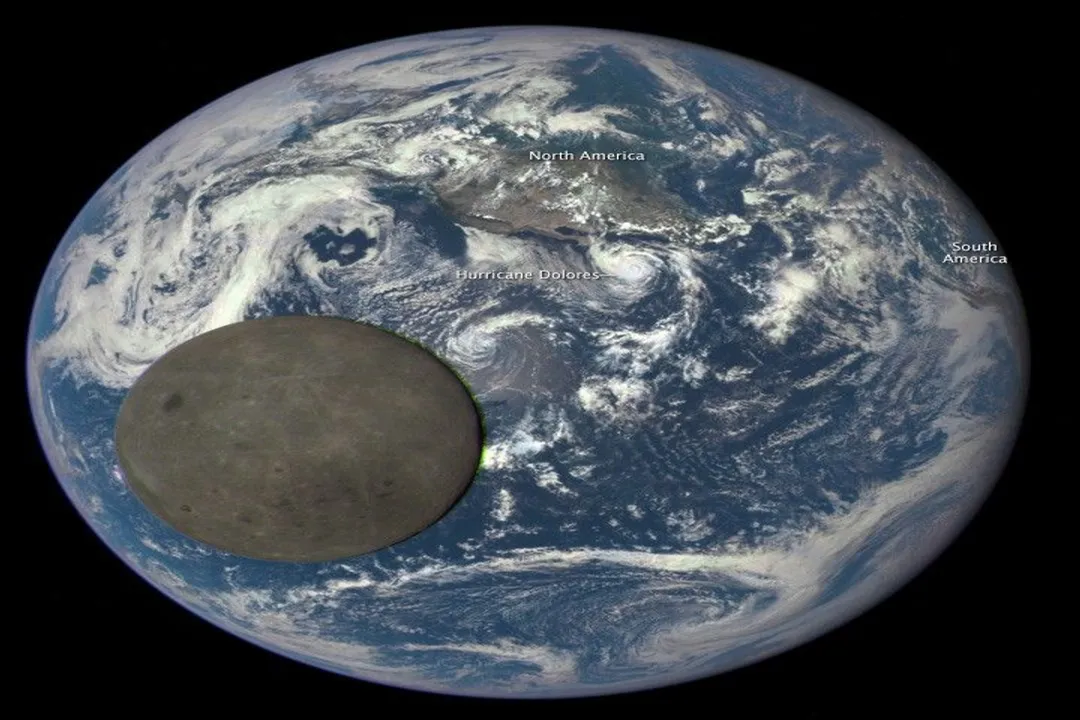
It imaged the Moon passing directly in front of the Earth.
In July 2015, the Deep Space Climate Observatory (DSCOVR) satellite, situated approximately 1.6 million kilometers away from Earth, provided a unique perspective. It used its Earth Polychromatic Imaging Camera (EPIC) to observe the Moon moving across the face of the Earth from its distant vantage point. This specific configuration allowed for the capture of a completely illuminated face of the Moon—the far side—over a period of several hours, illustrating the Moon's phases as viewed from deep space, rather than from Earth's orbit.
#Videos
What Did NASA Find On The Far Side of the Moon? - YouTube
What Did NASA Discover On The Darkest Side of the Moon?
Related Questions
What precisely defines the phenomenon of tidal locking causing the far side to remain unseen?Which Soviet spacecraft transmitted the very first, albeit grainy, images of the Moon's hidden far side in 1959?Which NASA asset, orbiting since 2009, has been instrumental in collecting terabytes of data for high-resolution topographic maps of the Moon?What technique did the Deep Space Climate Observatory (DSCOVR) employ using EPIC to show a fully sunlit view of the far side in 2015?What is the scientific term describing the striking geological contrast between the lunar near side and the far side?How does the surface composition of the far side typically contrast with the near side's vast dark plains?Relative to the near side, how does the thickness of the crust on the Moon's far side compare?What geological features serve as a 'geological clock' on the far side, indicating impact age by their relative brightness?What primary environmental advantage does placing radio telescopes on the far side of the Moon offer scientists?What major technical hurdle must be overcome, requiring relay satellites, for successful crewed landings on the far side?