Who was the first to see the dark side of the moon?

The familiar, cratered face of the Moon that hangs in our night sky is only half the story. For millennia, the other hemisphere remained a complete mystery, hidden by the mechanics of orbital mechanics. The misconception that this unseen area is perpetually shrouded in darkness is common, leading to the enduring phrase "the dark side of the Moon," but the reality is far more nuanced, involving robotic pioneers and a brave crew who broke the boundary of sight.[1][2]
# Unseen Surface
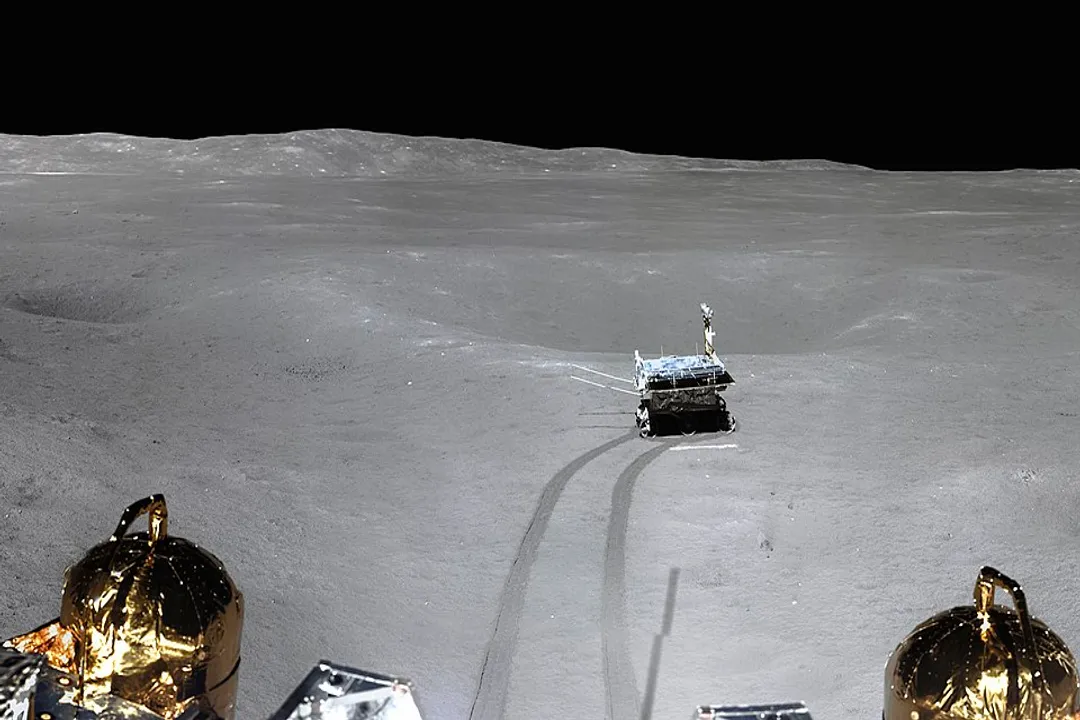
The crucial reason we only ever see one side of the Moon is due to tidal locking. [1] This phenomenon means the Moon rotates on its axis at the exact same rate that it orbits the Earth, locking its near side toward us over billions of years. [1][5] The side facing away is more accurately termed the far side of the Moon. [1][5] It receives just as much sunlight as the side we see; in fact, when we experience a New Moon (when the near side is dark), the far side is fully illuminated. [2][5]
Before any human being could cast their eyes upon this hidden terrain, technology had to pave the way. The first breakthrough came from the Soviet Union. In October 1959, the unmanned Luna 3 probe successfully flew around the Moon and transmitted the first-ever images of the far side back to Earth. [1][2] This achievement was monumental, as it confirmed the surface was substantially different from the near side, appearing much rougher and heavily cratered. [1] While Luna 3 provided the initial visual data, it was a grainy, indistinct glimpse compared to what came next.
# First Eyes

The true shift from robotic mapping to direct human visual experience occurred in December 1968. [3] The crew of Apollo 8—Frank Borman, Jim Lovell, and William Anders—became the first humans to travel to the Moon and witness the far side with their own eyes. [3] As their spacecraft swung around the Moon, moving out of Earth's view and into communication blackout, they became the first people to see the alien landscape that humanity had only theorized about for so long. [3]
This moment was profound, not just scientifically, but psychologically. For the first time, a portion of Earth’s closest celestial neighbor was viewed directly by human perception. Imagine the transition: one moment seeing the familiar near side, and the next, rounding the terminator line to face an utterly new panorama. This was a sensory experience that no photograph or radio transmission could fully convey. [3]
It is interesting to note the gap in time here: Luna 3 provided the first photographic evidence in 1959, but humanity had to wait nearly a decade for a person to actually witness that view directly. [1][3] This timeline illustrates the difference between engineering a machine to collect data and the qualitative leap that comes from subjective, firsthand observation. [1]
# Surface Contrast
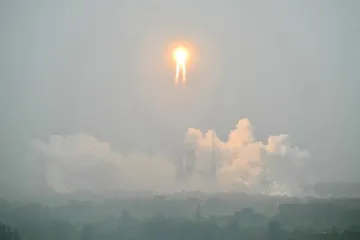
What the Apollo 8 astronauts saw confirmed earlier suspicions derived from probe imagery: the geological makeup of the two sides is remarkably distinct. [1][8] The near side, the face we see daily, is characterized by large, dark, smooth plains, which ancient astronomers called maria (seas). [5][8] These dark areas are vast plains of solidified basaltic lava that welled up billions of years ago. [5]
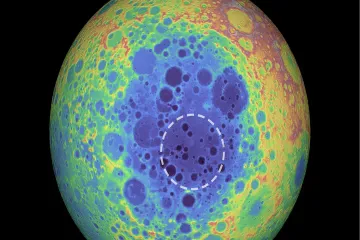
The far side, however, is dramatically different. It has far fewer of these maria. [1][8] Instead, the far side is dominated by heavily impacted terrain, appearing bright and rugged due to an exceptionally thick crust. [1][5] One of the most prominent features discovered later, and certainly visible to the Apollo 8 crew during their orbits, is the South Pole-Aitken basin, one of the largest and oldest impact craters in the entire Solar System. [1][8] This stark contrast suggests a different thermal history and crustal structure between the two hemispheres, a mystery that researchers continue to investigate, sometimes using modern analysis techniques to re-examine the 55-year-old data. [6]
# Imaging Legacy
The photographs taken by the Apollo 8 crew were foundational, but early robotic missions provided the necessary context for mapping. [4] While Luna 3 provided the very first images in 1959, subsequent missions, including the US Ranger 7, 8, and 9 probes and the Soviet Zond program, added much higher-resolution data over the following years. [1] The official mapping of the far side truly accelerated after the initial flybys. [9]
When we look at the first clear images, such as those captured in the late 1950s, we see a world completely unfamiliar to human eyes until that point. [4] These early photographs, often shared and studied intensely by scientists, represented not just a new view of our Moon but a validation that our understanding of the solar system required extending our vision past what was immediately observable from Earth. [4]
The sheer volume of impact craters on the far side is startling when compared to the near side's smoother expanse. [1] Analyzing this asymmetry in geology is key to understanding the early evolution of the Earth-Moon system. For instance, the thinner crust on the near side might have allowed magma to erupt and form the maria, while the thicker crust on the far side prevented that process from happening on the same scale. [5]
# The Viewpoint Shift
Thinking about the experience of Borman, Lovell, and Anders brings up another interesting analytical point: the shift in perspective regarding Earth itself. [3] While they were primarily focused on the alien landscape ahead, the trajectory required to get there and orbit the Moon meant that for a period, they were looking back at the Earth suspended in the blackness of space. [3] This transition—from seeing the Moon's hidden side to seeing the entirety of Earth—marked an unparalleled moment in human awareness.
The successful orbit of Apollo 8 proved the technical feasibility of reaching the Moon, but the visual confirmation of the far side fulfilled an ancient human curiosity. It removed the physical barrier to deep space exploration by demystifying the unseen half of our nearest neighbor. The fact that the Moon acts as a perfect shield, cutting off radio contact during that segment of the orbit, only heightened the sense of isolation and discovery felt by the crew as they passed behind that hemisphere. [3] It was an enforced, silent encounter with a world unknown.
For any aspiring engineer or scientist studying space missions, the timeline of discovery offers a practical case study. First, you achieve remote sensing (Luna 3, 1959) to prove the concept and gather basic data. [1] Next, you refine the observation and reconnaissance (later probes and orbital mapping). [9] Finally, you send humans for ground-truth verification and direct experience (Apollo 8, 1968). [3] Each step built upon the last, transforming a distant, mythical region into a documented, physically visited place.
While the term "dark side" persists in popular culture, perhaps now we can appreciate the actual visual difference: the far side is not dark, it is simply different, showcasing a heavily cratered, bright crust that contrasts sharply with the lava plains that dominate the face we see every night. [2][5] The first to see it were the Luna 3 instruments, but the first humans to truly witness that rugged panorama were the three astronauts of Apollo 8. [3]
Related Questions
#Citations
Far side of the Moon - Wikipedia
The Dark Side of the Moon - National Space Centre
The dark side of the moon. In 1968, the crew of Apollo 8 ... - Facebook
The First Photo Of The Dark Side Of Our Moon - October 2nd, 1959
The Dark Side and the Bright Side - Earth Observatory - NASA Science
55-year-old dark side of the moon mystery solved - Penn State
Omega Dark Side of the Moon Buying Guide - BobsWatches.com
Dark No More: Exploring the Far Side of the Moon
Far side of the Moon | Research Starters - EBSCO