Did Galileo discover the first moons of Jupiter?
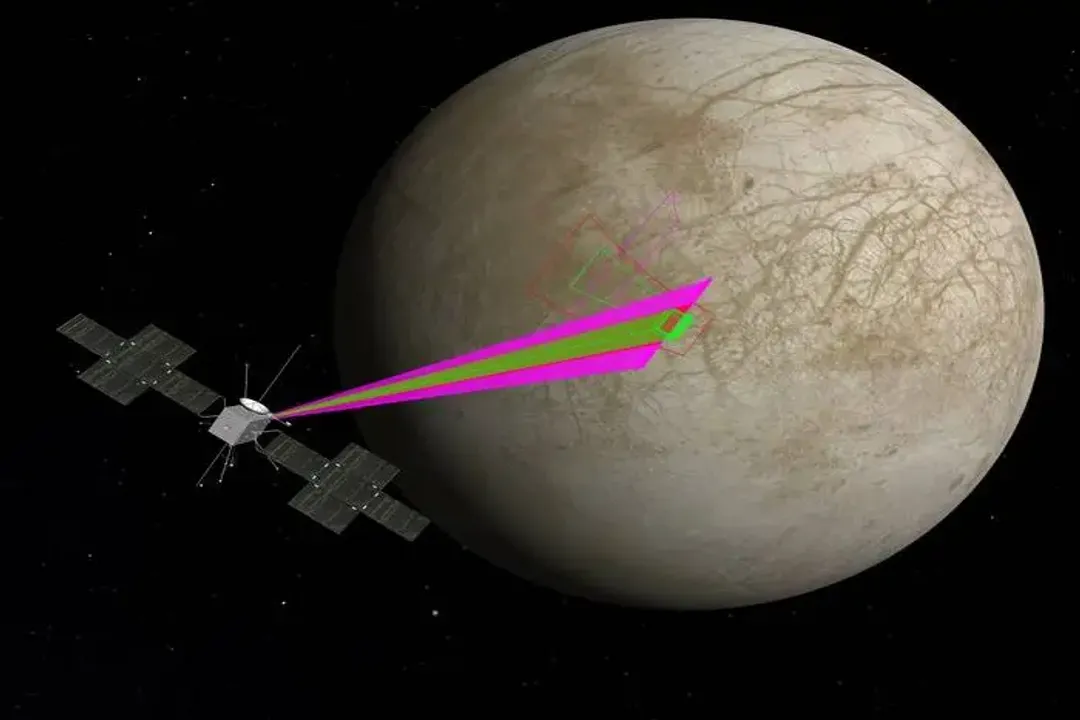
The question of whether Galileo Galilei discovered the first moons of Jupiter is fascinating, not because the answer is a simple yes or no, but because it forces us to define what "discovery" truly means in the context of scientific revolution. What is certain is that in the winter of $1609-1610$, Galileo, using his newly improved telescope, turned that revolutionary instrument toward Jupiter and saw something that irrevocably altered humanity’s perception of the cosmos. [3] He noticed three faint points of light clustered near the giant planet on January 7, 1610. [4][6][7] Initially, like any observer before him, he likely mistook these "stars" for fixed points in the background. [3][5]
However, Galileo was not merely looking; he was observing systematically. Over the subsequent nights, he charted their movement, noting that they did not follow the predictable paths of background stars but instead kept close company with Jupiter, shifting positions relative to each other. [3][4] By January $13$, he saw all four at once, and within a week, by the of January, the conclusion was inescapable: these were not stars, but four small bodies actively orbiting the planet Jupiter. [3][5][6] His findings were quickly compiled and announced in his momentous publication, Siderius Nuncius (The Starry Messenger), in March $1610$. [3][4][5]
This event marked a monumental step in observational astronomy. These were the first Solar System objects discovered to orbit a planet other than Earth. [5] In a geocentric, Ptolemaic universe—where everything, by definition, orbited the Earth—Galileo had provided concrete, undeniable visual evidence of a miniature solar system in motion elsewhere. The implication was a direct, powerful challenge to the established, Earth-centered view of the heavens that had dominated educated European thought for centuries. [3][5]
# The Galilean Four
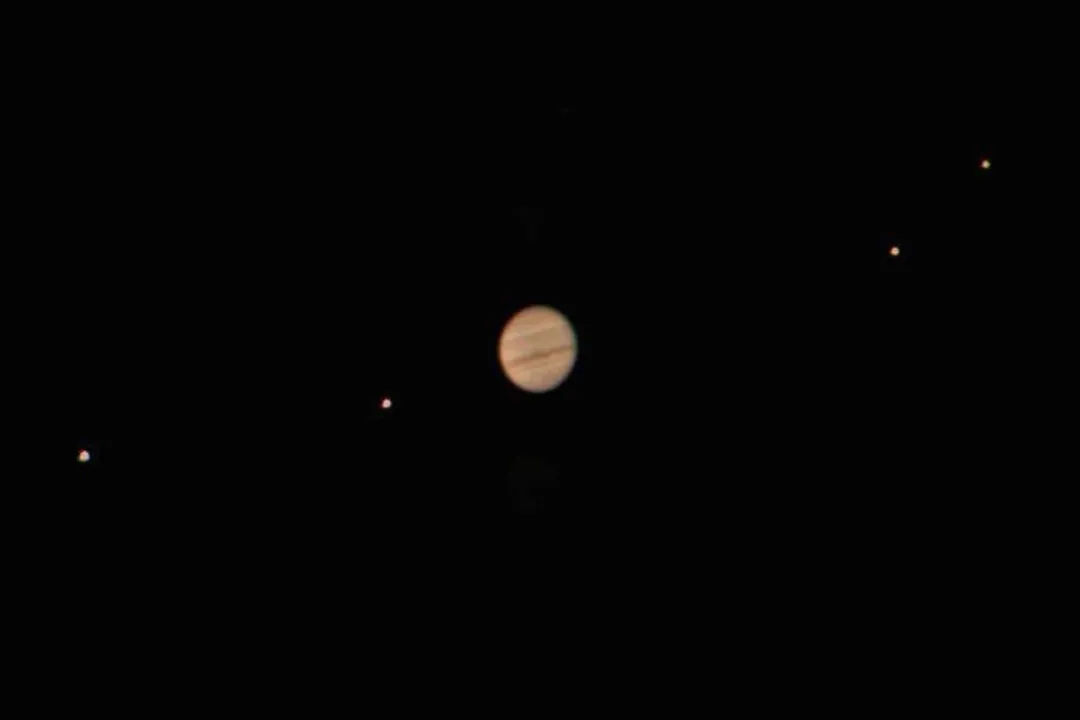
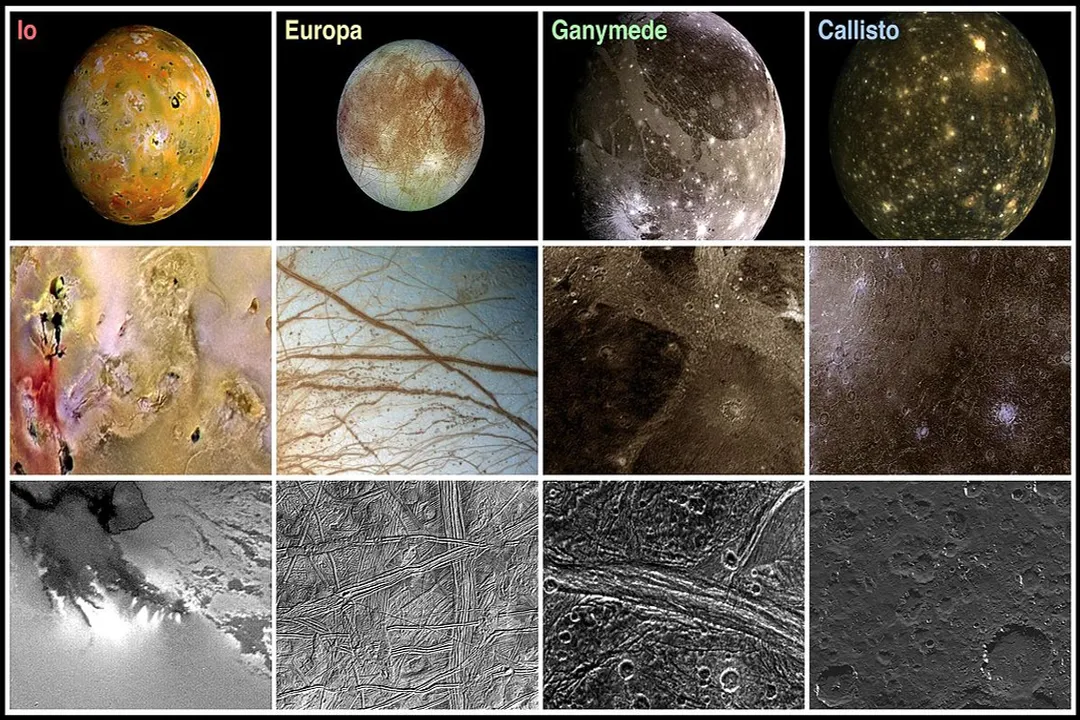
The four celestial companions Galileo found were the largest orbiting Jupiter, and they are still known today by the name honoring their discoverer: the Galilean moons. [3][5] They are Io, Europa, Ganymede, and Callisto. [5] These are not minor specks; they are massive worlds in their own right. Ganymede, the largest, surpasses the planet Mercury in physical size, although not in mass. [5] The entire group is significant enough that all four, along with Saturn's Titan and Earth's Moon, are larger than any of the Solar System's recognized dwarf planets. [5]
What Galileo observed was a dynamically complex system, even if he couldn't grasp the full geological implications. The moons possess remarkably varied natures, dictated by their proximity to the immense gravitational and tidal forces of Jupiter. Consider the differences revealed by later missions, all stemming from that initial sighting:
| Name | Designation | Diameter (km) | Density (g/cm³) | Orbital Period (days) |
|---|---|---|---|---|
| Io | Jupiter I | $3660.0$ | $3.528$ | $1.769$ |
| Europa | Jupiter II | $3121.6$ | $3.014$ | $3.551$ |
| Ganymede | Jupiter III | $5268.2$ | $1.942$ | $7.155$ |
| Callisto | Jupiter IV | $4820.6$ | $1.834$ | $16.689$ |
| [5] |
The data highlights a clear trend: the closer a moon is to Jupiter, the denser it is. [5] Io, the innermost, is primarily silicate rock with a molten core, boasting more than $400$ active volcanoes, making it the most geologically active body known in the Solar System. [4][5] In contrast, Callisto, the farthest of the four, has a density intermediate between ice and rock, is heavily cratered, and is considered less dynamically affected by tidal heating. [5] Europa, sandwiched between them, holds perhaps the most tantalizing possibility: a smooth, icy crust potentially floating over a subsurface ocean of liquid water—a potential habitat for life. [3][4] The discovery of these worlds, each with distinct characteristics, proved that the heavens were not the immutable, perfect spheres described by older philosophies.
# Claims of Precedence
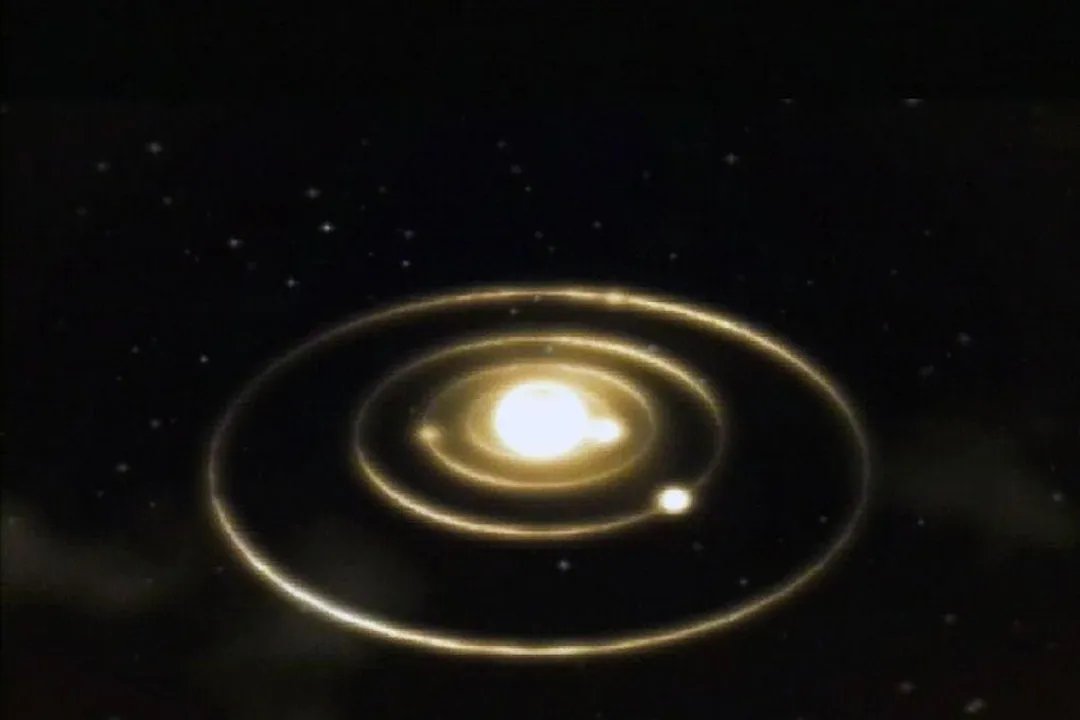
While Galileo's discovery is seminal because it was made with a telescope and published as systematic, verifiable evidence, he was not the first human to possibly glimpse a Jovian moon. [5] The claim that elevates Galileo above all others rests on the technology and the resulting paradigm shift, yet the historical record offers fascinating challenges to the title of "first" observer.
One significant alternative account comes from ancient China. Records from Chinese astronomer Gan De date back to approximately $365$ BC. [5] He reportedly noted a "small reddish star" accompanying Jupiter, which modern analysis speculates might have been Ganymede. [5] If true, this sighting predates Galileo's work by nearly two millennia. [5] However, this observation remains ambiguous. Moons are generally too faint for their color to be perceived with the naked eye, making the "reddish" description puzzling. [5] Furthermore, the observation was not part of a repeatable, telescopic survey intended to prove a celestial model; it was a fleeting, isolated note, not the beginning of a scientific campaign.
Another near-contemporary challenge came from German astronomer Simon Marius. [5] Marius claimed to have seen the moons even earlier, with a written record dated December $29$, $1609$. [5] This date appears to be earlier than Galileo's first observation on January $7$, $1610$. [5] The key difference, and the reason Galileo is credited, involves the calendar in use. Marius was using the Julian calendar, while Galileo was using the newer Gregorian calendar. When reconciled to the modern system, Marius's first written record was actually dated January $8$, $1610$—a full day after Galileo's initial sighting on January $7$. [5] Marius did, however, ultimately get his way with the names, as Kepler suggested names derived from Zeus's mythology (Io, Europa, Ganymede, Callisto), which eventually replaced Galileo’s politically motivated Medicean Stars. [3][5]
This squabble over the precise day and calendar system perfectly illustrates a unique original insight into the nature of scientific priority: sometimes, the value of a discovery lies not just in being first, but in being demonstrably first with a new methodology. Galileo’s advantage wasn't just $24$ hours; it was the telescope. The ability to systematically track orbital mechanics over weeks, which Galileo did, provided irrefutable proof of a non-Earth-centered motion, something a single, ambiguous naked-eye sighting could never achieve.

# The Technological Leap
Galileo’s triumph was intrinsically linked to his technological expertise. He didn't just get a telescope; he improved it, achieving about magnification. [5][6] This enhancement was the critical factor separating his work from the ambiguous observations of the past. While others, like the Dutch, had invented the initial spyglass for terrestrial use, Galileo was among the first to turn it skyward with scientific intent. His findings with the Moon (craters and mountains) and Jupiter demonstrated that technology was now capable of revealing details the unaided human eye could never detect. [3]
The shift in perspective facilitated by this technology is a cornerstone of modern science. As educational materials suggest, Galileo’s work established the evidence-based view of science by giving priority to evidence in developing explanations. The observed pattern of the four moons revolving around Jupiter was an empirical fact that demanded a new model of the cosmos. For a society convinced that the Earth was stationary, the idea that one celestial body could successfully shepherd four others around itself while also moving around the Sun was a staggering intellectual leap. [6] If Jupiter could hold onto its satellites while moving, why couldn't Earth hold onto the Moon if the Earth itself were moving? The telescope didn't just reveal new objects; it provided the necessary data to dismantle a cosmological structure.
# Beyond the Initial Sightings
Galileo’s commitment to recording the data is perhaps the strongest argument for his monumental discovery. He used a numbering scheme in his private notes—I, II, III, and IV in order of distance from Jupiter—which remains in parallel use today, while Simon Marius’s names became the common standard. [3][5] The consistent observation and mapping of these objects allowed later scientists to extract further, practical knowledge.
The very regularity that proved they were moons also gave rise to another original application: longitude determination. In $1616$, Galileo proposed using the precisely timed eclipses of these moons as a universal clock to help navigators accurately determine their longitude at sea, a major unsolved problem of the age. [5] Although the method proved impractical for moving ships at the time due to observational difficulties, the principle was sound and was later successfully applied by cartographers like Giovanni Domenico Cassini for land mapping in France. [5] This shows that the discovery’s impact extended far beyond pure astronomy, touching upon navigation, timekeeping, and geodesy.
The story did not end in $1610$. For centuries, the four Galilean moons remained the largest known satellites of Jupiter. It wasn't until $1892$ that American astronomer E.E. Barnard spotted the fifth moon, Amalthea. [4][5] This discovery was significant because Amalthea is far smaller and orbits much closer to Jupiter than Io. [4] Furthermore, Barnard's discovery is historically noted as the last solar system satellite found through visual observation; all subsequent discoveries of Jupiter's ever-growing census—which now stands at scores of smaller, irregularly shaped bodies [5]—have relied on photographic or digital imaging techniques. [4] The initial count of four observed through a $20$-power lens has ballooned to $79$ [4] or $95$ known satellites today. [6]
Ultimately, while ancient astronomers may have momentarily spotted a Jovian companion, and a contemporary may have seen them a day later, the title of discoverer belongs to Galileo. He was the first to systematically observe, chart, conclude, and publish the existence of an orbiting family of worlds around another planet using a revolutionary instrument, effectively ushering in the modern era of observational science. [3]
Related Questions
#Citations
410 Years Ago: Galileo Discovers Jupiter's Moons - NASA
Galilean moons - Wikipedia
Galileo: Discovering Jupiter's Moons | PBS LearningMedia
We figured out exactly what Galileo saw when he discovered the ...
On this day in history, January 7, 1610, Galileo discovers the moons ...
[PDF] In the Footsteps of Galileo: Observing the Moons of Jupiter