Why are some moons geologically active even though they are much smaller than planets?
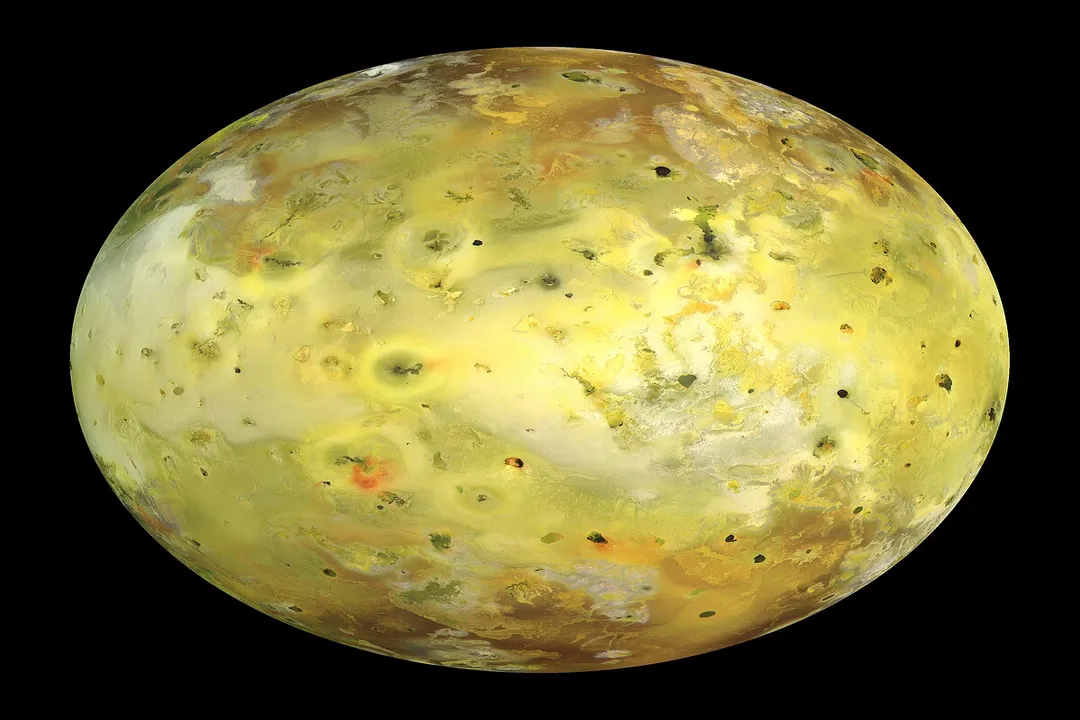
The sight of small, rocky, or icy bodies orbiting giant planets exhibiting ongoing geological activity often surprises observers. After all, we generally associate volcanism, tectonic shifts, and internal heat with large worlds like Earth or its much larger neighbor Mars, which, despite its size advantage over some moons, is largely considered geologically dead today. The mystery deepens when comparing a small moon to Mars; if planetary size dictates the retention of internal heat over eons, how can tiny satellites remain hot enough to reshape their surfaces? The answer lies not in their initial formation heat or their internal supply of radioactive elements, but in a powerful, continuous external energy source delivered by their massive planetary hosts.
# Heat Generation
For a celestial body, geological activity—the processes that reshape a surface, like volcanism or quakes—requires a sustained source of internal heat. On large terrestrial bodies, this heat comes from the slow cooling of the initial heat of accretion and ongoing heat generated by the decay of long-lived radioactive isotopes within the core and mantle. However, for smaller objects, the surface area to volume ratio is high, meaning they lose internal heat to space much faster than giants like Earth or even Mars.
Moons such as Jupiter's Io and Saturn's Enceladus are clearly defying this cooling trend. Io, for example, is the most volcanically active body in the entire solar system, continuously resurfacing itself with lava flows and sulfur plumes. This level of activity should have ceased billions of years ago if it relied only on stored formation heat or standard radioactive decay that smaller bodies possess. The sheer power required to maintain such vigorous, ongoing outgassing and surface change necessitates a dynamic energy input that dwarfs typical internal sources.
# Gravitational Stress
The key driver that supplies this massive, persistent energy is tidal heating. This phenomenon occurs when a moon is locked in a gravitational dance with a massive planet, often compounded by the influence of other moons in the system. As the moon orbits, the gravitational pull exerted by the planet is not constant; it varies depending on the moon's distance from the planet in its slightly elliptical orbit.
This varying gravitational force stretches and squeezes the moon’s interior rhythmically, much like kneading dough. This constant flexing creates immense internal friction, which manifests as heat—a process sometimes called tidal friction. The energy dissipated by this internal squeezing can be substantial enough to melt rock or, in the case of icy moons, maintain vast subsurface oceans.
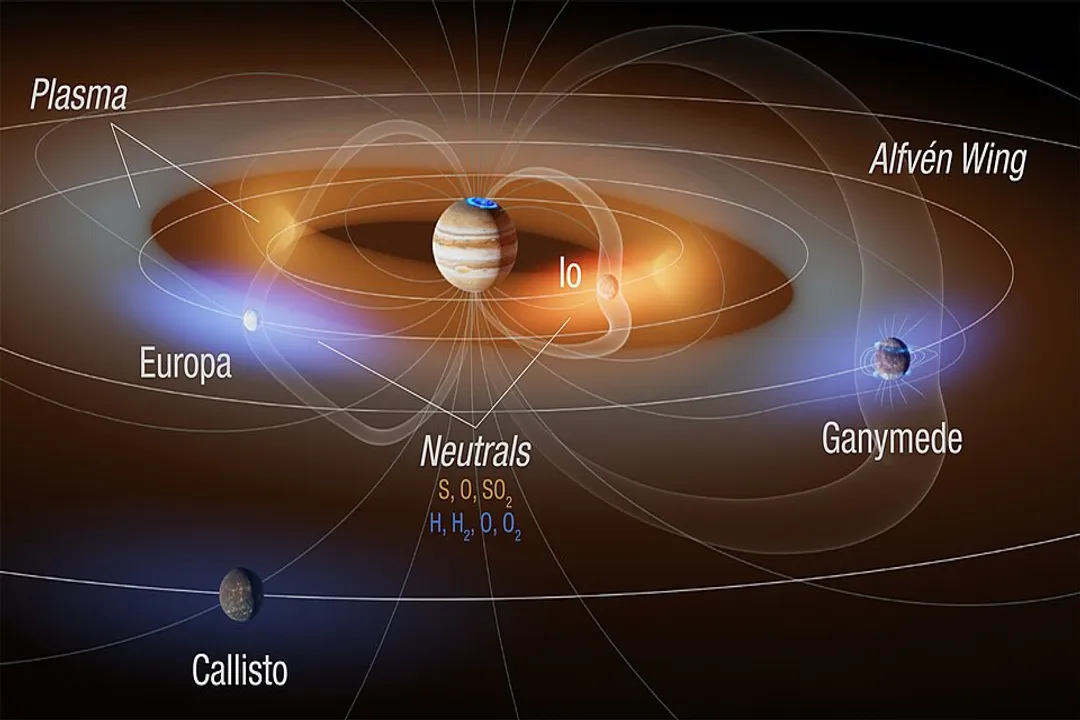
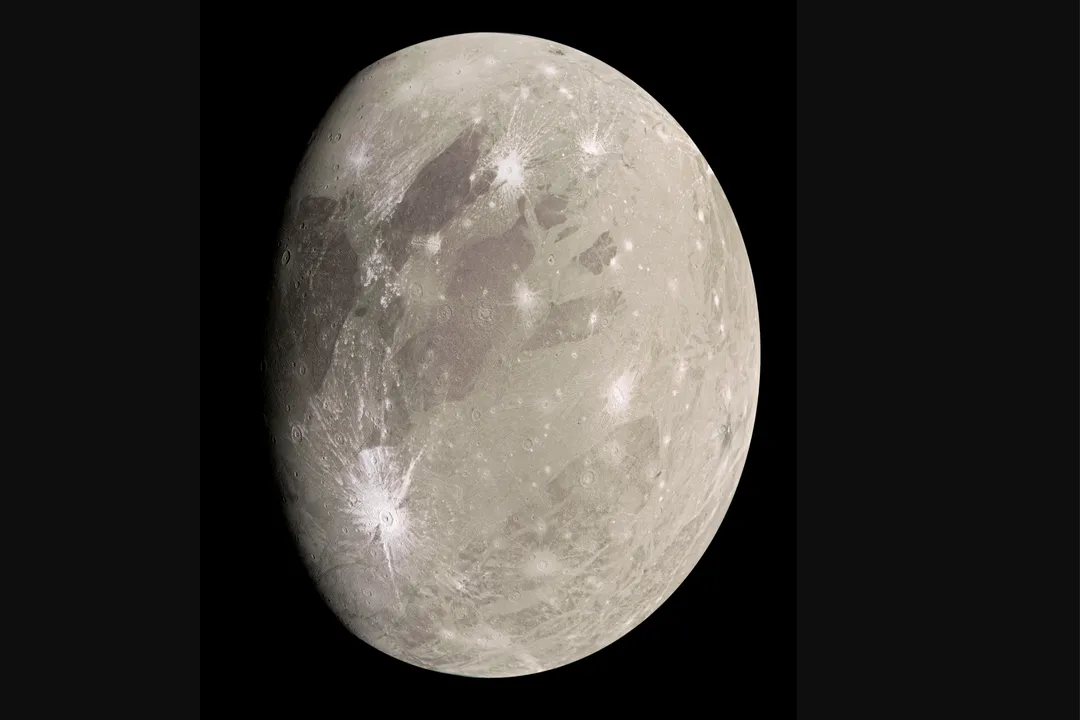
The efficiency of this process depends heavily on orbital mechanics. If a moon orbited in a perfectly circular orbit, the tidal stretching would be constant and non-dissipative, meaning no heat would be generated. Activity requires eccentricity in the orbit. Furthermore, many active moons are caught in orbital resonance with their siblings. For instance, the orbital resonance between Io, Europa, and Ganymede dictates the precise timing and magnitude of the tidal flexing Io experiences from Jupiter, driving its extreme volcanism. The gravitational tug-of-war effectively acts as an external, continuous power plant embedded within the moon's internal structure, completely decoupling its geological vitality from its small physical size.
Consider this perspective: a moon the size of a small planetoid, like Ceres in the asteroid belt, might have just enough internal heat from formation and minimal decay to perhaps have a brief period of activity before freezing solid. However, a smaller moon, like Enceladus (which is much smaller than Mars), orbiting tightly locked to a giant like Saturn, receives a constant, massive infusion of gravitational energy that keeps its core fluid and drives its famous cryovolcanic plumes erupting from the south pole region. The energy input rate from tidal forces can vastly exceed the rate of heat loss through radiation, keeping the interior active for timescales impossible for smaller, isolated bodies.
# Active Worlds
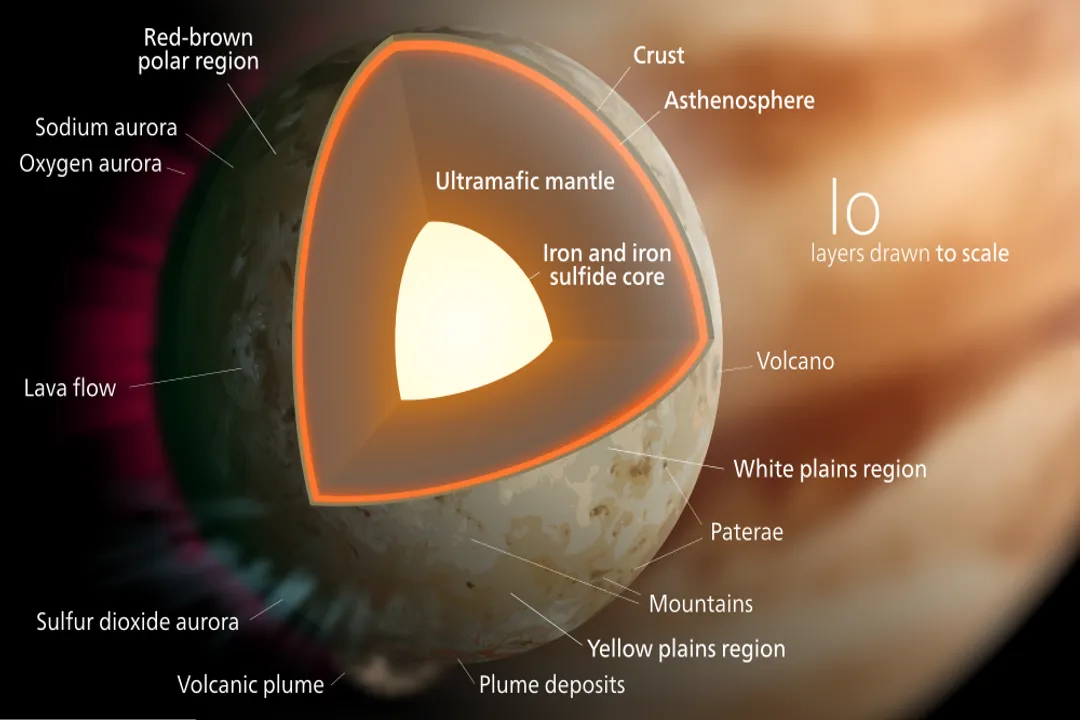
The most striking examples of this phenomenon are found in the Jovian and Saturnian systems.
# Io Volcanism
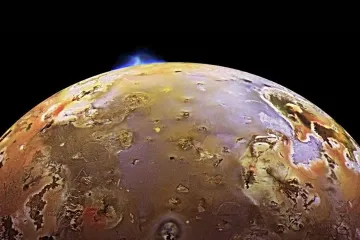
Io’s extreme activity is the textbook case for tidal heating. The intense flexing caused by Jupiter subjects Io’s interior to enormous stress, heating the mantle to temperatures high enough to generate constant silicate volcanism. This process is so vigorous that Io's surface is thought to completely renew itself every few million years. The sulfur dioxide and sulfur plumes visible from space are direct evidence of this powerful internal furnace operating despite Io’s relatively small mass.
# Enceladus Geysers
Saturn’s moon Enceladus offers a different, yet equally compelling, demonstration of tidal power—cryovolcanism. While its internal heat budget is insufficient to maintain liquid rock, the tidal kneading is enough to keep significant amounts of water liquid beneath its icy crust. This liquid water erupts through fissures near the south pole, creating massive geysers that feed Saturn's E-ring. The ongoing nature of these plumes suggests that the tidal heating mechanism has been operating consistently, maintaining a liquid reservoir over geological timescales. Observations of seismic shaking, or "icy moonquakes," further confirm that the subsurface environment is under constant mechanical stress, likely driven by these same tidal forces causing slippage along fractures.
# Dormant Neighbors
The comparative view further solidifies the importance of orbital context over simple mass. Mars, for example, is significantly larger than Io or Enceladus, yet its core has cooled enough that major tectonic activity has ceased, leaving behind only older geological scars. Mars simply lacks the massive gravitational driver required to keep its interior churning on the scale that the Jovian and Saturnian moons possess.
Within the Jovian system itself, the contrast between Io and Callisto is illuminating. Callisto orbits much farther from Jupiter than Io does and is not caught in the same tight orbital resonance driving massive energy dissipation. Consequently, Callisto is believed to be geologically inert or "dead". While it may possess some residual heat from its formation, it does not experience the continuous, powerful tidal flexing that fuels its inner neighbors.
It is instructive to see that geological activity is not a binary state (active or dead) but exists on a spectrum dictated by the rate of tidal energy deposition. Io is at one extreme, with enough heating to maintain molten rock. Enceladus is at another, with just enough heating to sustain a warm, liquid ocean layer beneath ice sheets. Callisto, too far out, receives insufficient energy to overcome heat loss, resulting in a frozen, static surface. This variation among moons of similar size but different orbital distances strongly argues that the proximity and orbital eccentricity imposed by the giant planet are the primary determinants of ongoing activity.
Related Questions
#Citations
Astronomy Ch 11 Flashcards - Quizlet
Why is Jupiter's moon Callisto geologically dead, when smaller icy ...
Icy moonquakes: Surface shaking could trigger landslides
Why is Enceladus the only geologically active moon among its ...
[PDF] Moons are `fossils" into a planet's past.
If Mars is larger than the moons of Jupiter and Saturn, why is ... - Quora
[PDF] Moons are planets too - Phys.org
Io (moon) - Wikipedia