Will the night sky eventually be bright?
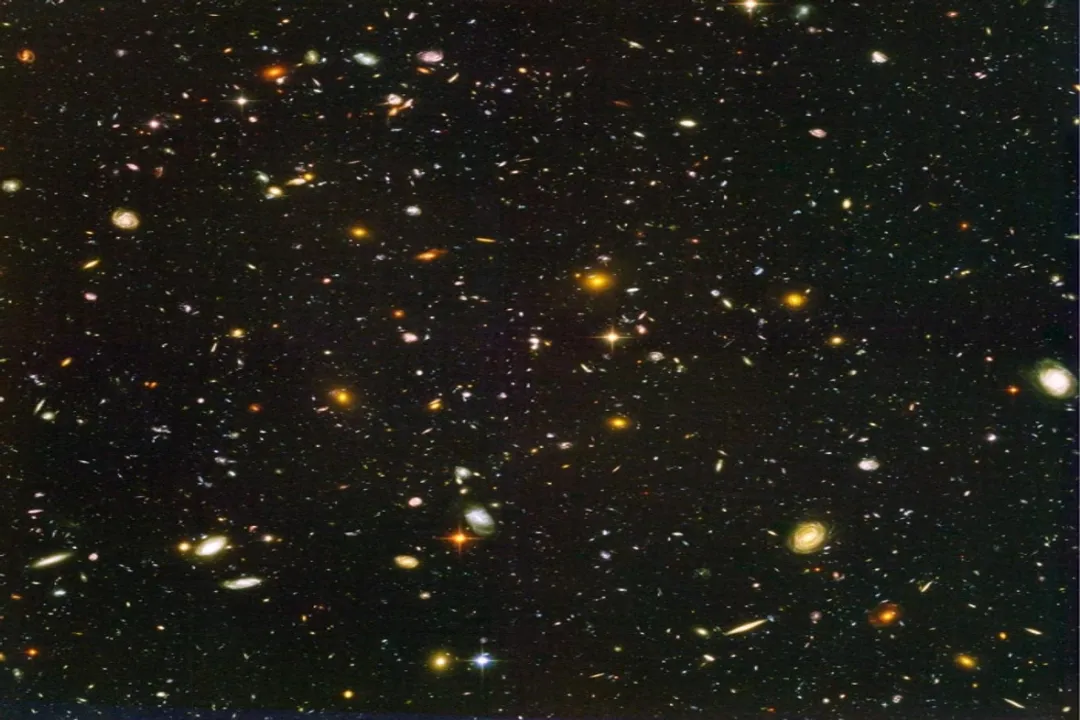
The darkness of the night sky, seemingly simple and self-evident, conceals one of the deepest puzzles in cosmology, often referred to as Olbers’ Paradox. If space were truly infinite, uniformly filled with stars that have existed forever, then every line of sight extending from Earth should eventually terminate on the surface of a distant star. Under these static, infinite conditions, the sky should appear brilliantly bright, as if it were the surface of the Sun itself. The fact that our night sky is profoundly dark presents a significant contradiction to these naive assumptions about the universe's scale and age. Early attempts to resolve this paradox suggested that interstellar dust might obscure the light from distant sources. However, this explanation fails under scrutiny; if enough dust existed to block the light from all the stars, that dust would eventually absorb so much energy that it would heat up and begin to glow just as brightly as the stars themselves, resulting in a bright sky regardless of the intervening dust. The true resolutions lie not in blocking the light, but in the fundamental properties of the universe we inhabit: its finite age and its ongoing expansion.
# Paradox Origins
The paradox is often named after the German astronomer Heinrich Wilhelm Olbers, though the fundamental question predates him. The thought experiment is elegant in its simplicity: imagine standing in an infinitely large, unchanging forest where trees are distributed evenly throughout space. No matter which direction you look, your line of sight would eventually hit a tree trunk, meaning the forest would appear as a solid, bright wall of wood. The universe, if static and eternal, is supposed to act the same way with stars replacing the trees. The puzzle persisted because the universe, as observed, did not fit the model required for the paradox to hold true. This dark sky is not an accident; it is direct evidence about the history and evolution of the cosmos.
# Cosmic Time Limit
The most significant factor preventing the night sky from being blindingly bright is the finite age of the universe. Our universe began with the Big Bang a finite time ago, estimated to be about $13.8$ billion years. Because light travels at a finite speed—approximately $299,792$ kilometers per second—there is a physical limit to how far we can see. This boundary is known as the observable universe. We can only see objects whose light has had enough time to travel across space and reach us since the universe began.
This concept establishes a "horizon" beyond which we cannot receive information, regardless of how many stars might exist out there. Any stars that are farther away than the distance light could travel in $13.8$ billion years simply haven't had their light reach us yet. Therefore, many of the supposed light sources required by the paradox simply do not exist within our visible cosmic horizon. The universe is old enough that we see billions of galaxies, but not so old that every line of sight ends on a star surface within our current epoch.
Consider this from a temporal perspective: if we were to wait an arbitrarily long time, say another trillion years, would the sky become brighter? Not necessarily, because the source of light—the stars themselves—do not last forever, and the expansion of space plays a far more dominant role over vast timescales. The darkness is a consequence of looking back in time to an era when most of the universe's current light sources had not yet formed, or when the universe itself was opaque.
# Expansion Dimming
While the finite age cuts off the view to the farthest stars, the expansion of space provides a second, equally critical explanation for the current darkness. Since the Big Bang, space itself has been stretching, causing galaxies to move away from each other. For very distant galaxies, this expansion is fast, and the light waves they emit are stretched as they travel toward us. This stretching shifts the light toward the red end of the electromagnetic spectrum—a phenomenon called cosmological redshift.
Light from the most distant objects visible to us, those near the edge of the observable universe, is severely redshifted. Visible light from these ancient sources is stretched so dramatically that it shifts out of the visible spectrum entirely, moving into the infrared, microwave, or radio regions. What would have been a brilliant burst of starlight, if the universe were static, arrives here as extremely low-energy radiation. This redshift effectively dims the contributions from the farthest sources, ensuring that the net brightness we observe remains low.
It is fascinating to compare the two major solutions. The finite age solution dictates where we can look (the horizon), while the expansion solution dictates how bright the things we do see look. If the universe were static but still had a finite age, the sky would still be dark near the edges of visibility, but it would be brighter than it currently is because the light received wouldn't be redshifted. Conversely, if the universe were infinitely old but expanding, the expansion would still redshift distant light, causing the sky to appear dim, though perhaps not perfectly black due to the changing light sources over time. The actual universe benefits from both effects working together to keep the night sky dark.
# Future Visibility
Addressing the core question: Will the night sky eventually be brighter? The scientific consensus suggests the answer is largely no, and in the very long term, it will become progressively darker. While new stars are forming and emitting light every moment, this new light is being added to a background that is simultaneously expanding away from us at an accelerating rate.
The current brightness we observe is a balance: we are receiving light from objects whose history is contained within the last $13.8$ billion years. Over many more billions of years, the rate at which new light arrives will not overcome the fact that the most distant, already visible galaxies will continue to redshift their light away from our visible detection threshold. Furthermore, the expansion of space is accelerating, driven by dark energy. This acceleration means that galaxies beyond a certain distance are receding from us faster than the speed of light, and any light they emit now will never reach us.
One way to conceptualize this is to think about the light budget. For the sky to get brighter, we would need an ever-increasing influx of new, visible photons that overcome the dimming and scattering effects. But the increasing recession velocity of galaxies ensures that the accessible volume of the universe that can actually contribute visible light to our future observations shrinks over cosmological time, leading toward an eventual state often called the "Big Freeze" or "heat death," where the visible sky fades as stellar fuel runs out and remaining light is redshifted beyond detection.
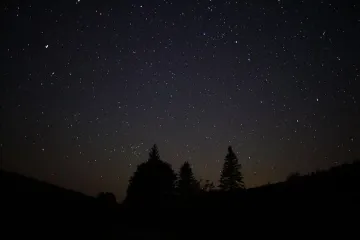
Here is a point for local consideration: while the cosmological view suggests eventual darkness, the nearest threats to a dark sky are entirely terrestrial. In a city like London or Los Angeles, the sky is already effectively brightened to the point of obscuring most stars due to artificial lighting. The contrast between the scientifically proven cosmic darkness and the self-inflicted local brightness is stark; the light pollution issue solves the paradox for the observer on a local scale by overwhelming the faint, distant signals, even though the cosmological reasons for darkness remain sound. This local contrast is often more immediately relevant to amateur astronomers than the fate of the universe's background radiation.
# Farthest Glow
Even though we cannot see the light from stars that existed before the $380,000$-year mark after the Big Bang because the universe was an opaque plasma fog, we can see the relic of that early epoch. This relic is the Cosmic Microwave Background (CMB). The light emitted when the universe cooled enough for atoms to form (recombination) has been traveling ever since. Due to the universe's expansion over the last $13.8$ billion years, this incredibly hot, visible light has been redshifted down to a temperature of only about $2.7$ Kelvin, placing it firmly in the microwave portion of the spectrum.
The CMB is the ultimate limit of the darkness problem. If the universe had no stars, just this background radiation, the night sky would still not be completely black; it would have a faint, uniform glow, perceptible only with microwave detectors. The fact that the visible sky is dark means the starlight from stars that do exist within the observable horizon is significantly dimmer than the CMB after redshift, which is a telling observation about the universe's composition and history.
# Hypothetical Brightness
To further appreciate why our current sky is dark, consider a thought experiment where the expansion stopped immediately after the Big Bang, and the universe was infinitely old but filled with stars. In this impossible scenario, the sky would be as bright as the Sun. Now, let's consider the actual universe if we only accounted for the finite age but ignored expansion. If light from the most distant visible galaxy traveled to us without being stretched, that galaxy would appear significantly brighter than it does now, perhaps visible to the naked eye even through modern telescopes, depending on its intrinsic luminosity and distance.
This leads to an original way of thinking about the resolution: the darkness is an artifact of cosmic velocity. If we could somehow magically halt the expansion of space today, the sky would, over the next few billion years, gradually brighten as the light from the most distant, formerly receding galaxies finally "catches up" in spectral terms, shifting back into the visible range until it hit the horizon defined by the age of the universe. However, since the expansion is not stopping, the light budget is fixed by what has already arrived and what is redshifted away, ensuring a steady, dark equilibrium dictated by the Hubble constant. The sky is not getting brighter because the geometry of spacetime is actively pushing the visible light budget further away from us in the spectrum faster than the supply of new, young stars can replenish it with visible light.
# Lasting Implications
The darkness of the night sky is more than just a scenic feature; it is one of the strongest pieces of evidence supporting the Big Bang model over a static, eternal universe model. The paradox is resolved by recognizing that space and time are dynamic, not infinite and static containers. We live in an evolving cosmos where looking into the deepest reaches of space is equivalent to looking back into the universe's past, a past that was hotter, denser, and fundamentally different from today.
The ultimate fate of the night sky is a slow fade toward blackness, punctuated only by the eventual consumption of stellar fuel and the accelerating isolation of gravitationally bound structures as the vast voids between them expand beyond any future possibility of communication. Therefore, the current view, a sprinkling of moderately bright stars against a deep, dark backdrop, represents a temporary, middle-aged phase of cosmic history, a sweet spot where enough stars have formed to make the heavens beautiful, but the universe hasn't expanded so far as to render them entirely invisible. The darkness is a testament to the beginning, and its persistence is a testament to the continuing expansion.
Related Questions
#Citations
Will the night sky eventually be bright? - Physics Stack Exchange
Is the night sky going to become progressively brighter as time goes ...
Olbers' paradox - Wikipedia
If space is infinite, why isn't the night sky blindingly bright ... - Facebook
Why isn't the night sky blindingly bright? Olbers' Paradox explains ...
Astronomical Answers! – The bright night sky paradox…
Will the night sky get brighter as more light reaches us? - Quora
Why Is the Sky Dark Even Though the Universe Is Full of Stars?
Olbers' Paradox | ASTRO 801: Planets, Stars, Galaxies, and the ...
The Real Reason the Night Sky is Dark - NASA ADS