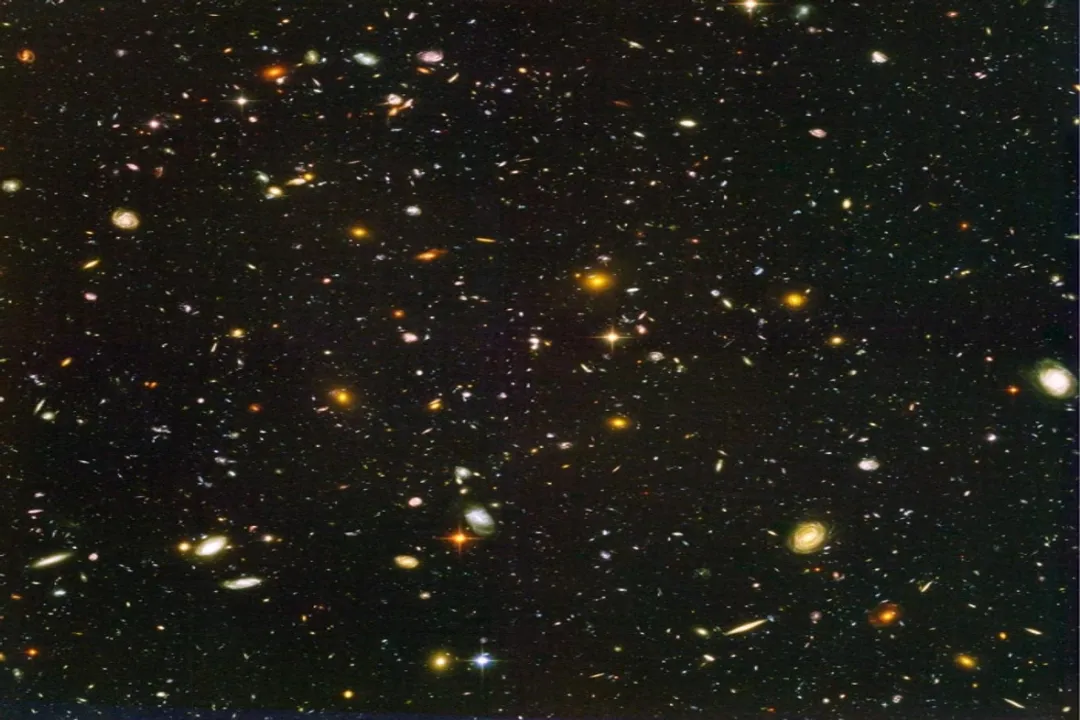
What defines the 'horizon' preventing us from seeing infinitely far due to the universe's finite age?
The observable universe, limited by how far light could travel since the Big Bang (13.8 billion years)
The finite age of the universe, stemming from the Big Bang approximately 13.8 billion years ago, establishes a hard physical limit on visibility because light propagates at a finite speed (approximately 299,792 kilometers per second). This time constraint creates a boundary known as the observable universe. We can only detect light originating from sources whose light has had sufficient time, since the universe began, to traverse the intervening space and reach our detectors. Any hypothetical star situated beyond this specific distance simply has not had its emitted photons travel long enough to reach Earth within the current epoch, thereby creating a cosmic horizon beyond which no information can be received.