Why does Polaris appear stationary in the sky?
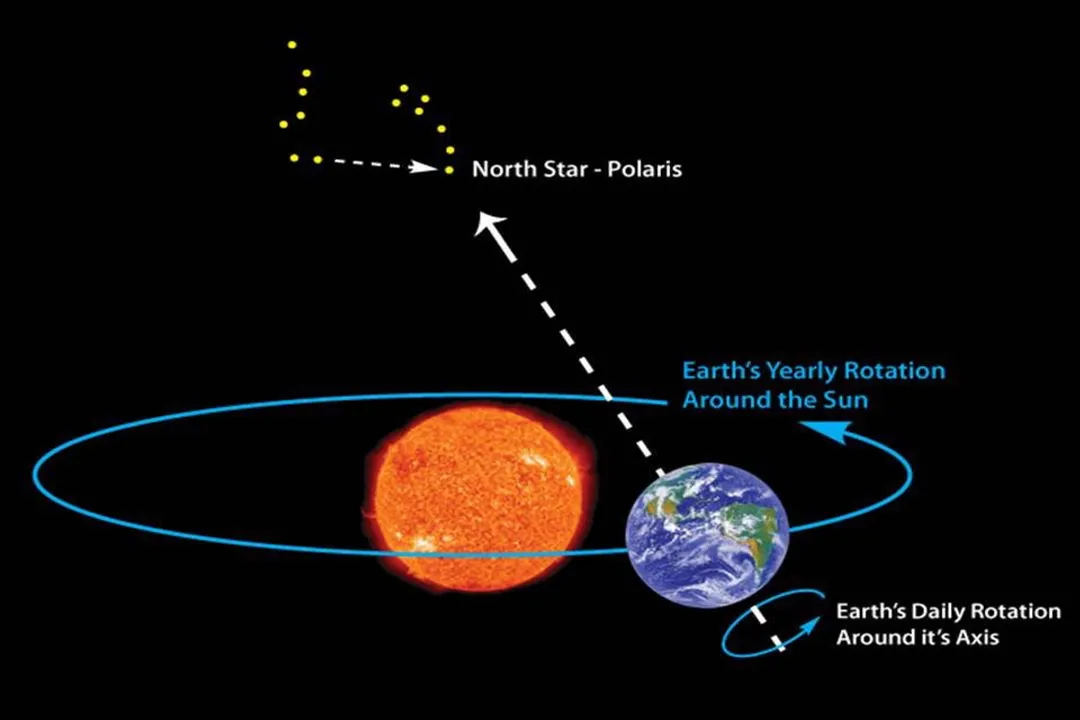
The night sky seems like a vast, churning ocean of light, with stars rising, setting, and tracing arcs across the dome above us. Yet, there is one star that reliably holds its position, acting as a fixed anchor point in the Northern celestial sphere. This steadfast beacon is Polaris, commonly known as the North Star, and its apparent stillness against the backdrop of cosmic motion is not a trick of the eye but a direct consequence of our planet's own orientation in space.
# Earth Axis
To understand why Polaris doesn't seem to move, we first need to visualize the Earth itself. Our planet is constantly spinning on an imaginary line called its axis, completing one full rotation roughly every $24$ hours. This rotation is what causes the sun to rise and set, giving us day and night. From our perspective on the surface, it is the Earth that moves, making the entire celestial sphere appear to rotate in the opposite direction. If you stand outside on a clear night and watch the stars, you will see them moving in smooth paths, circling around a specific, unseen point in the sky.
# Celestial Pole
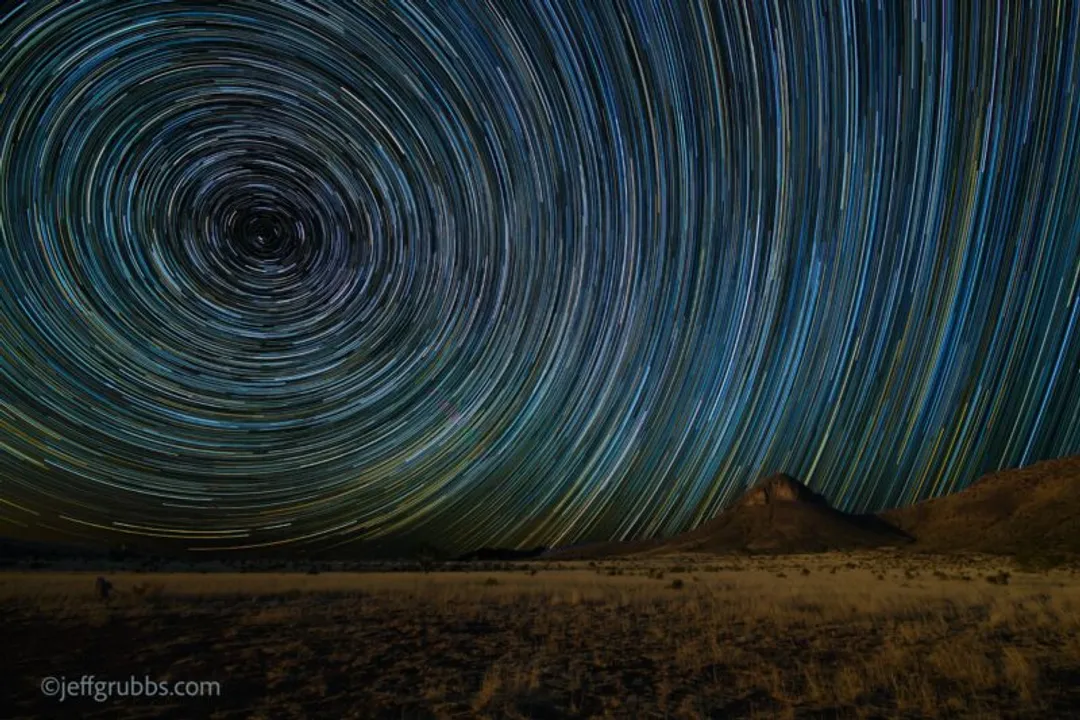
This central, seemingly fixed point around which the entire night sky appears to pivot is known as the north celestial pole. Imagine extending the Earth's axis of rotation straight out into space, far past the North Pole. That projection hits the celestial sphere at this exact point. Every star in the Northern Hemisphere appears to move in a circle around this pole over the course of the night. The closer a star is to this pole, the smaller its nightly circle of travel will be.
# Polaris Alignment
Polaris earns its title because it happens to lie almost directly on top of this north celestial pole. Because it is positioned so precisely along the projection of the Earth's spin axis, its path across the sky is negligibly small for casual observation. While every other visible star seems to be in constant motion, Polaris remains in almost the same spot from dusk till dawn, year after year. This consistency is why it has been essential for navigation for centuries—if you find Polaris, you have found geographic North.
# Apparent Motion
The difference in movement between Polaris and other stars highlights the mechanics at play. Stars farther away from the celestial pole trace large arcs; stars near the celestial equator would appear to rise due east and set due west, traveling in great circles across the sky. Polaris, positioned at the pole's location, remains stationary. This is a purely geometric effect resulting from the observer's position on a rotating sphere relative to a distant fixed point.
# Southern View
The situation is markedly different if you travel south of the equator. Observers in the Southern Hemisphere do not have a bright navigational aid near their celestial pole. The south celestial pole is an area in the sky that appears empty of prominent stars. From the Southern Hemisphere, observers see the stars circle around this blank point, which is antipodal to the northern pole. The stars there rotate clockwise, as opposed to the counter-clockwise rotation seen in the North.
# Polaris Drift
While we perceive Polaris as perfectly stationary, it is important to note that it is not exactly at the pole, though it is remarkably close. Currently, Polaris is offset by only about $0.7$ degrees from the true north celestial pole. This slight misalignment means that over the course of a full night, Polaris does trace a minuscule circle in the sky.
To put this into perspective, consider the angular size of the full moon, which is roughly half a degree across. Polaris's entire $24$-hour circuit is wider than the Moon's diameter, but only just barely. Over the course of a single hour, its movement amounts to approximately $0.03$ degrees. This shift is so small that it requires precision equipment or dedicated long-exposure photography to detect easily; to the naked eye, it appears fixed against the rotating stellar field.

# Long Term
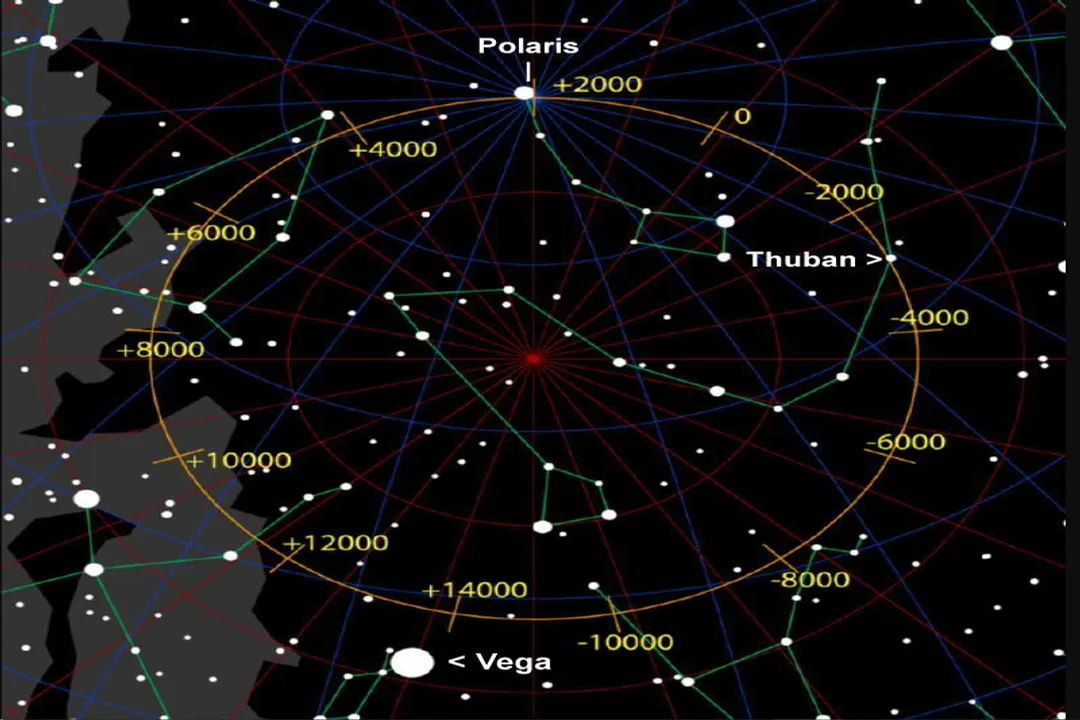
The steadfastness of Polaris is not eternal, though the changes are measured across millennia. The Earth’s axis is not perfectly rigid; it undergoes a slow wobble known as precession. This wobble causes the point in space that the axis points toward to slowly change its position over a cycle lasting about $26,000$ years. Twelve thousand years ago, the star Vega occupied the position near the north celestial pole, and it will regain that distinction again in about $13,000$ years. Polaris is merely the current star that has the good fortune of being near the pole during our current epoch.
# Practical Verification
For those interested in confirming this phenomenon without relying on astronomical charts, a simple, though time-consuming, observation can be set up. Find Polaris using a star chart or a constellation guide like the Big Dipper. Then, choose a very distant, fixed reference point on the horizon—perhaps a distant mountain peak or the top of a tall building that won't shift. Using a camera capable of long exposures (say, $3$ to $4$ hours), take a shot pointed directly at Polaris. When you review the image, you will see the trails of all the other stars curved around Polaris, but Polaris's trail will appear as a very short, tight arc or even just a slightly thickened point, visibly demonstrating its relative lack of movement compared to the background.
#Videos
Why is the North Star Always in the Same Place? - YouTube
Why Do Stars Draw Circles Around Polaris? - YouTube
Related Questions
#Citations
ELI5: Why does the north star appear stationary? - Reddit
Why The Polaris Star Seems To Be Stationary In The Sky ... - Medium
Why does Polaris appear to stay stationary while all other stars ...
Why is the North Star Always in the Same Place? - YouTube
Does the North Star ever move in the sky? - EarthSky
Why stars appear stationary despite solar system movement
Why does Polaris appear stationary on a rotating Earth? - Metabunk