Is Polaris a fixed point?

The North Star, Polaris, has long held a revered, almost mystical position in the night sky, often described by sailors, explorers, and backyard stargazers as the one celestial body that never moves. This perception of immobility is deeply ingrained in human understanding of the heavens, serving as a reliable beacon for navigation across centuries. [2][8] To understand why Polaris holds this reputation, one must first grasp the grand, overarching motion of the entire celestial sphere that surrounds us. All stars in the Northern Hemisphere appear to sweep in slow circles around a singular, stationary point in the sky—a phenomenon entirely dependent on the way our own planet behaves. [1][7]
# Earth's Rotation
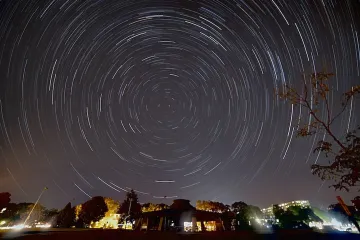
The illusion of a moving sky full of stars is a direct consequence of the Earth spinning on its axis once every 24 hours. [1] As our planet completes this daily rotation, the stars appear to drift eastward across the sky, rising in the east and setting in the west, much like the Sun and Moon. [1] However, one point in the sky remains conspicuously absent from this circular motion: the North Celestial Pole (NCP). [7][9] This point is located directly above the Earth’s geographic North Pole. [7] Any star that happens to be positioned very close to this NCP will appear nearly motionless to an observer on the ground, while all other stars trace visible arcs. [1][9]
# Celestial Pole Defined
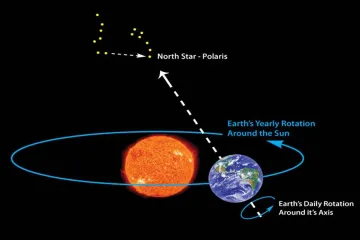
The North Celestial Pole is not a physical object; rather, it is an imaginary point in the sky that marks the projection of the Earth’s rotational axis into space. [7][9] If you could stand at the North Pole, this NCP would be directly overhead, at your zenith. [7] For observers further south, this point sinks lower toward the northern horizon. [7] The apparent lack of movement of any star near the NCP is what grants it its usefulness for navigation and timekeeping. [3] Because the stars appear to rotate around this fixed axis point, Polaris’s apparent stability is not due to its own inherent nature, but rather due to our perspective from a rotating sphere. [7]
# Polaris's Proximity

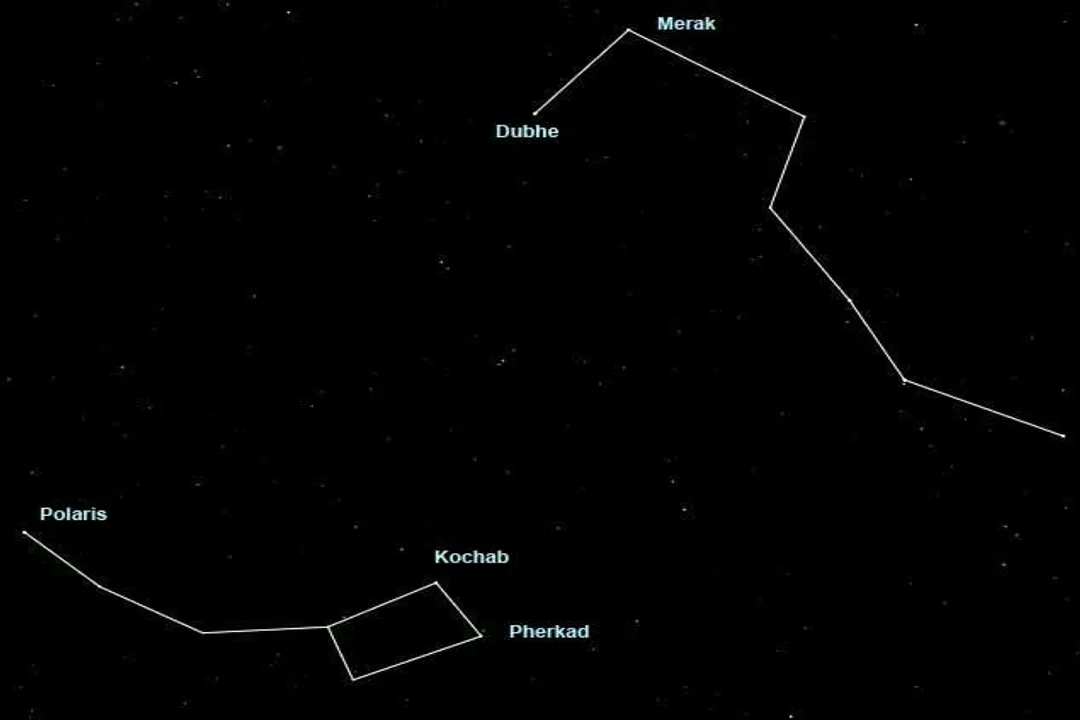
The star we currently call the North Star, Polaris, is not exactly at the North Celestial Pole, but it is currently the star closest to it. [1][2][7] This closeness is the key to its fame. It lies only about 0.7 degrees away from the true NCP. [1] To put this into perspective, the apparent diameter of the full Moon in the sky is about half a degree. [1] This means Polaris is only slightly more than one Moon-width away from the exact point that anchors the celestial sphere’s rotation. [1] This extremely small angular separation is why, even over the course of an entire night, Polaris appears to hover almost perfectly still in the northern sky, while every other bright star wheels around it. [4][9]
# Slight Movement

While Polaris is famous for being fixed, it is essential to understand that it does not sit precisely on the NCP. [9] It exhibits a very small, almost imperceptible circle of motion around the NCP over a 24-hour period, mirroring the Earth's rotation. [4] If one could track Polaris over a full night with extremely precise equipment, this tiny circle would become visible, but to the naked eye, this movement is completely negligible. [4]
Consider the apparent angular shift this represents. If we look at the position of Polaris in relation to the NCP today, its small diurnal path traces a circle with an angular radius of about . [1] Over the course of a single night, the entire circle is traced. If we consider a period of, say, fifty years, Polaris will have drifted slightly further away from the true pole due to the slow, long-term shift in the Earth's axis, though this gradual drift is entirely separate from the nightly rotation. [5] For practical navigation, this minute daily wobble is easily ignored, which is why it is effectively fixed for everyday use. [4]
# The Shifting North
The concept of a permanent, fixed North Star is actually a temporary arrangement on astronomical timescales. [5] The Earth does not spin perfectly upright relative to the plane of its orbit around the Sun; it has an axial tilt of about 23.5 degrees. [7] This tilt causes the seasons, but it also means the North Celestial Pole slowly wanders across the sky over an extremely long period, a phenomenon known as the precession of the equinoxes. [5]
This slow wobble means that the star closest to the NCP changes over thousands of years. [5] Polaris is merely the current occupant of the position, having become the North Star around the year . [5] Because of precession, it will continue to be the North Star for a few more centuries before it gradually moves away from the pole, and another star will take its place. [5]
The star that held the title of North Star roughly 4,800 years ago, during the time the Great Pyramids were being constructed, was Thuban (Alpha Draconis). [5] Thuban was much closer to the NCP then than Polaris is now, perhaps only away from it, making it an even better, though still not perfect, alignment. [5] Looking far into the future, in about , the star Alderamin (Alpha Cephei) will be the closest bright star to the NCP. [5]
Here is a summary of the changing nature of the North Star designation:
| Epoch | Approximate North Star | Proximity to NCP (Approximate) |
|---|---|---|
| Ancient Egypt (Pyramids) | Thuban ( Dra) | Very close (better than current Polaris) [5] |
| Current Era () | Polaris ( UMi) | away [1][5] |
| Future () | Alderamin ( Cep) | Closest bright star |
This long-term cosmic shift underscores that the "fixed point" is only fixed on a human lifespan scale; cosmically, it is in constant, albeit glacial, motion. [5]
# Ancestral Observation
How did our ancestors, lacking modern astronomical instruments, recognize Polaris as this fixed point? They did so by observing the night sky over multiple hours. [3] While the movements of the Sun, Moon, and planets (the wanderers) were obvious, the background stars appeared to rotate as a coherent unit. [3] By watching the stars near the northern horizon over the course of a single night, observers could discern the single point around which all others swung. [3] Early navigational techniques often involved simply identifying this central, unmoving star, even if their understanding of why it was fixed was rooted in mythology or different cosmological models than our current scientific understanding. [3] The fact that this star remained in the same relative position night after night, season after season, gave it unparalleled authority for determining direction. [3]
# Practical Application Versus True North
For anyone trying to find true geographic North, Polaris is the standard reference. [2] However, because it is slightly offset from the true NCP, a direction determined by pointing directly at Polaris will point slightly west of true North right now, and the error changes slightly over the centuries. [4]
If we consider the current approximate offset of , one can calculate the small linear distance that this represents on the ground at various latitudes. For someone standing at North latitude, the angular difference of translates to an offset from true North of about $0.7$ arcminutes per degree of latitude, resulting in a small angular difference. More simply, a error translates to a deviation of about 0.73 nautical miles (or about $1.35$ kilometers) for every $60$ nautical miles traveled north when relying solely on Polaris as the true North indicator. [1] This distance is small enough that for most practical applications, such as basic orienteering or camping, the difference is negligible and Polaris serves its purpose well. [2] However, for modern geodesy, high-precision surveying, or satellite alignment, this small, consistent error must be mathematically accounted for, requiring the use of precise astronomical tables or GPS data to pinpoint the true pole. [9]
The authority of Polaris stems not from perfect alignment, but from consistent misalignment relative to the rotating background. [9] We can use its position relative to the horizon to determine latitude—a star that is degrees above the northern horizon must be at an altitude of degrees above the celestial pole, which, for an observer in the Northern Hemisphere, approximates their latitude. [7][2] This relationship is far more valuable than the star's exact position relative to the pole itself, solidifying its standing as the navigational anchor. [7]
Related Questions
#Citations
Does the North Star ever move in the sky? - EarthSky
What is the North Star and How Do You Find It? - NASA Science
How did our ancestors know about the existence of Polaris ... - Quora
How can it be that the polar star is always direction north on Earth?
Polaris: A Brief History of the Current North Star | Answers in Genesis
Understanding Polaris and its Role in Navigation and Astronomy
What keeps the North Star stuck at exactly North?
Polaris: How to find the North Star | Space
If Earth is tilted, why is Polaris always above the same spot?