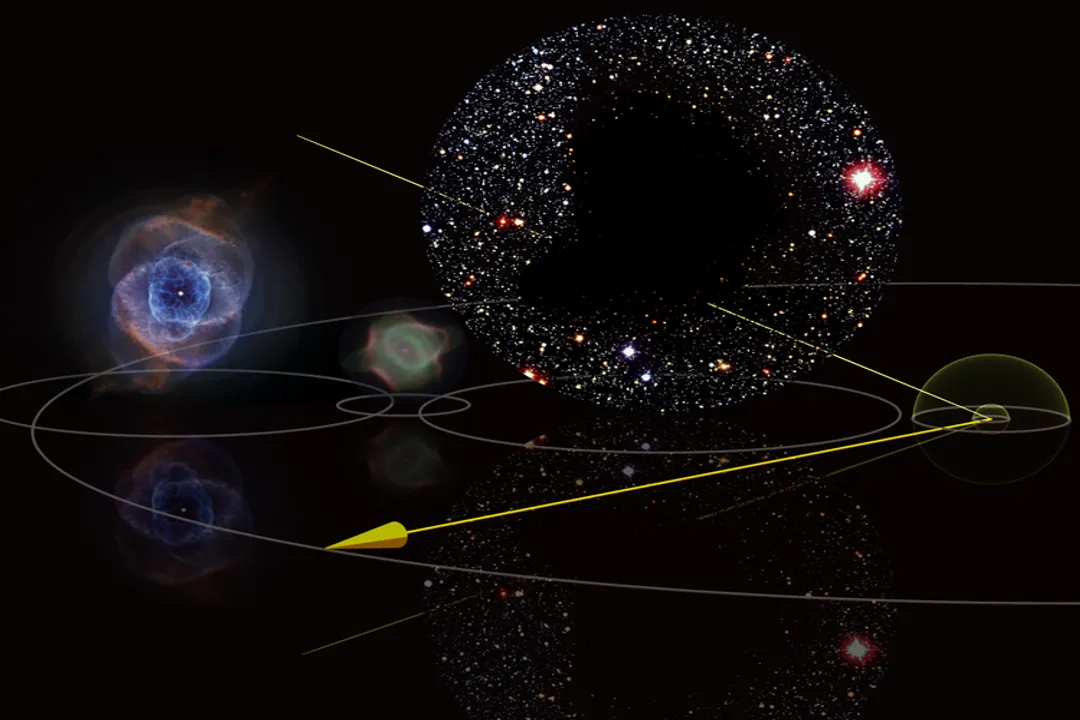
When measuring Proxima Centauri, why switch from AU to light-years?
The resulting number in AU (around 268,000) becomes too large and impractical to manage.
Scientific measurement involves a fundamental principle of choosing the unit that yields a manageable number, typically falling within a practical range like 0.1 to 100. While the AU is excellent for measuring distances within the solar system, it becomes excessively large when applied to interstellar space. For example, the nearest star, Proxima Centauri, is approximately 4.24 light-years away, which translates into roughly 268,000 AU. Expressing this distance in AU is cumbersome and violates the principle of usability, akin to measuring continental distances in millimeters. Therefore, astronomers seamlessly transition to larger units like light-years or parsecs, which convert the massive AU figure into a concise, manageable number.