Why don't we use kilometers in space?
The choice of measurement units in astronomy often strikes newcomers as unnecessarily complicated, leading many to wonder why common, easily understood units like the kilometer—which we use routinely on Earth—fall out of favor when discussing the vast emptiness between worlds. While kilometers absolutely appear in astronomical contexts, particularly when tracking objects relatively close to Earth or discussing spacecraft maneuvers, they quickly become impractical for anything beyond our immediate neighborhood. [1] The fundamental reason we gravitate away from kilometers for interstellar and even interplanetary travel distances boils down to one inescapable factor: the sheer, mind-boggling scale of space itself. [4]
# Terrestrial Preference
For many people globally, the kilometer is the default unit of distance, given its place within the metric system, which is dominant in science and most nations worldwide. [2] Even in contexts where science fiction settings are established, developers sometimes choose to stick with kilometers for their space measurements, perhaps as a nod to the scientific community or to anchor the fictional scale within a familiar metric structure, even if the distances dwarf terrestrial reality. [3] However, the very nature of space measurement forces a shift away from terrestrial anchors, even the metric ones. [4]
# The Scale Problem
When we talk about moving between planets, or even between stars, expressing those distances in kilometers results in numbers that are unwieldy, prone to transcription errors, and utterly divorced from human intuition. [6] Consider the scale: the distance from the Earth to the Moon is roughly $384,400$ kilometers. That’s already a huge number, but it’s the start of the problem. When we consider the distance to Mars, or especially to Jupiter or beyond, the kilometer count quickly balloons into the tens or hundreds of millions, or even billions. [4] For instance, the distance to the sun—a number crucial for calculations—would be expressed as approximately $150,000,000$ kilometers. Trying to discuss the trajectory of a probe to Saturn or a mission to the outer solar system using these figures becomes an exercise in managing gigantic strings of zeros, making simple comparisons incredibly difficult. [4]
Scientists inherently prefer units that make their data cleaner and more accessible for immediate comparison. If one object is $400,000,000$ km away and another is $750,000,000$ km away, grasping the difference is harder than if one were $2.7$ Astronomical Units (AU) away and the other $5.0$ AU away. [4] This is where specialized units step in to provide necessary contextual anchors. [6]

# Introducing Contextual Units
To manage these immense stretches of space more naturally, astronomy relies on derived units that are scaled specifically to the solar system and the galaxy. [8] The metric system itself is perfectly precise, but its base unit—the meter, and its multiple, the kilometer—is simply too small for cosmic distances. [4]
# Solar System Anchor
The most common intermediate unit for measuring distances within our solar system is the Astronomical Unit (AU). [7][8] An AU is defined by the average distance between the Earth and the Sun. [2][7] It is fixed at approximately $149.6$ million kilometers, or about $93$ million miles. [2][7] Using the AU simplifies calculations significantly. Instead of saying Jupiter is $778,000,000$ kilometers from the Sun, we simply state it is about $5.2$ AU away. [7] This immediately places Jupiter in context relative to Earth's own orbit, offering an intuitive sense of scale that a string of nine kilometers digits simply cannot convey. [6] The fact that some of these fundamental units are based on Earth-derived distances, like miles or yards in their historical definition, sometimes causes public confusion when comparing them against the internationally recognized metric standard of the kilometer. [2] However, for scientific work, the AU is the preferred, standardized scale for the solar neighborhood. [4]
# Interstellar Jumps
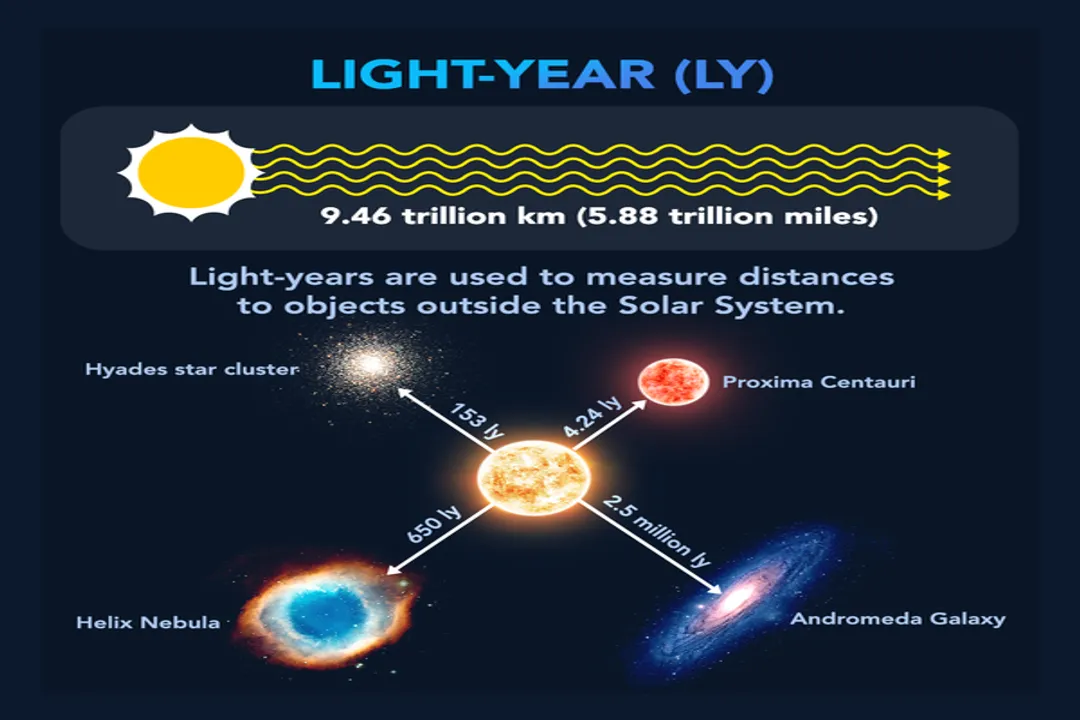
When moving beyond the solar system to talk about the nearest stars, even the AU becomes too small. Proxima Centauri, the closest star to our Sun, is about $4.24$ light-years away. Converting this to AU yields a number in the hundreds of thousands ($268,000$ AU), which, while better than using kilometers, is still quite large. [8] This is where the light-year enters the picture. A light-year is the distance light travels in one Earth year, an enormous span equivalent to about $9.46$ trillion kilometers. [8] Saying Proxima Centauri is $4.24$ light-years away is far more manageable than stating its distance in kilometers, which would require nearly a full line of text to write out completely.
For professional astronomers dealing with the vastness between galaxies or even just large sections of our own Milky Way, an even larger unit, the parsec, is often employed. [8] A parsec is defined based on parallax measurements and equates to about $3.26$ light-years, or roughly $30.9$ trillion kilometers. [8] The preference for these specialized, large-scale units over the humble kilometer reflects a necessity born of distance, not a rejection of the metric system itself. [4]
| Unit | Primary Use Case | Approximate Value (km) | Human Context |
|---|---|---|---|
| Kilometer (km) | Near-Earth space, orbital mechanics | $1$ | Terrestrial travel |
| Astronomical Unit (AU) | Within the Solar System | million | Earth-Sun distance |
| Light-Year (ly) | Interstellar space | trillion | Light travel time |
This hierarchy shows that it’s not that kilometers are forbidden; it’s that they are only useful for the shortest steps in the cosmic ladder. [1]
# The Communication Trade-Off
The move away from kilometers is an exercise in efficiency, but it introduces a communication trade-off. While an astronomer instantly grasps the scale implied by a value in light-years, the general public, especially those more familiar with metric units for ground travel, might struggle to internalize the sheer distance represented by a light-year versus a kilometer. [6] This leads to public confusion, where organizations reporting space news sometimes default back to kilometers because they are perceived as more universally understood, even if the resulting figures obscure the true scale of the measurement. [9]
An interesting analytical point here is how human cognition handles these scales. When we use kilometers, we are anchoring the distance to a familiar, tactile reality—a car ride or a flight. When we switch to the AU, we anchor it to our solar system's home base—Earth's orbit. The light-year, however, anchors us to the speed of light, shifting the cognitive framework from distance to time. It becomes a measure of how long it takes information or energy to traverse that gap, which is arguably more relevant when studying light from distant objects than a purely linear distance in kilometers. [4]
This means the utility of the unit changes depending on what you are trying to convey. For trajectory planning of a new Mars rover, kilometers (or meters per second for velocity) are essential because the forces and timescales are relatively short. [1] For mapping the location of a star cluster, light-years or parsecs are essential because the physical baseline of Earth becomes meaningless.
# Reconsidering Kilometer Utility
Despite the dominance of AU and light-years, kilometers maintain a strong foothold in areas requiring extreme precision over shorter spans. For instance, tracking satellites, measuring the distance to the International Space Station (ISS), or calculating the orbital paths of asteroids that might pose a near-term threat, kilometers provide the necessary granularity and consistency with on-orbit telemetry data systems, which are often designed around SI base units. [1] Furthermore, when a mission involves entering another body's sphere of influence, the local distances are often calculated in kilometers before being converted back to AU for larger system context. [4]
If we were forced to calculate the Earth-Mars distance every time using only light-seconds or light-minutes—units based on the speed of light—the numbers would be small (around $3$ to $22$ light-minutes depending on their alignment), but the conversion factor back to a familiar unit like kilometers would be unnecessarily frequent for mission planning that involves gravitational modeling based on known masses expressed in SI units. [4] Thus, the choice is not about avoiding kilometers, but about scaling appropriately for the phenomenon being described. [6] We use kilometers when precision on a human-relevant scale is needed, and we switch to AU or light-years when the human scale of measurement collapses under the weight of the universe’s enormity. [4][8]
#Videos
We Can't Measure* Distance In Outer Space! - YouTube
Related Questions
#Citations
Why do most Measurements in Space use km?
Why do we use kilometers instead of miles on Earth when ... - Quora
Why does CIG insist on using KM for space navigation? : r/starcitizen
We Can't Measure* Distance In Outer Space! - YouTube
How do astronomers measure distance in space? It wouldn't be ...
What is the Astronomical Unit? | Science Guys - Union University
Astronomy 101: Astronomical distances