What is an object of ice and dust?
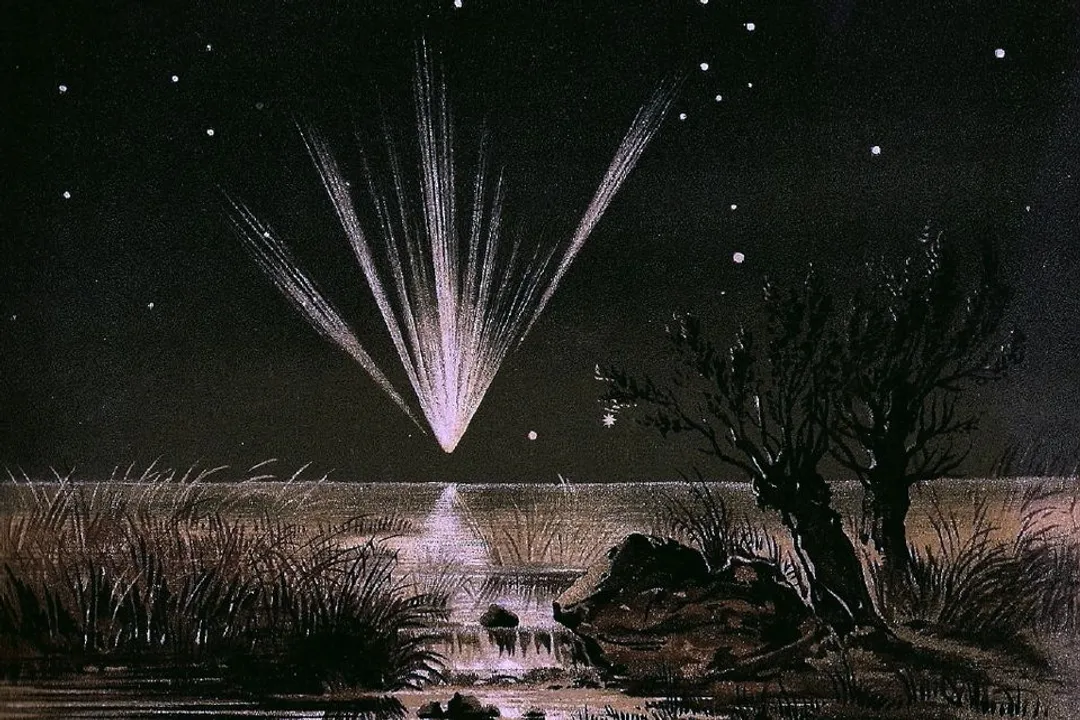
Objects in space composed primarily of ice mixed with dust and rock are formally known as comets. [1][2][6] These small solar system bodies are often vividly described as "dirty snowballs". [2][6] Unlike asteroids, which generally orbit closer to the Sun and are composed mainly of rock and metal, comets retain significant amounts of volatile ices—frozen water, carbon dioxide, methane, and ammonia—mixed with rocky grains and dust particles. [1][2][4] This composition is crucial because it dictates how they behave when they approach the Sun, transforming them from dark, relatively inert bodies into the spectacular objects seen from Earth. [2]
The defining characteristic that separates a comet from a simple frozen rock is its tendency to become active as its orbit brings it nearer to the Sun. [6] As the solar radiation heats the icy material, these frozen volatiles skip the liquid phase entirely and turn directly into gas—a process called sublimation. [1][6] This escaping gas carries dust particles with it, creating a vast, temporary atmosphere around the comet’s solid center, which is known as the nucleus. [1][2]
# Cosmic Snowballs
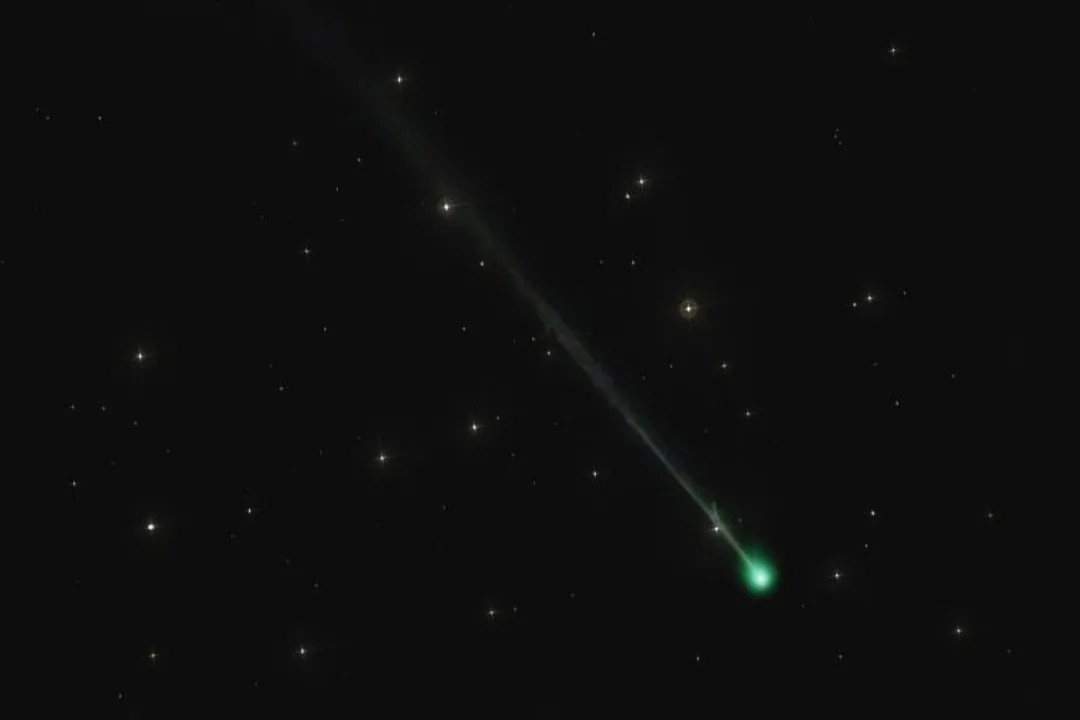
The nucleus of a comet is the true heart of the object, the remnant of the material that formed the outer planets billions of years ago. [1][2] These kernels are relatively small, typically only a few kilometers to a few tens of kilometers across. [1] Because they originate in the cold outer reaches of the solar system, their ices remain preserved over astronomical timescales. [5] When a comet is far from the Sun, it is simply a dark, small chunk of ice and dust moving silently through the void, often mistaken for a minor asteroid or simply going undetected. [6]
It is the activity that grants comets their fame, but this activity is inherently temporary. While an asteroid’s appearance remains static regardless of its orbital position (barring a collision), a comet’s visibility is entirely dependent on its proximity to solar heating. [2] This fundamental difference in behavior—being dormant far out and highly dynamic near the Sun—is why we classify these ice-and-dust mixtures separately from rocky bodies. [4][6] If we were to assign a density profile to the solar system’s population, comets would occupy the lowest density tier, owing to their fluffy, porous structure created by the escaping gases. [1]
# Comet Anatomy
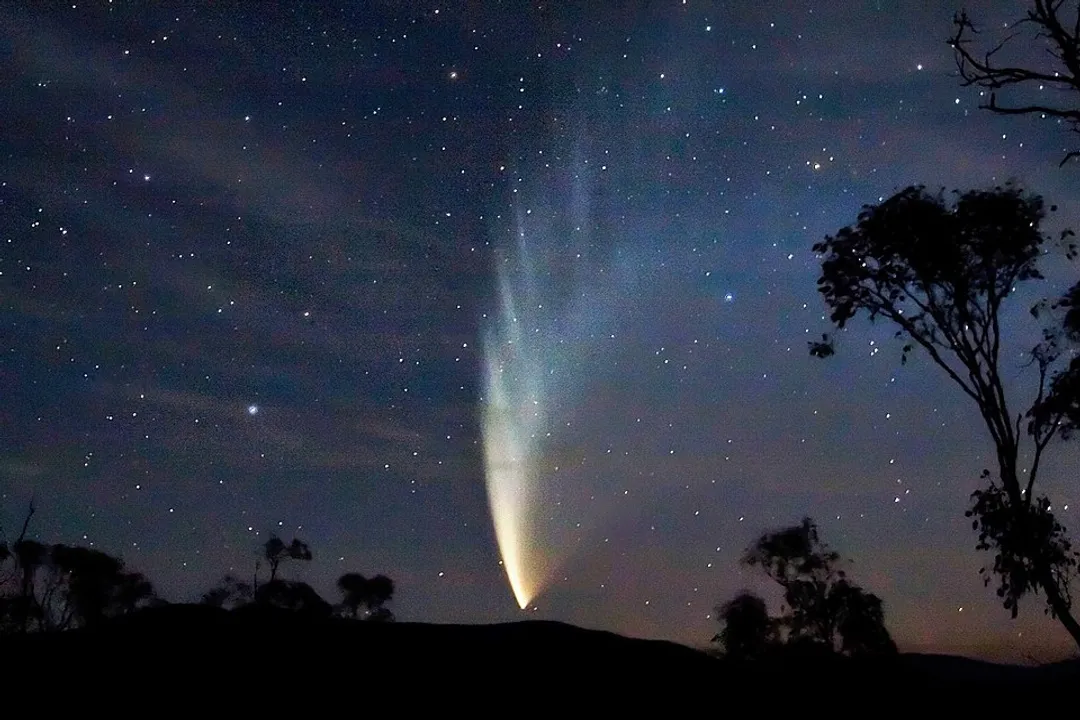
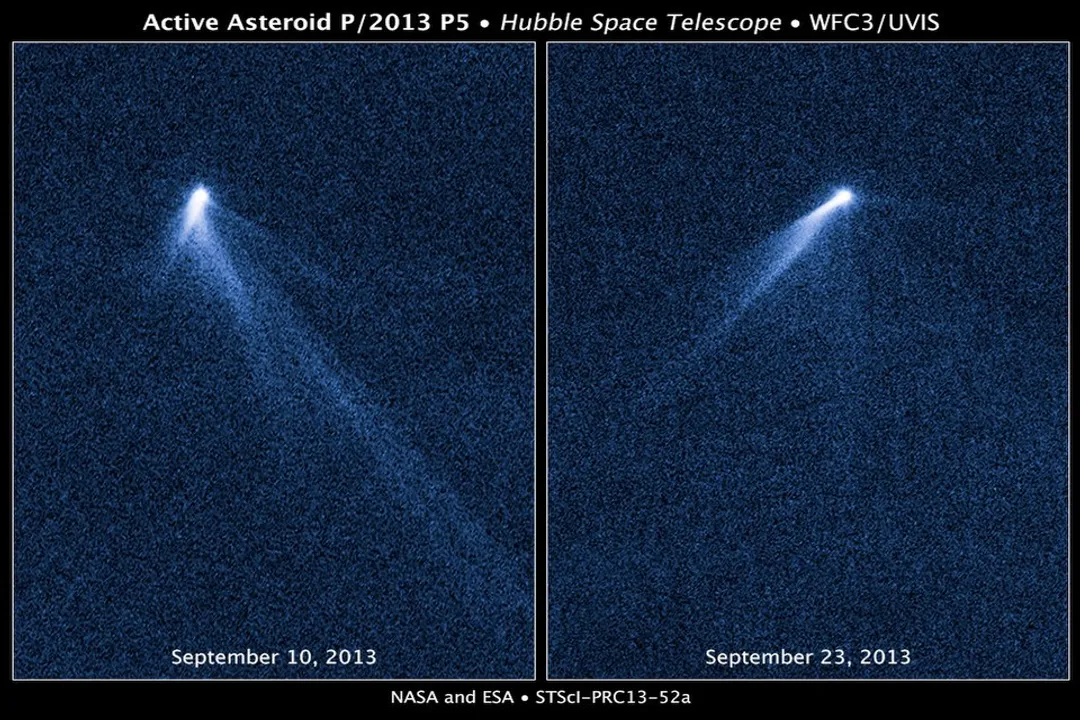
When a comet nears the Sun, the sublimation process creates several distinct features that characterize its appearance. The first major feature to emerge is the coma. [1][6] This is the cloud of gas and dust that envelopes the nucleus, sometimes growing hundreds of thousands of kilometers wide. [1] The coma acts as a temporary atmosphere, making the comet much larger than its solid core. [2]
Extending away from the Sun are the spectacular tails. Most comets develop two principal tails that can stretch for millions of kilometers. [2][5]
The Dust Tail: This tail is composed of dust particles swept away from the nucleus by the pressure of sunlight. [1][6] Because the dust particles are relatively heavy, they are pushed outward but tend to lag slightly behind the comet's path, resulting in a curved appearance. [2] This tail is usually yellowish-white because it reflects sunlight.
The Ion (or Gas) Tail: This tail is made up of ionized gas molecules that have been stripped from the coma by the solar wind—a stream of charged particles emanating from the Sun. [1][6] Since ions are strongly affected by the Sun’s magnetic field, the ion tail is generally pushed directly away from the Sun in a straight line, regardless of the comet's direction of travel. [2]
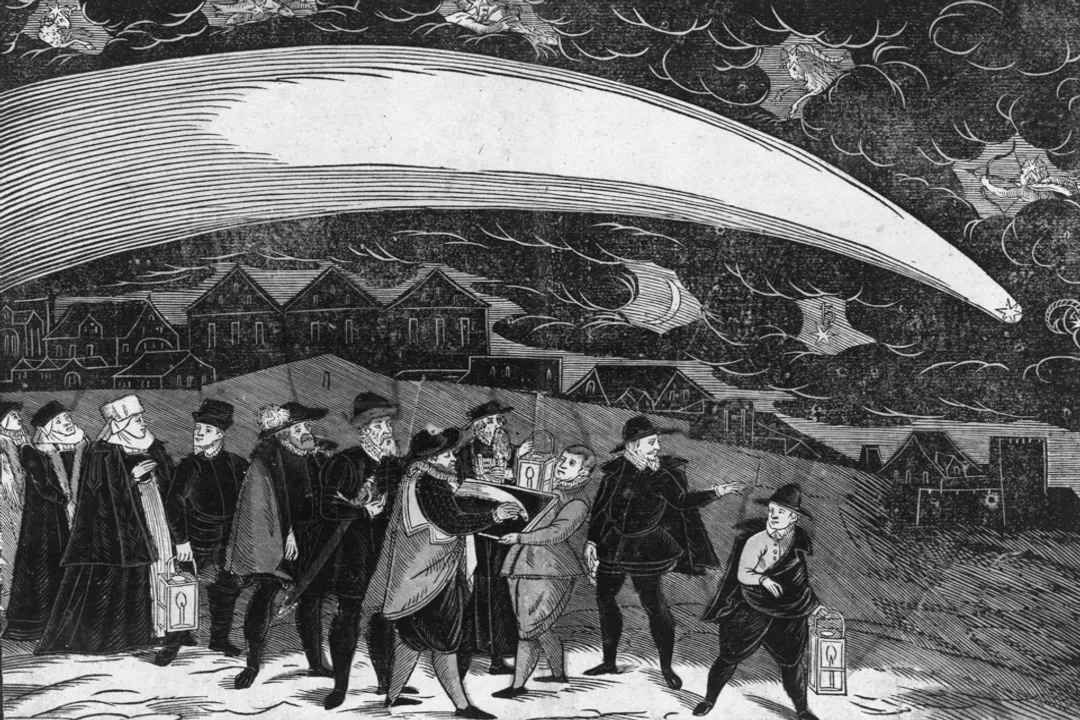
A fascinating characteristic often observed is that a comet heading away from the Sun will still have its tails pointing away from the Sun, meaning the tails often lead the nucleus in its orbital path. [6] This phenomenon—where the tail is not simply left behind like smoke from a fire, but actively pushed by solar forces—is a key physical distinction when observing these visitors. [1]
# Solar Effects
The transformation from a dark chunk of ice to a bright comet is driven entirely by solar energy interacting with ices like water (), carbon monoxide (), and carbon dioxide (). [1][6] When the comet reaches a certain distance from the Sun, usually around $3$ to $5$ Astronomical Units (AU), these frozen materials begin to sublimate. [1]
The temperature increase drives the entire process, but the different ices sublimate at different temperatures, leading to complex outgassing patterns. [2] For instance, the more volatile ice can sublimate even when the comet is still quite far out, helping to form the initial coma before the water ice starts turning to vapor. [2]
Observing the specific composition of the gases released allows scientists to trace the comet’s birthplace. A comet rich in water ice likely formed in the cooler, outer regions of the solar nebula, while one dominated by highly volatile compounds like might have formed even farther out. [1] Analyzing these gases effectively acts as retrieving a pristine sample from the original building blocks of our solar system, providing invaluable clues about early planetary formation conditions. [9] This is analogous to finding a perfectly preserved artifact from the solar system's construction site, untouched by the heat and geological activity that altered inner rocky planets like Earth. [9]
# System Origins
The location from which a comet originates determines its orbital characteristics and, to some extent, its composition. [5] In our solar system, comets primarily hail from two distant reservoirs: the Kuiper Belt and the Oort Cloud. [1][5]
The Kuiper Belt: This is a vast, donut-shaped region situated just beyond the orbit of Neptune, extending from about $30$ to $50$ AU from the Sun. [1][5] Comets originating here are often called short-period comets because their orbits take less than $200$ years to complete. [1][5] These objects generally orbit in the plane of the planets.
The Oort Cloud: This is a theoretical, immense, spherical shell of icy bodies thought to surround the Sun out to perhaps $50,000$ AU or more. [1][5] Comets from the Oort Cloud are long-period comets, often taking thousands or even millions of years to complete a single orbit. [1] Their paths are usually highly inclined or even retrograde (opposite to the direction of the planets) because they are gravitationally perturbed from this distant spherical cloud by passing stars or galactic tides. [1]
The distinction between these two groups is important for understanding solar system dynamics. Kuiper Belt objects are thought to be relatively untouched remnants of the protoplanetary disk, whereas Oort Cloud objects may have been flung outward from the inner solar system during the giant planet formation era. [5]
# Foreign Objects
Not all comets visiting our solar system are native residents. [3] Objects originating outside our Sun’s gravitational influence are termed interstellar objects. [3] These visitors, such as the first confirmed one, 'Oumuamua, or subsequently discovered comets, possess orbits that are clearly hyperbolic, meaning they are moving fast enough to escape the Sun’s gravity after their flyby. [3][9]
The study of these interstellar visitors is incredibly exciting because they carry material forged around other stars. [9] While they may appear structurally similar to comets originating in the Oort Cloud—composed of ice, dust, and rock—their elemental and isotopic ratios reflect the chemical history of a different stellar nursery. [9] When physicists analyze the composition of these passing fragments, they are essentially opening a literal message in a bottle sent from another part of the galaxy. [9] Comparing the pristine composition of these interstellar travelers against our own solar system's bodies offers a unique opportunity for comparative planetology that would otherwise require launching expensive, decade-long interstellar missions. [9] The fact that even these rare, fleeting visitors, like the one observed by Forbes's correspondent, can be tracked and studied highlights significant advancements in detection technology. [3]
The very existence of interstellar objects confirms that the process of forming planets and small bodies is universal, but it also highlights how frequently material is exchanged between star systems through gravitational interactions. [3]
# Visibility Factors
The brightness of a comet is not solely determined by its nucleus size, but heavily by the rate of sublimation and the presence of dust. [6] A comet with a large amount of highly volatile material close to its surface will brighten rapidly as it nears the Sun, potentially becoming naked-eye visible even if its nucleus is small. [2] Conversely, an object with a thick crust of non-volatile dust covering its icy interior might remain dim, even when close to the Sun, because the crust prevents efficient sublimation. [1] This means that the comets we see—the bright ones—represent only the population that happens to be shedding material effectively at the right time and location relative to Earth's observation point. Many, many more icy bodies exist that never produce a spectacular tail or coma, remaining permanently dark and difficult to distinguish from other cold, distant solar system matter. [6] Their orbits dictate that we will only ever see the most dynamically active or the luckiest ones from our vantage point. [5]
#Videos
What is a Comet? | Learn about the Composition and ... - YouTube
Related Questions
#Citations
Comet - Wikipedia
Comets - NASA Science
3I/ATLAS: The Truth About The Interstellar Comet Everyone's ...
What are objects in space that are made of rock and ice called?
Comets: Everything you need to know - Space
Comets are icy balls of gas, dust and rock - EarthSky
comets are cosmic snowballs of ice and dust - Facebook
What is a Comet? | Learn about the Composition and ... - YouTube
Physicists Open a “Message in a Bottle” From Interstellar Space