What are lumps of ice and dust?
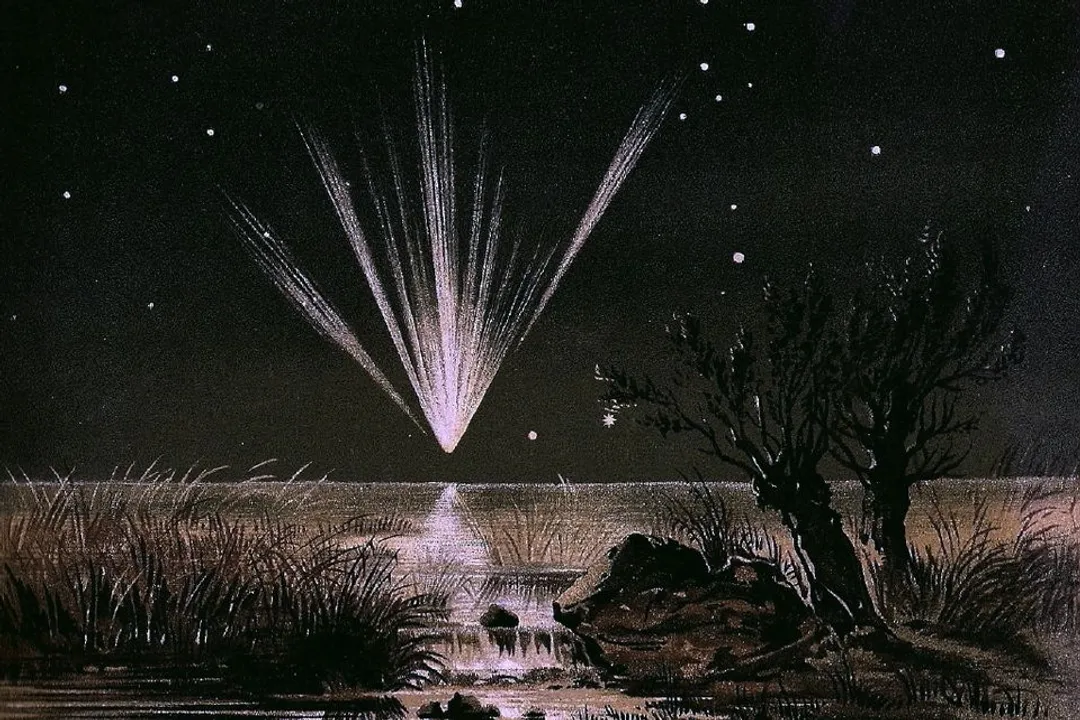
These celestial wanderers, often described as giant, slow-moving snowballs tumbling through space, are formally known as comets. [2][4][5] They represent some of the most primitive material left over from the solar system's formation nearly $4.6$ billion years ago. [1][5] Essentially, a comet is a loosely aggregated structure composed primarily of ice, dust, and rocky material. [2][4] Unlike the solid, rocky planets orbiting closer to the Sun, these icy bodies originate from the cold, distant reaches of the Sun's realm, preserving an ancient record of the solar nebula from which everything formed. [1][5]
# Icy Makeup
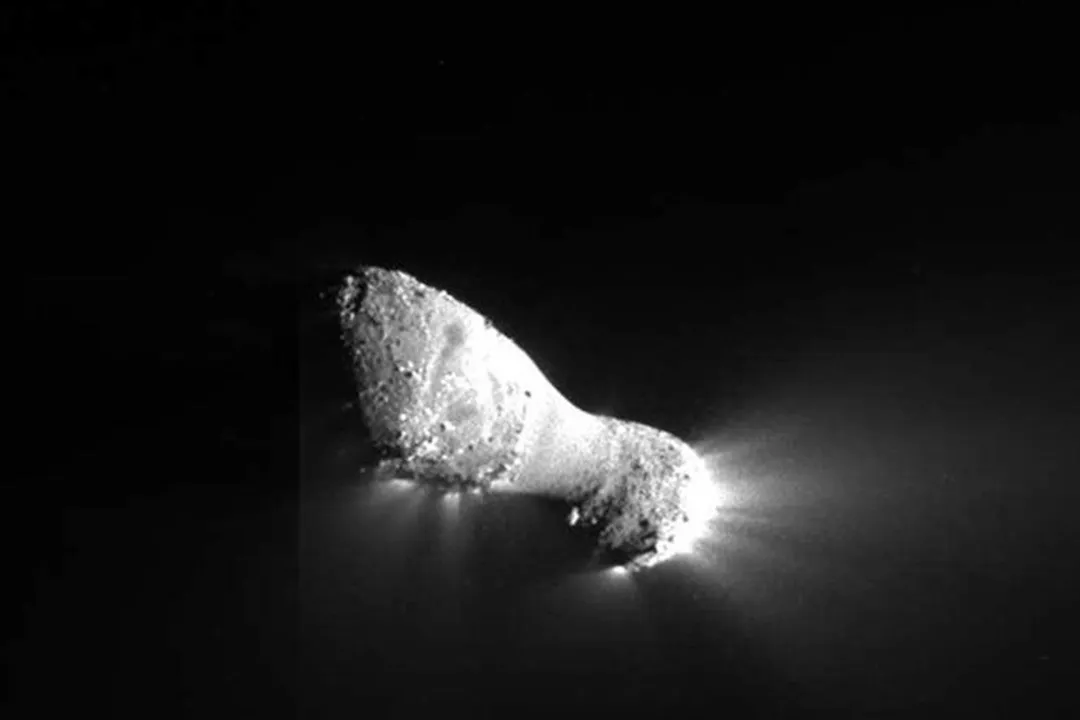
The term "dirty snowball," coined by astronomer Fred Whipple, remains an apt description for the solid part of a comet, known as the nucleus. [2][5] This nucleus is not a uniform sphere but rather a porous, fragile structure held together by weak forces. [2] The primary components are not just water ice, though that is certainly abundant; they also contain frozen forms of gases that would be air near Earth's surface. [1][5]
The volatile ices include frozen carbon dioxide (dry ice), carbon monoxide, methane, and ammonia, mixed in with silicate dust particles and organic compounds. [1][5] This combination of highly volatile ices and more refractory (heat-resistant) dust particles hints at the mixed conditions present during the early stages of planetary disk development. [1] It’s fascinating to consider that the ratio of ice to dust dictates how dramatically a comet will react when heated; a comet rich in easily sublimated frozen gas will likely become more active, sooner, than one where dust heavily encases the ice. [2][5]
# Reservoir Locations
These icy relics dwell in two main reservoirs far beyond the orbits of the major planets. [1][5] The first region is the Kuiper Belt, a vast, donut-shaped zone extending just beyond Neptune's orbit, roughly $30$ to $50$ astronomical units (AU) from the Sun. [1] Comets originating here are typically categorized as short-period comets, meaning their orbits take less than $200$ years to complete a revolution around the Sun. [1]
Further out still lies the Oort Cloud, a theoretical spherical shell thought to extend perhaps $5,000$ to $100,000$ AU away. [1][5] Objects flung into the Oort Cloud are thought to be remnants from the formation of the giant planets, scattered by gravitational interactions early in the solar system's history. [1] Comets emerging from this deep reservoir are long-period comets, often taking thousands or even millions of years to return, and their paths can be highly elliptical, taking them from the very edge of the Sun's gravitational influence right into the inner solar system. [1]
# Structure Appears
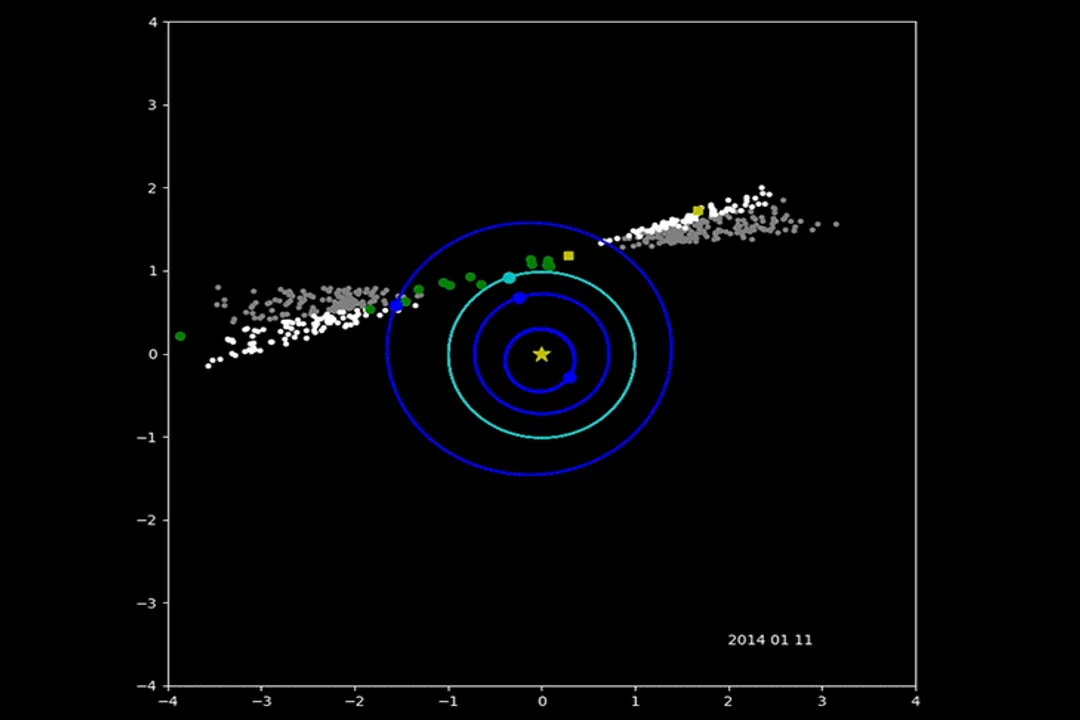
A comet remains essentially inert, a frozen lump, while residing in the deep freeze of the outer solar system. [2] Its dramatic transformation begins only when its elliptical orbit brings it close enough to the Sun to warm up significantly. [2][5] As the temperature rises, the frozen materials begin to sublimate—turning directly from solid to gas—releasing the trapped dust and gas into space. [2][5]
This process creates several distinct features:
- The Nucleus: The solid, central body, typically only a few kilometers to tens of kilometers across, where the ice and dust are stored. [2][5]
- The Coma: The Sun's heat causes the outer layer of the nucleus to vaporize, creating a vast, hazy atmosphere around the nucleus called the coma. [2][5] This cloud of gas and dust can grow to be larger than a planet, though it is extremely tenuous. [2]
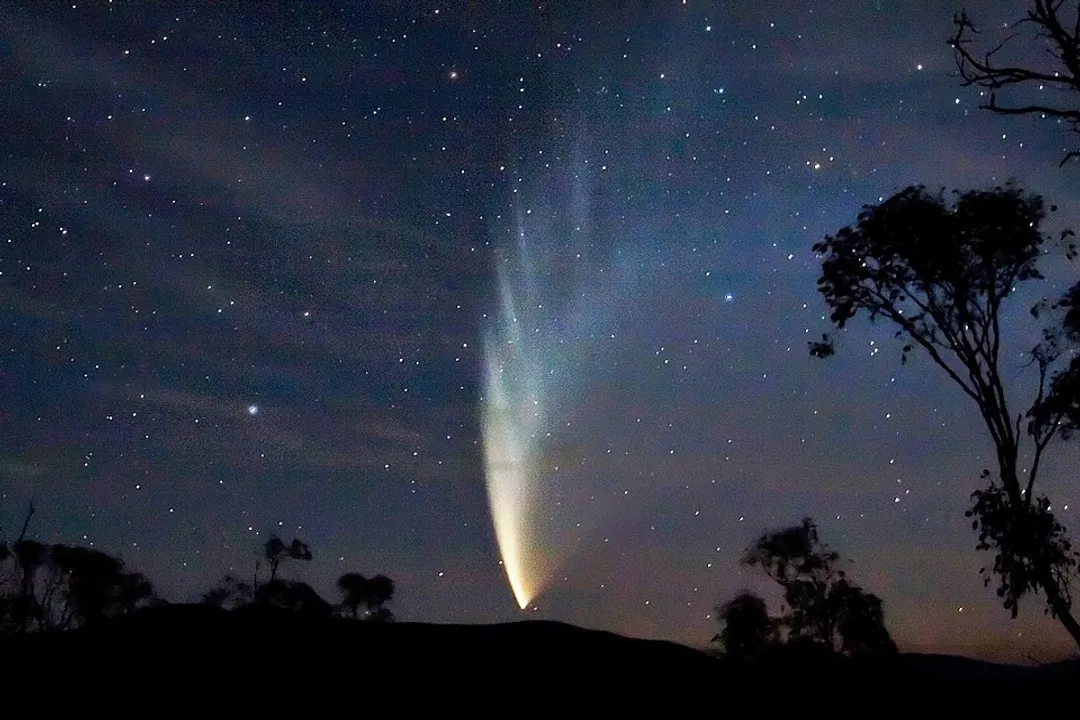
- The Tails: The solar wind and radiation pressure push the material from the coma away from the Sun, forming the spectacular tails for which comets are famous. [2][5]
# Tail Formation
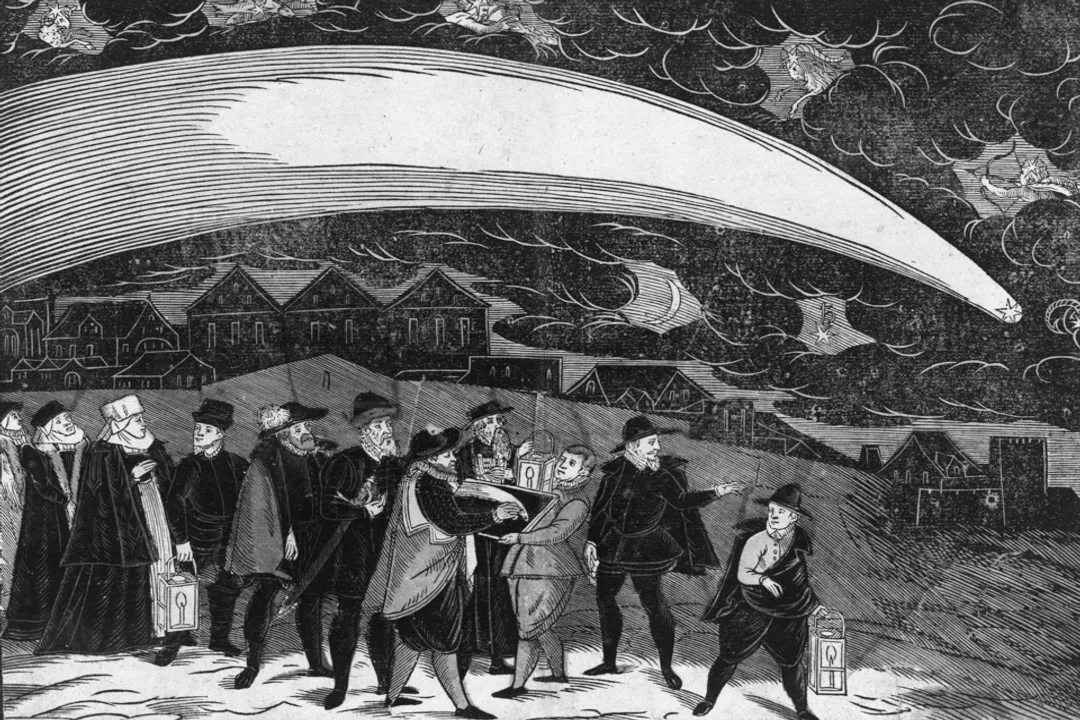
The visibility and shape of a comet are entirely dependent on its proximity to the Sun and the resulting outgassing. [2][5] When an observer sees a comet with glowing tails stretching across the night sky, they are witnessing the direct result of solar heating acting upon that distant icy lump. [2]
There are generally two distinct tails, each formed by different material interacting with solar forces:
# Dust Tail
This tail is composed of the tiny dust grains released from the nucleus. [5] The dust particles are pushed gently away from the Sun by the pressure of sunlight itself. [5] Because the dust grains are relatively heavy compared to the gas molecules, their trajectory lags slightly behind the comet's path, often resulting in a broad, yellowish-white, curved tail that follows the comet's orbit. [5] This is the part of the comet that reflects sunlight, making it visible to the naked eye or through a telescope. [2]
# Ion Tail
The second tail is the ion tail (or gas tail), which is composed of ionized gas molecules. [5] These gases are energized by ultraviolet radiation from the Sun, causing them to become electrically charged. [5] The solar wind—a stream of charged particles flowing outward from the Sun—interacts strongly with these ions, sweeping them directly away from the Sun along the magnetic field lines. [5] Consequently, the ion tail is almost always straight and blue (due to emission from ionized carbon monoxide), pointing directly away from the Sun, regardless of the comet's direction of motion. [2][5]
When a comet is moving away from the Sun after passing closest approach (perihelion), the two tails often point in different directions relative to the observer's line of sight, which can be a confusing but telltale sign of the physics at play. It is helpful for observers to remember that the tails always trail away from the star, acting like a cosmic windsock affected by both light pressure and particle flow. [2][5]
# Orbital Motion
The path a comet takes dictates its life cycle and how often we might see it. [1] The distinction between short-period and long-period orbits creates very different observational opportunities. Short-period comets, such as those in the Jupiter family, have more circular orbits and generally remain closer to the plane of the solar system planets. [1] They are sometimes perturbed by Jupiter's gravity, which can alter their periods or even eject them from the inner solar system entirely.
Long-period comets, conversely, arrive from the Oort Cloud with highly eccentric, elongated paths that can take them far above and below the plane of the planets. [1] These visitors often arrive unannounced, having spent millennia in the deep cold, and their first passage through the inner solar system might be their only one, as subsequent passes near the Sun can cause them to lose significant mass, eventually rendering them dormant or leading to their disintegration. [2][5]
If one were to plot the orbital paths of several dozen observed comets, a clear pattern emerges: those with periods under $200$ years cluster near the ecliptic (the plane of the planets) and have semi-major axes less than about $30$ AU, while the long-period ones show random inclinations, tracing paths that seem to come from every direction in three-dimensional space. [1] This positional data is precisely what helps astronomers map the extent of the Oort Cloud, even though it cannot be directly observed. [1] Observing the brightness changes over time—how quickly a comet brightens as it approaches and fades as it recedes—gives researchers clues about the available volatile materials in the nucleus, providing an indirect census of its initial composition. [2][5] This means that two comets with similar sizes might behave wildly differently based on the proportion of easily vaporized material locked inside their icy matrix.
#Videos
Learn about where Comets come from and how they are formed!
Related Questions
#Citations
Comets - NASA Science
Comet - Wikipedia
What are comets? - Q-files - Search • Read • Discover
What is a comet? - Quora
Learn about where Comets come from and how they are formed!
Types of Weather Phenomena - NOAA
All kinds of death - 8
It is known that COMETS are lumps of Ice, dust and gases. They are