Which of the following objects is located in the Kuiper Belt?
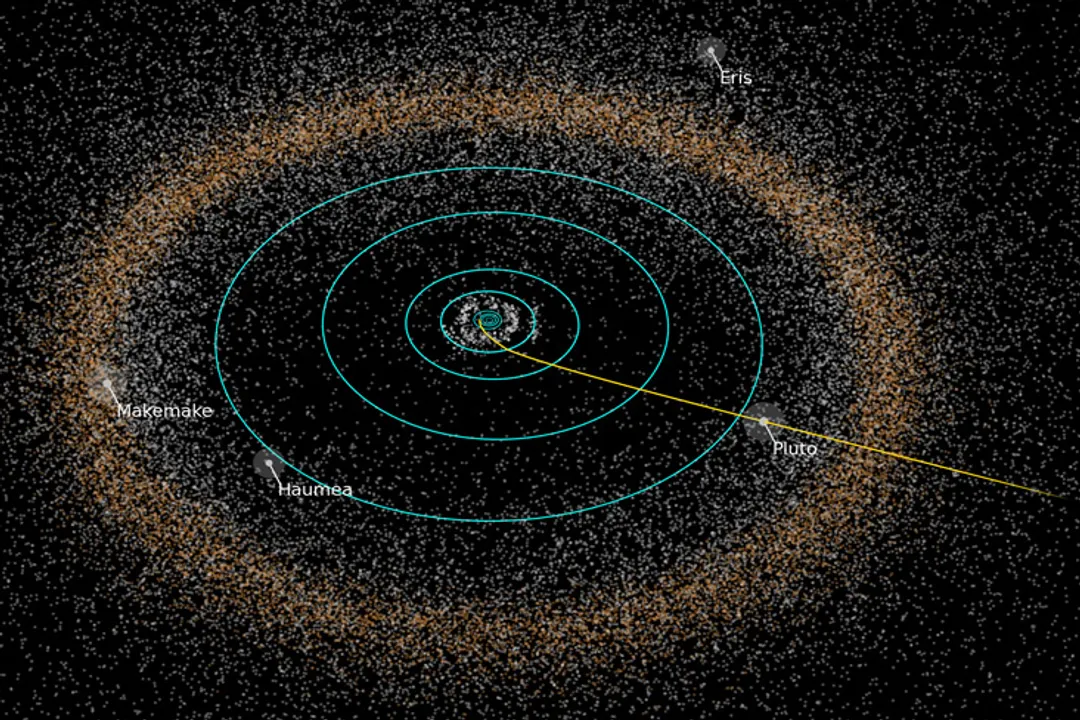
The vast, cold expanse beyond the orbit of Neptune harbors a population of ancient, icy worlds, remnants left over from the solar system’s tumultuous birth billions of years ago. This region, now widely recognized by planetary scientists, is one of the most fascinating frontiers in modern astronomy, serving as a deep-freeze storage unit for primitive material. Answering the question of what resides there requires looking past the familiar planets and diving into the trans-Neptunian realm where the Sun's warmth is but a distant, faint star. [1][3]
# Distant Domain
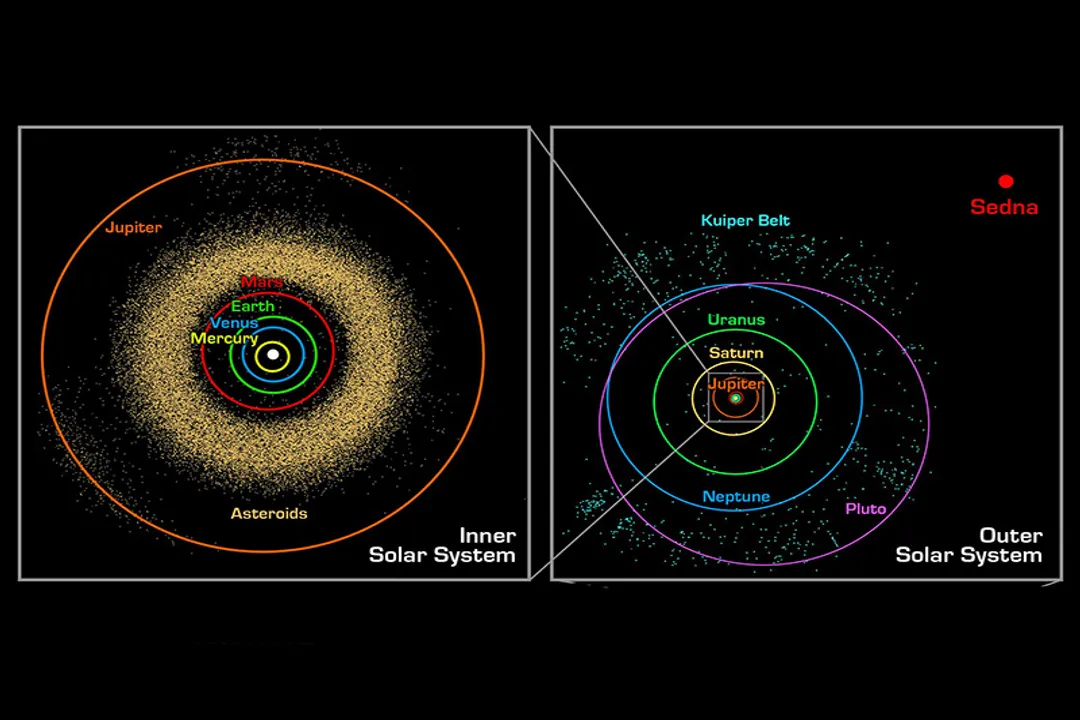
The Kuiper Belt is a sprawling, doughnut-shaped structure encircling our Sun, situated just beyond the orbit of the solar system’s outermost major planet, Neptune. [2][5] To grasp its scale, consider the distances involved. Neptune orbits at roughly () from the Sun, where one is the distance from the Earth to the Sun. [1][3] The Kuiper Belt starts around this mark and extends outward, generally accepted to stretch to about from the Sun. [1][3]
This massive area is populated by countless small solar system bodies, often referred to as Kuiper Belt Objects, or . [2][8] While the inner solar system has the Asteroid Belt between Mars and Jupiter, the Kuiper Belt is fundamentally different; it is significantly larger and, crucially, much colder, allowing volatile materials to remain frozen solid. [2] These icy bodies are essentially time capsules, holding pristine compositions that date back to the initial condensation of the solar nebula roughly billion years ago. [1][3]
# Icy Composition
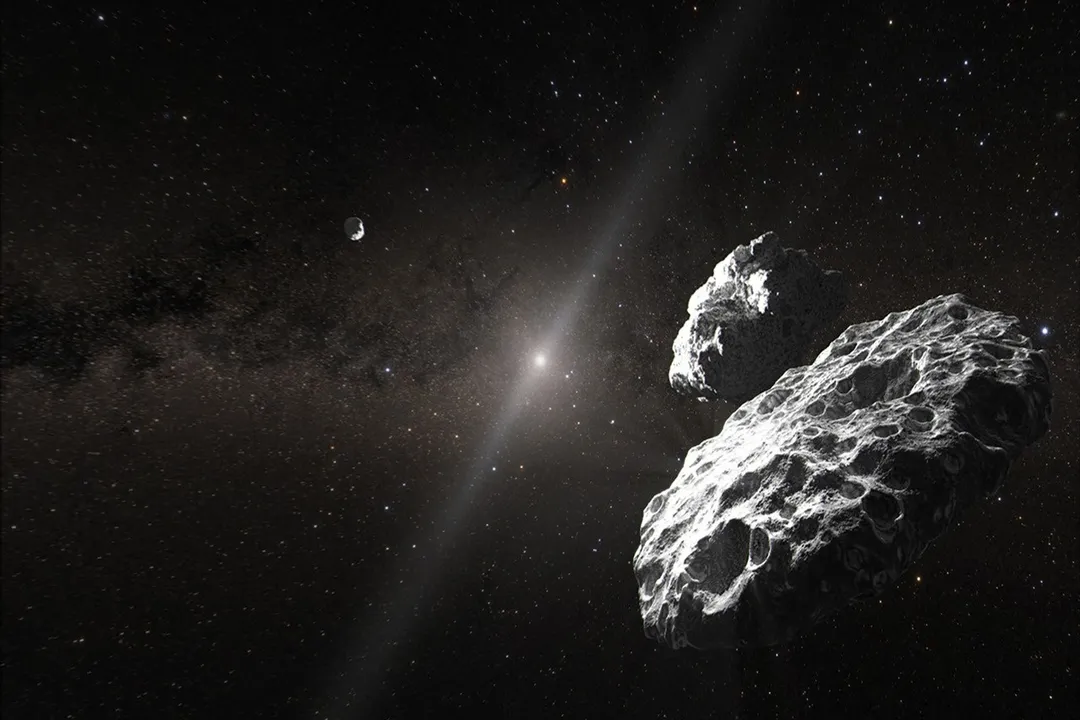
The objects populating this outer region are not merely inert rocks. Their low temperatures—hundreds of degrees below freezing—preserve volatile compounds that would have evaporated closer to the Sun. [5][7] A ’s makeup generally consists of a mix of rock and various ices, including frozen water, methane, and ammonia. [5][7] This high ice content is a defining feature that separates them from the rockier inhabitants of the inner solar system. [3]
The size range among these objects is immense. While the region hosts minor bodies, it is also home to several objects massive enough to have achieved hydrostatic equilibrium, qualifying them for the classification of dwarf planets. [7] These larger objects exert enough gravity to pull themselves into a nearly round shape, a clear distinction from the smaller, irregularly shaped debris scattered throughout the belt. [5]
# Major World
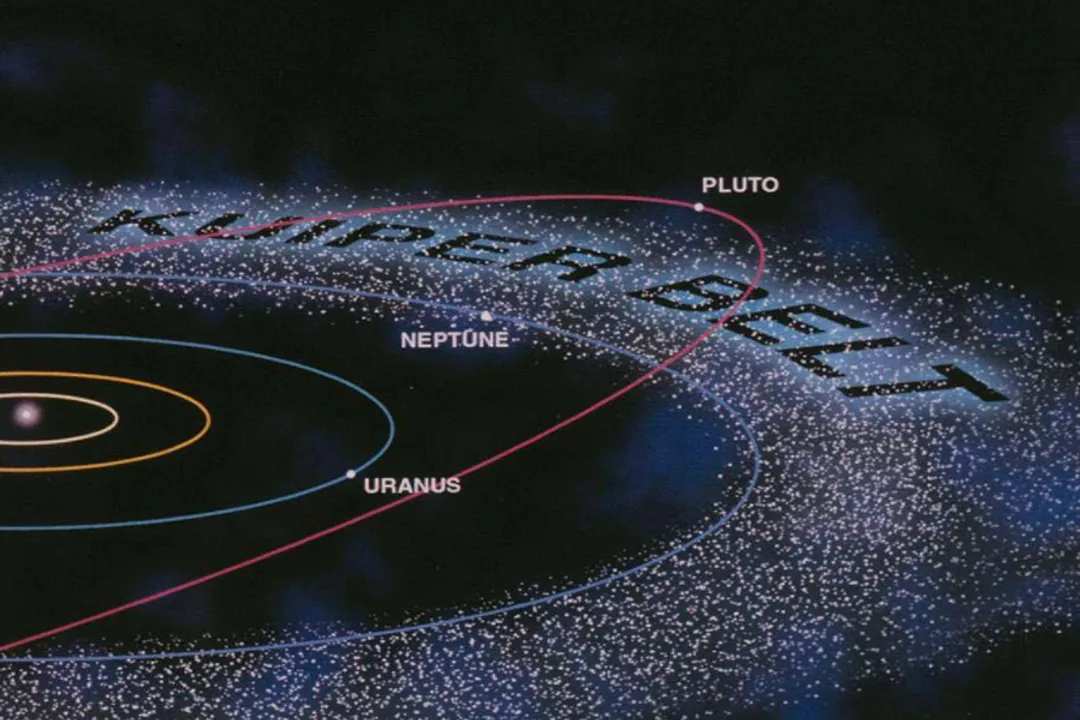
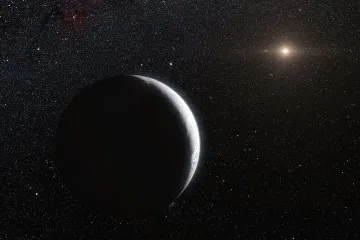
When discussing objects located in the Kuiper Belt, the most famous resident must be mentioned first: Pluto. [1][2][5][7] Before its reclassification in , Pluto was considered the ninth planet, and even now, it remains the largest and most widely studied body in the Kuiper Belt. [1][7] Pluto’s orbit does indeed lie mainly beyond Neptune's, firmly placing it within the Kuiper Belt domain. [8] It serves as the anchor point for understanding the entire population of . [1]
Pluto is far from a dead, inert world. Data gathered from missions exploring this region suggest it possesses a complex geology, complete with mountains, plains, and perhaps even cryovolcanic activity, all covered by surface ices of nitrogen, methane, and carbon monoxide. [5] Its continued study helps scientists understand how substantial bodies can evolve even in the frigid outer reaches of the solar system. [5]
# Other Dwarf Planets
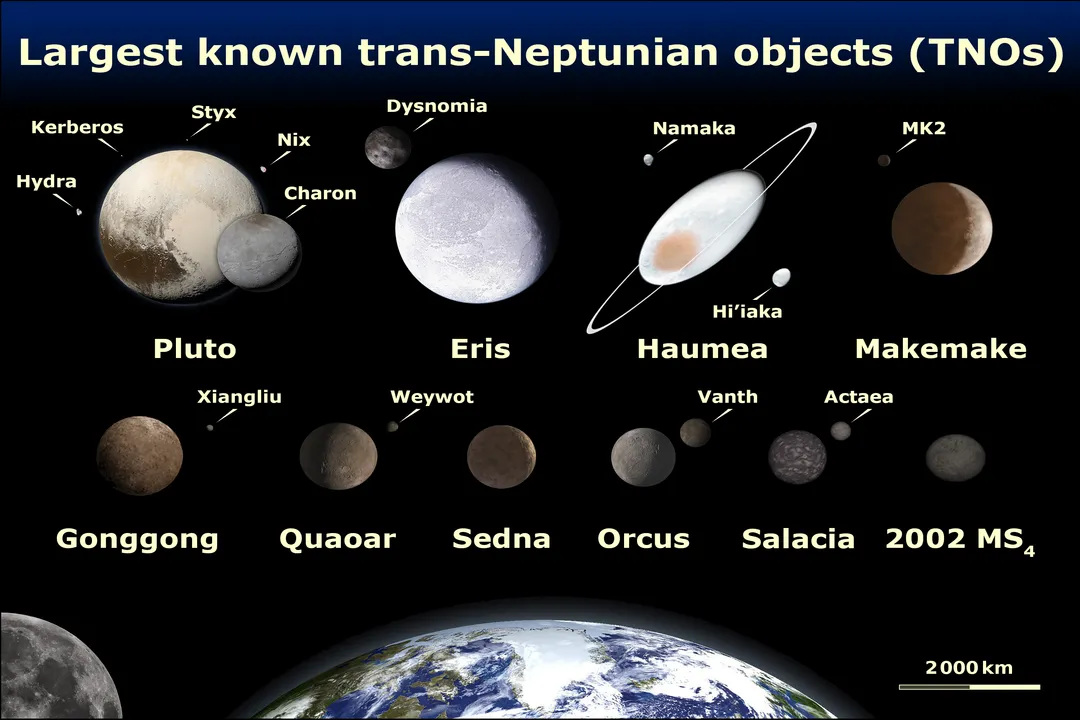
Pluto is not alone among the dwarf planets in the Kuiper Belt. The discovery of other large, icy worlds orbiting out there has confirmed that Pluto is merely the most accessible example of a much larger class of objects. [2][5] Astronomers have identified several other significant bodies that also reside primarily beyond :
- Eris: Once briefly considered for a tenth planetary designation, Eris is another massive known to be quite similar in size to Pluto, though slightly more distant on average. [2][8]
- Makemake: This world is large enough to be considered a dwarf planet and is one of the brighter objects in the region. [2][8]
- Haumea: Perhaps one of the most bizarre objects, Haumea is notable for its rapid rotation, which has stretched it into an elongated, ellipsoid shape, unlike the near-spheres of Pluto and Eris. [2][8]
It is insightful to note the density gradient implied by these discoveries. Pluto orbits relatively closer to the Sun than Eris, yet Eris is more massive. [2][8] This difference implies that the material distribution in the early solar nebula was not uniform, or that processes affecting the orbits and accretion of these massive bodies occurred very differently depending on their initial distance from the nascent Sun. For example, the composition and reflectivity of these large can vary widely, suggesting different formation histories or varying degrees of processing by solar radiation or internal heating over time. [2][8]
# Smaller Worlds Explored
While the dwarf planets capture the headlines, the sheer volume of smaller is what defines the belt. [8] These smaller bodies range in size from hundreds of kilometers down to mere meters across. [1] They are less understood because detecting and characterizing them requires immense observational time due to their distance and faintness. [1]
One of the most significant steps in understanding these smaller objects came from the New Horizons mission, which famously visited Pluto but later conducted a flyby of another named Arrokoth. [5] Arrokoth, which was originally known by the placeholder name Ultima Thule, provided the first up-close look at a primordial object from the region. [5] Its shape is highly irregular, resembling two cosmic snowballs stuck together, which offers direct evidence about the gentle accretion processes that likely formed the first planetesimals in the outer solar system. [5]
Considering the estimated population, if we were to visually map the Kuiper Belt today, we would find that for every one dwarf planet like Pluto, there are likely millions of smaller icy bodies making up the bulk of the mass, though their total combined mass is still thought to be only a fraction of that of Earth or Mars. [1][7] This highlights that while the largest objects dictate orbital dynamics, the small, numerous hold the majority of the chemical record of the outer solar nebula. [3][7]
# Belt's Role Comets
The Kuiper Belt is not a static collection of objects; it is dynamic, albeit slowly. Gravitational perturbations, primarily from the planet Neptune, can occasionally nudge these icy bodies out of their stable, distant orbits. [1][3] When a is thrown inward toward the Sun, it crosses the paths of the major planets and becomes visible as a short-period comet. [1][3][7]
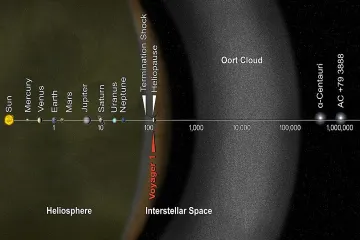
This connection establishes the Kuiper Belt as the source reservoir for many of the comets we observe regularly, in contrast to the more distant and diffuse Oort Cloud, which is thought to supply the long-period comets. [3] The comets originating from the Belt—those with orbital periods generally less than years—are essentially visitors from the outer solar system, briefly passing through the warmer, inner regions before returning to the deep freeze of the Kuiper Belt. [1][3] Studying the composition of these comets provides an indirect way to sample the materials locked away in the themselves. [7]
# Defining the Edge
The term itself is defined by orbital mechanics: a is any small solar system body whose orbit primarily resides outside of Neptune's path. [8] While the main body of the belt is concentrated between and , the gravitational influence of Neptune sculpts this region significantly, creating distinct zones, though some objects possess highly elongated orbits that take them much farther out or even cross Neptune’s path. [5] The presence of objects like Quaoar, Gonggong, and Sedna shows the diversity, with some bodies having orbits that extend much further, blurring the lines between the classic Kuiper Belt and more distant populations. [8]
In summary, the objects located in the Kuiper Belt are a diverse population of icy and rocky bodies, ranging from large dwarf planets like Pluto, Eris, Makemake, and Haumea, down to countless smaller planetesimals, with notable examples like Arrokoth giving us direct insight into their formation. [1][2][5][8] They are the preserved building blocks of the outer solar system, orbiting in the cold, dark region beyond Neptune that defines the Belt’s boundaries. [1][3]
Related Questions
#Citations
Kuiper Belt - NASA Science
What is the Kuiper Belt? - Space Center Houston
Comets, the Kuiper Belt and the Oort Cloud
Which of the following can be found in the Kuiper belt? A. Comets B ...
Kuiper Belt Facts For Kids | AstroSafe Search - DIY.org
About the Kuiper Belt - New Horizons
What Is the Kuiper Belt? | NASA Space Place – NASA Science for Kids
Kuiper Belt Object | The Solar System Wiki - Fandom
Astronomy Ch. 5 Flashcards - Quizlet