Which of the following best describes an open cluster?
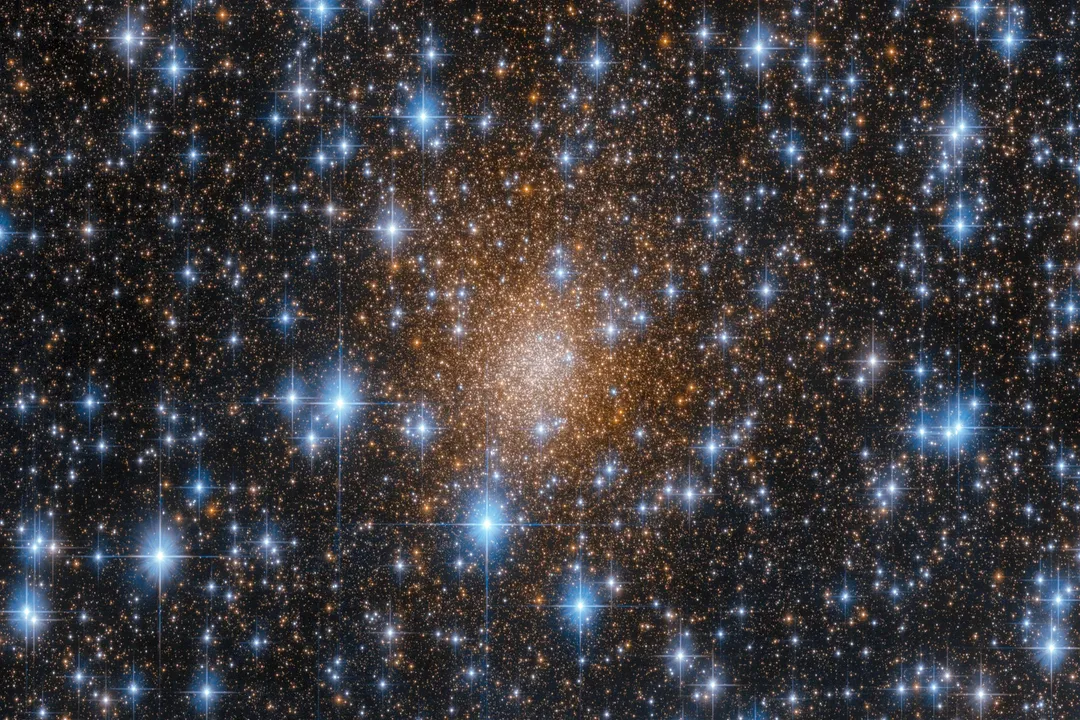
The best description for an open cluster involves recognizing it as a collection of stars that share a common origin and are loosely held together by mutual gravitational attraction. [1][2][7] These celestial groupings are fundamentally different from their older, more tightly packed relatives, the globular clusters, primarily defined by their relative youth and placement within a galaxy. [7] An open cluster is essentially a stellar nursery that has not yet fully dispersed, featuring stars that were all born around the same time from the collapse of a single, massive cloud of gas and dust—a giant molecular cloud. [1][2]
# Stellar Grouping
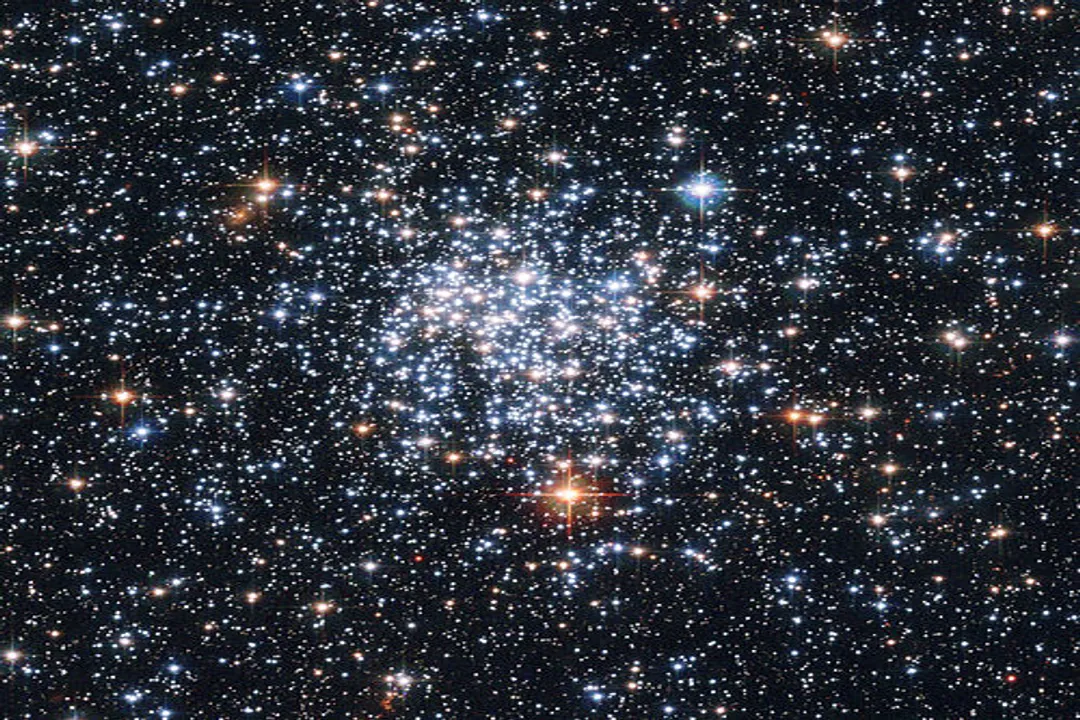
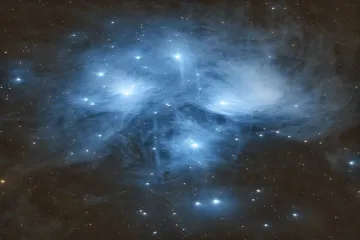
When astronomers speak of an open cluster, they are referring to a relatively small, irregular gathering of stars, typically found in the plane or disk of a spiral galaxy, such as our own Milky Way. [2][7] Unlike the immense, spherical congregations seen elsewhere, these clusters are characterized by a lower stellar density and a more scattered appearance. [7] They usually contain anywhere from a few dozen to a few thousand individual stars. [1][7] For example, one of the most famous is the Pleiades, or the Seven Sisters, which, while containing many more stars than just seven visible to the naked eye, still represents a relatively sparse population compared to larger structures. [1]
The key characteristic tying them together is that they are gravitationally bound, though this bond is far weaker than what holds larger structures together. [2] This relatively weak binding means that the individual stars within the cluster exert noticeable gravitational influence on each other, but they are also constantly being tugged by the mass of the entire galaxy. [7]
# Stellar Youth
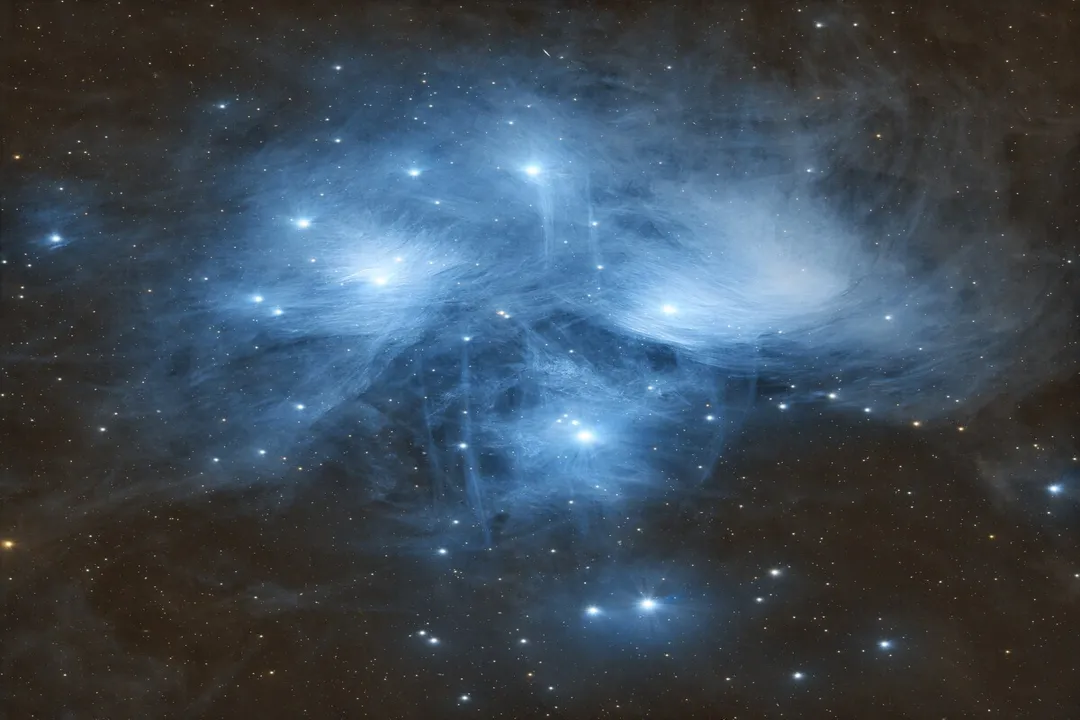
A defining attribute of open clusters is their age; they are considered young stellar populations. [2] The stars within them generally share spectral characteristics, often indicating that they are main-sequence stars that formed recently in cosmic terms. [7] Since the formation process is swift—the entire collapse and ignition phase takes only a few million years—all the stars in the cluster will be roughly the same age, a feature that makes them invaluable laboratories for stellar evolution studies. [1] If you were to look at the star formation history of the Milky Way disk, open clusters act as temporal markers, showing where and when star formation occurred in specific regions. [1]
Consider this: a cluster containing many massive, hot, blue O and B type stars is definitively young, as those stars burn through their fuel very quickly, perhaps in only tens of millions of years. [7] If a cluster is identified that contains only small, cool, dimmer stars, it is harder to age precisely based on stellar mass alone, but the general consensus places most observed open clusters at ages younger than a few billion years. [7] This contrasts sharply with globular clusters, which are ancient, often containing stars over 10 billion years old. [2][7]
# Galactic Home
The location of these stellar groups is quite specific within the context of a spiral galaxy. [2][7] Open clusters are predominantly located in the galactic disk, specifically within the spiral arms where the interstellar medium is richest in the gas and dust required for star formation. [2][7] They are not typically found in the galactic halo, which is the realm of globular clusters and old, isolated field stars. [2]
This localization provides a crucial piece of context. Because they inhabit the crowded disk, open clusters are constantly subjected to the tidal forces generated by the galaxy's overall structure and the gravitational wakes of other nearby molecular clouds and stellar streams. [7] This external influence is the primary driver of their eventual fate.
# Cluster Evolution
The life of an open cluster is, cosmically speaking, brief. While the stars themselves might live for billions of years, the cluster as a coherent structure does not last that long. [2] The weak gravitational binding that defines them also seals their fate. [7] Over time, the stars gradually drift apart due to internal stellar motions and, more significantly, external gravitational perturbations from the surrounding galaxy—a process known as tidal stripping. [7]
For the Pleiades, for instance, it is estimated that the cluster has already lost a significant fraction of its original stellar population since it formed roughly 100 million years ago. [1] In a few hundred million years more, the tidal field of the Milky Way will have completely dispersed the remaining members, scattering them into the general background of field stars—stars in the galaxy that are not gravitationally bound to any specific group. [2] This transition from a recognizable cluster to isolated field stars is the natural endpoint for every open cluster. [7]
To visualize this gravitational disintegration, think of the cluster as a loosely packed flock of birds. Initially, they stay close, but even small shifts in the wind (galactic tides) and occasional bumps between birds (internal stellar encounters) cause the flock to spread out until the individuals are too far apart to be considered a group anymore. [2]
# Comparing Cluster Types
To truly understand what an open cluster is, it helps to define what it is not. [7] The primary contrast is with globular clusters:
| Feature | Open Cluster | Globular Cluster |
|---|---|---|
| Shape | Irregular, scattered | Spherically symmetric, dense core |
| Stellar Population | Young (up to a few billion years) | Very Old (often >10 billion years) [2][7] |
| Size (Stars) | Tens to a few thousand [1] | Tens of thousands to millions [7] |
| Location | Galactic Disk/Spiral Arms [2] | Galactic Halo and Bulge [7] |
| Binding Strength | Weakly bound | Extremely strongly bound |
This fundamental difference in age and location means that open clusters tell us about the current state and recent history of star formation in our galaxy's arms, whereas globular clusters provide a window into the galaxy's earliest formation phases. [7]
Here is an analytical point to consider: Because the stars in an open cluster formed from the exact same initial material at the exact same moment, they possess identical initial chemical compositions (metallicity). However, over the cluster's lifetime, external tidal forces strip away the less massive stars first because they are easier to eject from the group's weak gravitational potential well. [7] Therefore, the stars remaining in an older open cluster might show a slight bias toward higher mass than the original average, a subtle evolutionary imprint that researchers can use to model the cluster's dynamic history within the disk.
# Observing These Groups
For the amateur astronomer, identifying an open cluster often involves locating one of the well-known examples in the night sky. [1] The Pleiades (M45) is visible across the Northern Hemisphere and is a textbook example of a young, loosely arranged group. [1] Another excellent target is the Hyades in the constellation Taurus, which appears as a V-shape of stars. [4]
If you are using a small telescope or even good binoculars, looking for a small, irregularly shaped patch of stars that seems distinct from the general, random background of the Milky Way band can be a good indicator of an open cluster. [1] Unlike a globular cluster, which will look like a tiny, fuzzy ball of light concentrated in the center, an open cluster will look like a handful of bright stars randomly scattered within a slightly hazy field. [1][4]
As a practical tip for astrophotography enthusiasts, open clusters are fantastic targets because their stars are relatively bright, and the field of view required to capture the entire group is usually small enough for standard camera lenses. When capturing an image, try taking one very short exposure and one very long exposure; when stacking them, you can often use the bright, close-in stars to map the cluster boundaries accurately and use the faint background stars to gauge the true darkness of the surrounding region, something that is harder to do with older, more diffuse objects. [6] The absence of significant nebulosity surrounding the cluster often suggests it has passed the stage where its most massive stars have already exploded as supernovae, further confirming its "middle age" in cluster terms. [1]
In summary, the descriptor that best captures the essence of an open cluster is a young, irregularly shaped, loosely gravitationally bound collection of stars residing in the disk of a spiral galaxy, destined for eventual dissolution into the field star population. [2][7] They are the transient stellar families of the galactic plane. [1]
Related Questions
#Citations
Open cluster - ESA/Hubble
Open cluster - Wikipedia
PHYS 1403 (Test 3) Flashcards - Cram.com
Astronomy Exam 2 Flashcards | Quizlet
Which of the following statements about open clusters is true? A. All ...
Practice Exam (docx) - CliffsNotes
Open clusters - Stellar Groups, Galaxies, Nebulae - Britannica
Hubble's Star Clusters - NASA Science
[DOC] 15_Testbank.doc