What are the facts about open clusters?
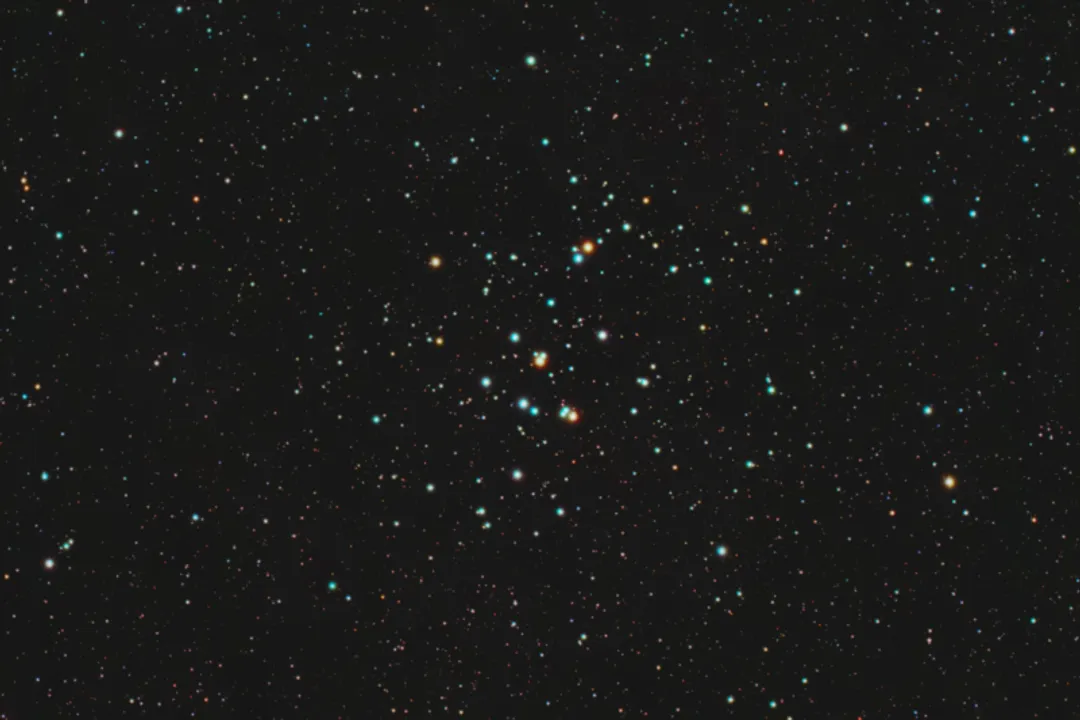
The stars we see sprinkled across the night sky are not always solitary wanderers; sometimes, they gather in beautiful, temporary associations known as open clusters. These structures represent stellar nurseries caught in a brief moment after birth, offering astronomers a window into the early lives of stars. Unlike their ancient, dense cousins, open clusters are relatively common features within the plane of our Milky Way galaxy and other spiral systems, recognizable by their scattered appearance rather than a tightly packed ball shape. [1][4]
# Stellar Kinship
The defining characteristic of an open cluster is shared ancestry. Every star within one of these groupings was formed at nearly the same time, originating from the gravitational collapse of a single, massive giant molecular cloud. [2][3][5][9] This shared birthplace means that all the stars in the cluster are essentially siblings, possessing similar chemical compositions, though their masses will vary widely depending on where they were formed within that initial cloud. [9]
The number of stars in an open cluster is generally modest when compared to the behemoths of the universe. While some contain only a few dozen stars, others can boast several thousand members. [1][2][5][9] To visualize this, consider a typical cluster might hold a few hundred to a few thousand stars, scattered across a volume of space that is relatively sparse compared to the core of a globular cluster. [2][9]
When thinking about the initial conditions, it’s fascinating to consider the immediate aftermath of formation. The process that triggers star birth within a molecular cloud often involves shockwaves or density fluctuations, creating regions where gravity wins out over internal pressure. Once these stars ignite, the surrounding remnant gas and dust—the material that didn't become a star—is rapidly blown away by the intense radiation and stellar winds from the most massive, hottest stars in the group. This swift dissipation of the parent cloud is what leaves the stars exposed relatively quickly, marking the beginning of the cluster’s countdown clock to dispersion. [1][3] The initial binding energy must overcome the kinetic energy gained from this rapid clearing, setting the stage for the cluster's relatively short existence. [2]
# Youthful Appearance
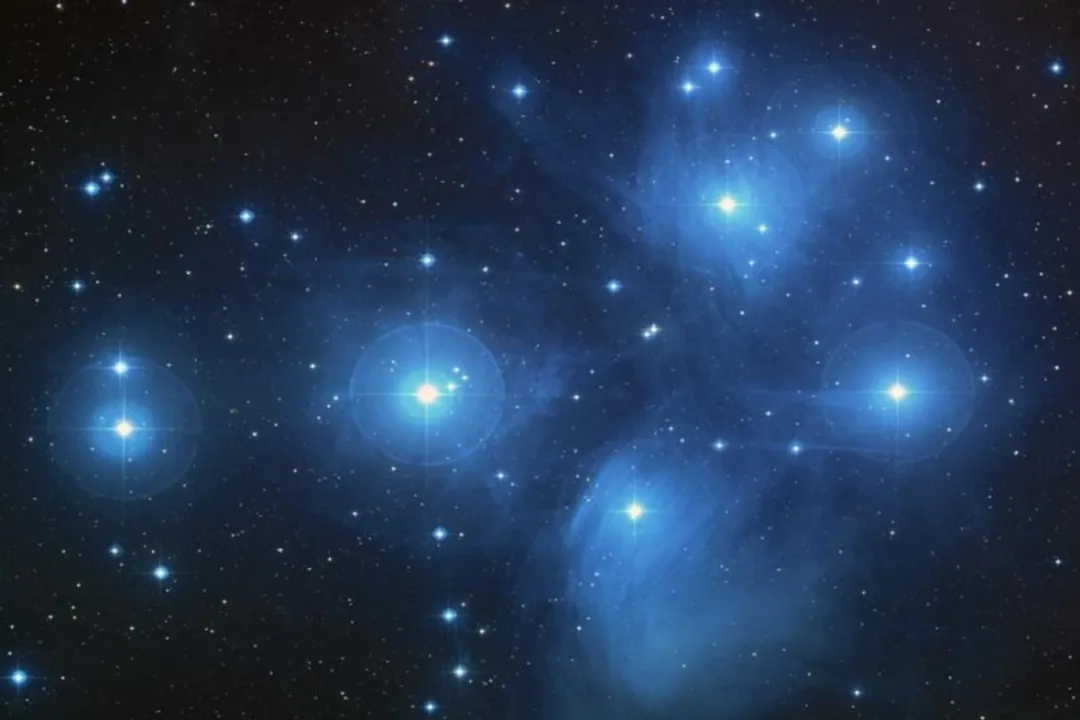
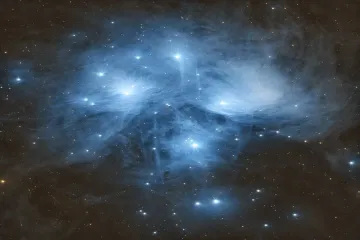
Open clusters are overwhelmingly characterized by their youth. Astronomers typically date them to be anywhere from a few million to about a billion years old. [9] This youthfulness is directly observable in their color. Because they are so young, they still contain a significant population of massive, luminous stars. [1] These massive stars burn their nuclear fuel incredibly fast and shine with a brilliant, hot, blue-white light. [1][3] Consequently, when observing a young open cluster through a telescope, the overall impression is one of bright, bluish diamonds strewn across velvet darkness. [3] As the cluster ages, these massive blue stars evolve and die off, leaving behind dimmer, longer-lived, yellower, or redder stars, which alters the cluster's visual signature over time. [1]
# Galactic Neighborhood
The location of open clusters within a galaxy is strongly correlated with where new stars are currently being made. In spiral galaxies like our own Milky Way, active star formation occurs predominantly in the spiral arms. [4][6][9] Therefore, open clusters are almost exclusively found embedded within the galactic disk, specifically tracing these spiral structures. [1][8] This is a fundamental contrast with globular clusters, which orbit in the sparsely populated galactic halo surrounding the main disk, indicative of their ancient origins from a time when the galaxy was forming its main structure. [8]
If you were to map out the location of all known open clusters in the Milky Way, you would effectively be tracing the galaxy’s current sites of active star birth. This concentration is an important factor in understanding galactic dynamics, as the clusters exist within the plane where gas clouds, magnetic fields, and density waves interact most strongly. [8]
# Loose Association
Unlike the tightly knit, spherical structures known as globular clusters, which can contain hundreds of thousands of stars packed into a volume only a few tens of light-years across, open clusters are loosely bound by gravity. [2][6][9] The stars are gravitationally connected, but the average distance between members is much greater than in a globular cluster. [9] This loose configuration has profound implications for their longevity.
The gravitational influence of passing clouds of gas and dust, or even close encounters with other stars or nebulae within the busy galactic disk, are enough to perturb the cluster's orbits and eventually pull the members apart. [2][8] This process, known as tidal stripping, means that open clusters have a relatively short cosmic lifespan, often lasting only a few hundred million years before dissolving completely into the general stellar population of the galaxy. [1][2][8] In essence, they are transient structures on the cosmic timescale. For amateur astronomers, this means that when you spot an open cluster, you are looking at something that is gravitationally temporary, a snapshot of stellar congregation that won't exist for long, geologically speaking. [6]
# Famous Families
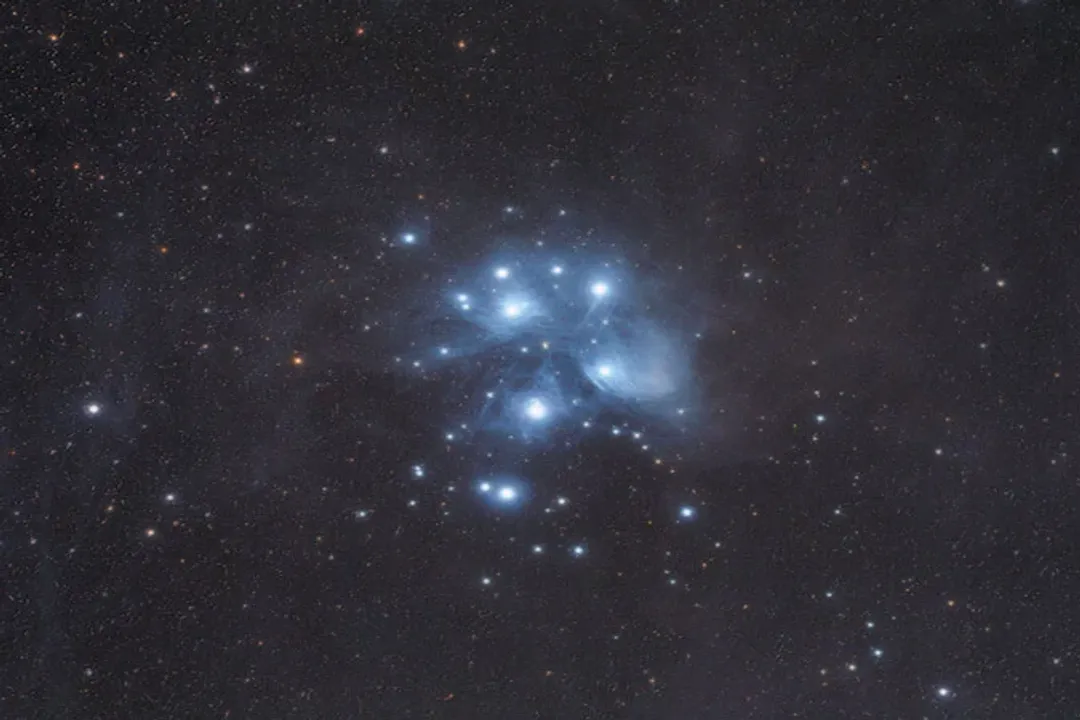
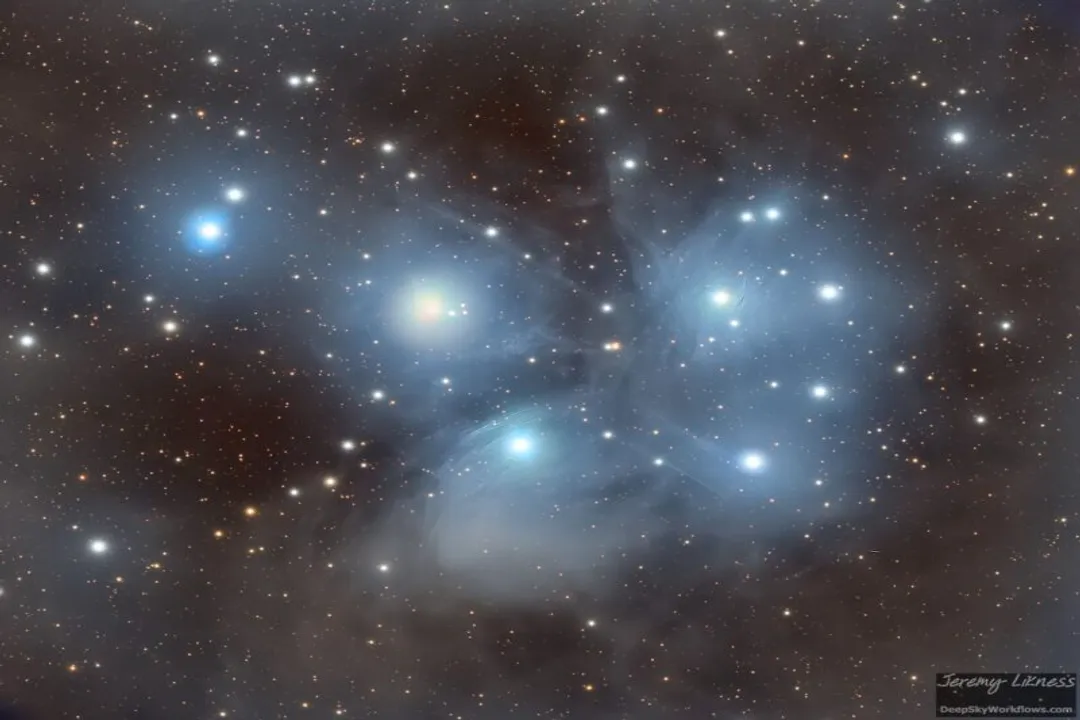
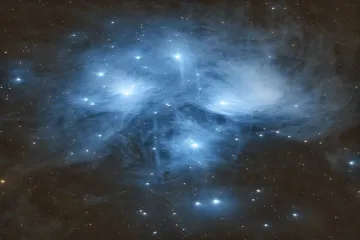
Several open clusters are famous enough to be easily recognizable, even to observers with modest equipment. One of the most famous is the Pleiades, also known in the Messier catalog as M45. [2][3][6] Often called the Seven Sisters, this cluster is one of the brightest and nearest to Earth, visible to the naked eye in the constellation Taurus. [6] Its distinctive blue light is apparent even without magnification.
Another spectacular example, especially rewarding for telescopic viewing, is the Double Cluster, which consists of two bright neighboring clusters: NGC 869 and NGC 884, located near the constellation Perseus. [6] These clusters offer a stunning view of bright, hot young stars grouped closely together against the background of the Milky Way plane. These examples serve as excellent test targets for anyone learning to use binoculars or a small telescope to scan the rich star fields of the galactic plane. [6]
# Comparison Table
To summarize the key distinctions between the two main types of star clusters based on their structure and location:
| Feature | Open Cluster | Globular Cluster |
|---|---|---|
| Shape | Irregular, loose grouping [2][6] | Dense, spherical [9] |
| Age | Young (millions to billion years) [9] | Ancient (billions of years) [8] |
| Location | Galactic Disk and Spiral Arms [1][8] | Galactic Halo and Bulge [8] |
| Star Count | Dozens to a few thousand [1][2] | Hundreds of thousands to millions [9] |
| Binding | Loosely bound by gravity [2][9] | Tightly bound by gravity [9] |
# The Dissolution Process
The final stage in the life of an open cluster is its inevitable dispersal. Because they lack the strong central gravitational pull of a globular cluster, the stars begin to drift apart over time. [2][8] This gravitational loosening is accelerated by external forces within the galaxy. [2] Imagine a handful of marbles scattered loosely on a table that is occasionally bumped; the marbles will spread out until they are no longer recognizably a group. The tidal forces exerted by the Milky Way's gravity act as those bumps, pulling the stars away from each other. [8]
Once the cluster has lost enough of its members to external interactions, or its internal velocity dispersion overcomes the remaining gravitational cohesion, it ceases to exist as a distinct entity. Its constituent stars continue orbiting the galactic center, now as field stars, indistinguishable from the billions of other stars that were never part of a cluster formation event. [2] It is a gentle fading rather than a catastrophic explosion that marks the end of an open cluster's life.
Related Questions
#Citations
Open cluster - ESA/Hubble
Open cluster - Wikipedia
Open star clusters are loose groups of stars - EarthSky
Star Clusters: Inside the Universe's Stellar Collections - NASA Science
Astronomy & Astrophysics 101: Open Cluster - SciTechDaily
What is an Open Star Cluster? Facts, Pictures, and Examples
Star Clusters | Center for Astrophysics | Harvard & Smithsonian
Why are open clusters and globular clusters found in different places?
Open Clusters | ASTRO 801: Planets, Stars, Galaxies, and the ...