What is a cluster in cosmology?
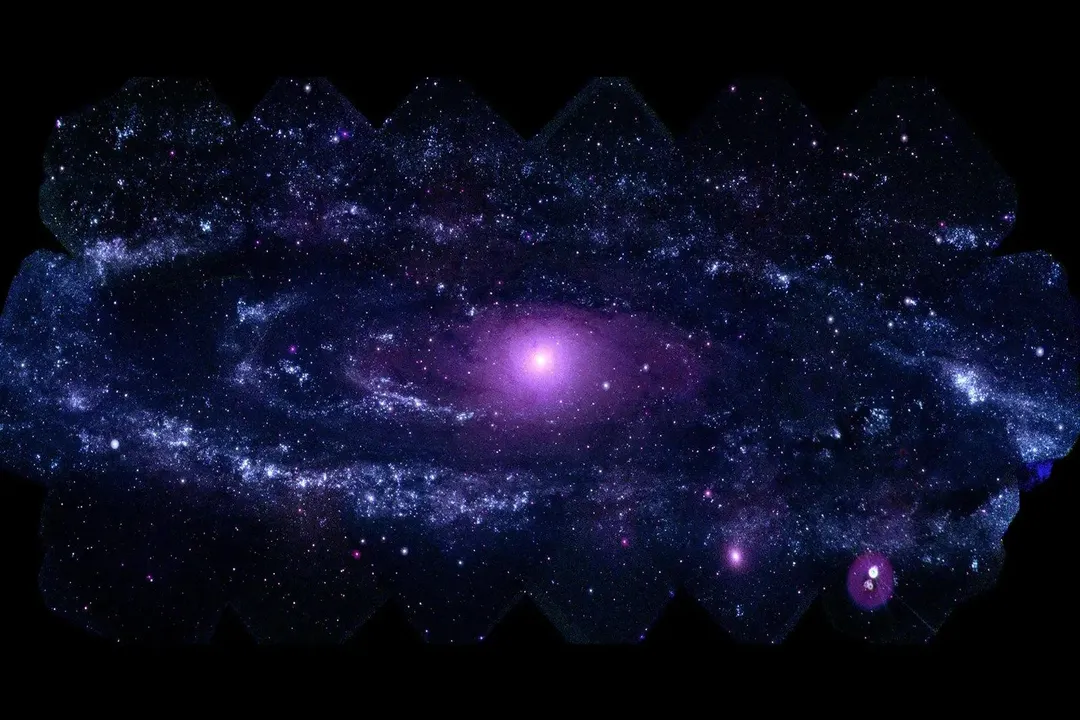
Galaxies are not scattered randomly throughout the universe; instead, they organize themselves into immense structures, and perhaps the grandest of these are galaxy clusters. [1][3] These colossal collections represent the largest gravitationally bound structures in the cosmos, acting as crucial laboratories for understanding how matter is distributed and how the largest structures in the universe formed over cosmic time. [2][3] A galaxy cluster is fundamentally a concentration of hundreds to thousands of galaxies, all bound together by their mutual gravitational attraction. [1][9] They are typically massive, containing matter equivalent to to times the mass of our Sun, which is orders of magnitude larger than a typical galaxy. [1][8]
# Structure Scales
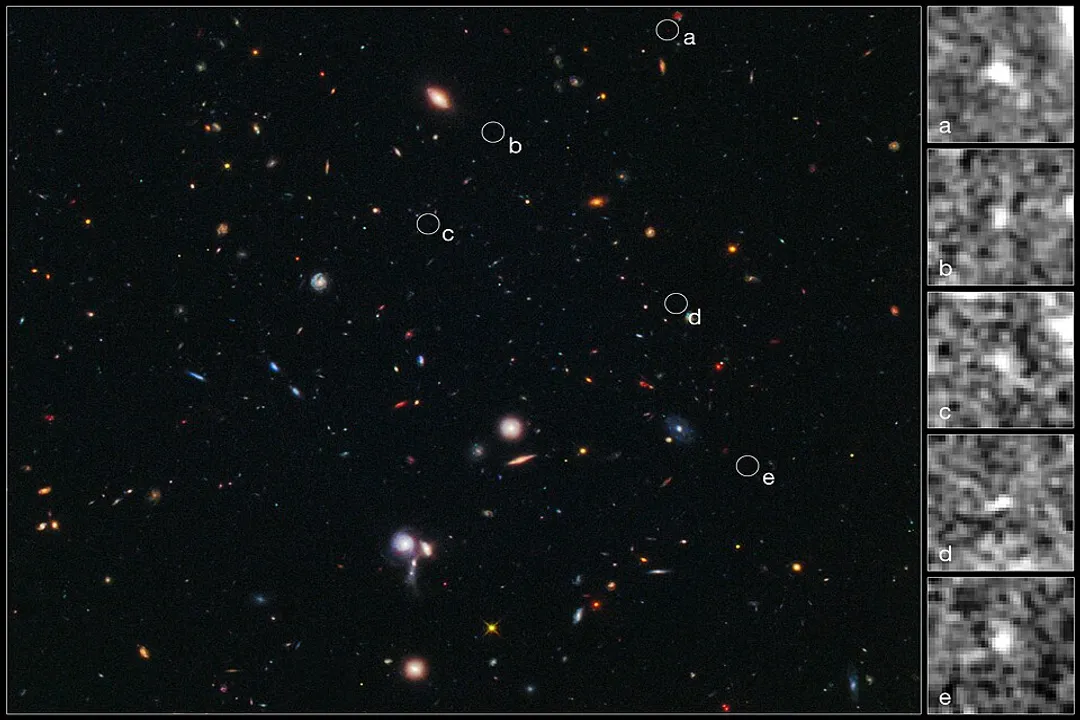
Understanding what defines a cluster requires looking at the cosmic hierarchy. In the grand scheme of the universe's architecture, galaxies themselves are generally organized into groups, which are smaller aggregations of perhaps fifty or fewer members. [1][4] Clusters, however, are significantly more substantial and dense than these galaxy groups. [1][4] While galaxy groups often have a more irregular shape, clusters tend toward a more spherical or ellipsoidal structure, though this structure is subject to ongoing dynamic evolution. [1]
The sheer scale of these objects is difficult to grasp intuitively. A massive cluster can span several million light-years across. [1] For comparison, the Milky Way galaxy is only about $100,000$ light-years in diameter. If our own galaxy were a coin, a massive cluster would encompass an area covered by thousands of such coins spread out across a continent. [2] This immense size means that the gravitational forces holding them together are enormous, primarily dictated not by the visible galaxies but by a vast, unseen component: dark matter. [2][8]
# Cosmic Web
Galaxy clusters do not exist in isolation; they are key nodes in the large-scale structure of the universe, often referred to as the cosmic web. [3] This web is characterized by filaments, sheets, voids, and walls of matter. [3] The clusters sit at the intersections, or knots, where the long filaments of dark matter and baryonic matter converge. [3][4] The filaments act as cosmic highways, channeling galaxies and gas toward these dense central meeting points. [3][4]
Thinking about the universe in terms of this structure provides context for cluster formation. The early universe was nearly uniform, but tiny quantum fluctuations created slight density variations. [7] Over billions of years, gravity amplified these denser regions. The largest of these regions grew into clusters, drawing in surrounding material along the cosmic web's filaments. [7] Therefore, a cluster is not just a random collection of galaxies; it is the result of the largest initial density peaks in the primordial universe collapsing and virializing under gravity. [8] It is worth noting a subtle distinction in classification; while some use the term "supercluster" for the largest groupings, these are often just looser associations of galaxy clusters and groups that are not necessarily gravitationally bound, unlike the true, gravitationally cohesive galaxy clusters themselves. [1][3]

# Internal Components
What is inside a cluster once it has formed? It is a surprisingly complex and energetic environment, far different from the relatively quiet space between galaxies. [5] The primary components are the galaxies themselves, the hot gas trapped within the cluster's gravitational well, and the dominant component, dark matter. [1][8]
# The Dark Component
The gravitational evidence overwhelmingly points to dark matter as the invisible scaffolding for clusters. [2][8] Dark matter, which does not emit or interact with light, provides the majority of the mass required to keep the cluster bound, especially against the high velocities of the constituent galaxies. [1][8] If we look at the total mass budget of a typical cluster, the contribution from visible matter—stars and gas—is surprisingly small compared to the inferred gravitational mass. [8] This mass discrepancy is what initially fueled the study of dark matter in the context of galaxy clusters, dating back to observations like those of Fritz Zwicky in the Coma Cluster. [9]
# The Hot Gas
One of the most distinctive features of galaxy clusters is the Intracluster Medium (ICM). [5][9] This is a superheated plasma—ionized gas—that permeates the space between the galaxies. [5][9] Because this gas is so hot, it radiates strongly in X-rays, which is one of the primary ways astronomers detect and study these structures. [5][9] The ICM represents a significant fraction of the baryonic (normal) mass in a cluster, often outweighing the mass of all the visible stars combined. [5] The gas is held in place by the cluster's immense gravity, having been stripped from the individual galaxies or accumulated over cosmic time. [5] Studying the temperature and distribution of the ICM gives scientists vital clues about the cluster's formation history and its total mass profile. [5]
# Galaxy Evolution
The environment within a cluster drastically affects the galaxies residing there. [5] Galaxies that fall into a cluster experience significant interactions that can strip away their gas reserves—a process known as ram-pressure stripping by the dense ICM. [5] This stripping halts the galaxy's ability to form new stars, causing it to evolve more quickly into a "red and dead" elliptical or lenticular galaxy. [5][7] Consequently, clusters tend to be dominated by older, elliptical galaxies, especially near the center, while spiral galaxies (like our Milky Way) are more common in the less dense outskirts or in isolated groups. [5][7]
One fascinating aspect arises when considering the life cycle of a galaxy before it settles. A galaxy falling into a cluster for the first time might be significantly altered by tidal forces from the cluster's largest members, known as BCGs (Brightest Cluster Galaxies), even before it reaches the very core. These tidal interactions can shear off outer stellar halos, effectively pruning the galaxy into a different morphological class than it would have otherwise become in isolation. [4] This environmental sculpting is a key area of research for understanding galaxy diversity. [4]
# Observation and Measurement
Detecting a structure millions of light-years across that is mostly dark matter requires looking for its integrated gravitational effects and its high-energy emissions.
# X-ray Emission
As mentioned, the ICM is extremely hot, often reaching temperatures of tens of millions of degrees Celsius. [5] At these temperatures, the gas glows brightly in X-rays. [5][9] Instruments like the Chandra X-ray Observatory specialize in detecting this faint, diffuse X-ray glow emanating from the cluster's center, which allows astronomers to map the gravitational potential well that confines the gas. [9]
# Gravitational Lensing
A more powerful, and perhaps the most accurate, method for weighing a cluster relies on Einstein’s General Relativity: gravitational lensing. [2] Massive objects bend the fabric of spacetime, causing the light from background galaxies to be distorted, magnified, or multiply imaged as it passes near the cluster. [2] By analyzing the degree of this distortion—the shear—scientists can create a detailed map of the total mass distribution, revealing the location and extent of the underlying dark matter halo. [2][8] This technique offers a direct, mass-based measurement, independent of the cluster's dynamics or X-ray temperature, which provides a crucial cross-check against other methods. [8]
# Dynamic States
Clusters are not static; they are dynamic systems constantly undergoing gravitational interactions, which can be broadly categorized into relaxed (virialized) and unrelaxed (merging) states. [1][8]
# Virialization
A virialized cluster is one that has settled down after billions of years of gravitational collapse. In this state, the kinetic energy of the constituent galaxies and the potential energy are in a state of equilibrium, meaning the cluster is gravitationally stable and bound. [8] These clusters tend to have smoother X-ray emission profiles and more regular, spherical shapes. [1] Our own Virgo Cluster is often cited as an example of a structure that is relatively close to this state, though still evolving. [1]
# Merging Systems
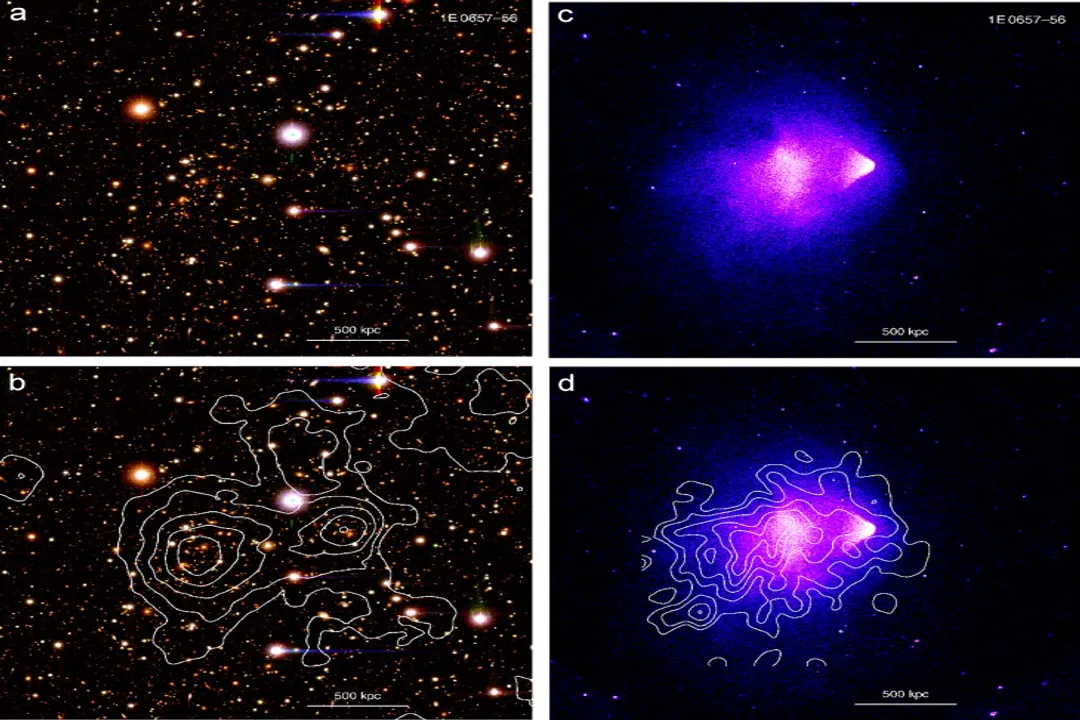
The universe is still relatively young, and the process of structure formation is ongoing. Therefore, many massive structures we observe today are actually clusters in the process of merging. [3] When two or more clusters collide, the event is incredibly violent on a cosmic timescale, releasing vast amounts of energy and dynamically heating the ICM. [5] During a merger, the visible gas clouds slam into each other, creating shock fronts that can heat the plasma significantly, while the invisible dark matter halos pass right through one another with minimal interaction. [3][5] Observing these mergers—often identified by disturbed X-ray morphologies or non-symmetric galaxy distributions—allows scientists to study the nature of dark matter, as the separation of the gas from the dark matter provides a unique observational test. [3]
If we consider the Bullet Cluster as a classic case study, we see the dark matter halos passing through each other nearly unimpeded, while the hot gas from the two systems collides and slows down, separating visibly from the mass distribution as traced by lensing. [2] This separation is considered one of the strongest pieces of evidence supporting the existence of non-baryonic dark matter. [2]
# Comparing Structures
To really appreciate the significance of a cluster, it helps to place it against other large-scale features.
| Structure Type | Typical Member Count | Mass Range () | Gravitationally Bound? | Primary Component |
|---|---|---|---|---|
| Galaxy Group | to $50$ | Yes | Spiral Galaxies | |
| Galaxy Cluster | to $1000+$ | to | Yes | Dark Matter Halo & ICM |
| Supercluster | Collections of Groups/Clusters | Not applicable (often unbound) | No | Large-scale filamentary arrangement |
While superclusters are vast, it is important to remember their ephemeral nature. A supercluster is more of a "city name" describing a large region of space where the density is slightly higher than average, whereas a cluster is a genuine gravitationally bound "family unit" that will survive intact for the age of the universe. [3] If you could observe a supercluster over tens of billions of years, you would likely see its constituent clusters and groups eventually separating or falling into larger, yet-to-be-formed mega-structures. [7]
# Research Implications
The study of galaxy clusters offers profound insights into cosmology because their formation is sensitive to the fundamental parameters that govern the universe's evolution. For instance, the rate at which clusters have formed and grown over time depends heavily on the density of matter in the universe () and the amount of dark energy (). [8]
A deeper investigation into the oldest, most distant clusters—those seen as they were just a few billion years after the Big Bang—is particularly revealing. Observing them allows cosmologists to place constraints on cosmological models. If the universe had contained significantly more matter than it did, structure formation would have happened much faster, leading to more massive clusters in the early epochs than are currently observed. [7] Conversely, a universe dominated too heavily by dark energy would have inhibited the growth of these large structures, resulting in fewer massive clusters today. [8]
Furthermore, the study of cluster environments touches upon the subtle differences between galaxy populations in various density regimes. While we noted ellipticals dominate the core, understanding the transition zone—where infalling spirals are first stripped of gas—is crucial. It is in these intermediate regions, often a few million light-years from the absolute center, that astronomers find evidence for the subtle 'starvation' process affecting newly arrived galaxies, long before they become fully quenched ellipticals in the core. This gradual change, rather than an abrupt switch, suggests that the environmental effects are complex and happen across a range of distances defined by the cluster's total mass halo, not just its visible boundary. [5] The distribution of satellite galaxies around the central Brightest Cluster Galaxy (BCG) can serve as a proxy for this mass distribution, offering an independent, galaxy-centric way to map the dark matter structure around the most dominant member. [4]
Galaxy clusters stand as monumental landmarks in our cosmos. They are the largest gravitationally bound structures, representing the final state of baryonic and dark matter collapse along the filaments of the cosmic web. [1][3] By studying the hundreds or thousands of galaxies they contain, the scorching hot X-ray emitting gas (the ICM), and the dominant gravitational fingerprints left by dark matter through lensing, astronomers gain direct access to the physics governing the universe on the grandest scales. [2][8] They are not merely collections of galaxies; they are the universe's most massive milestones, recording its entire history of growth and interaction. [9]
#Videos
Cluster, Field, and Void Galaxies: What Are They? - YouTube
Related Questions
#Citations
Galaxy cluster - Wikipedia
Galaxy Clusters
Large Scale Structures - NASA Science
Galaxy Clustering - Astronomy in Hawaii
Cluster Environment | COSMOS
Cluster, Field, and Void Galaxies: What Are They? - YouTube
The Origins of the Universe: Galaxy clusters and large scale structure
Galaxy Clusters - Rutgers Physics
Galaxy Clusters - an overview | ScienceDirect Topics