Which of the following statements about open clusters is true?
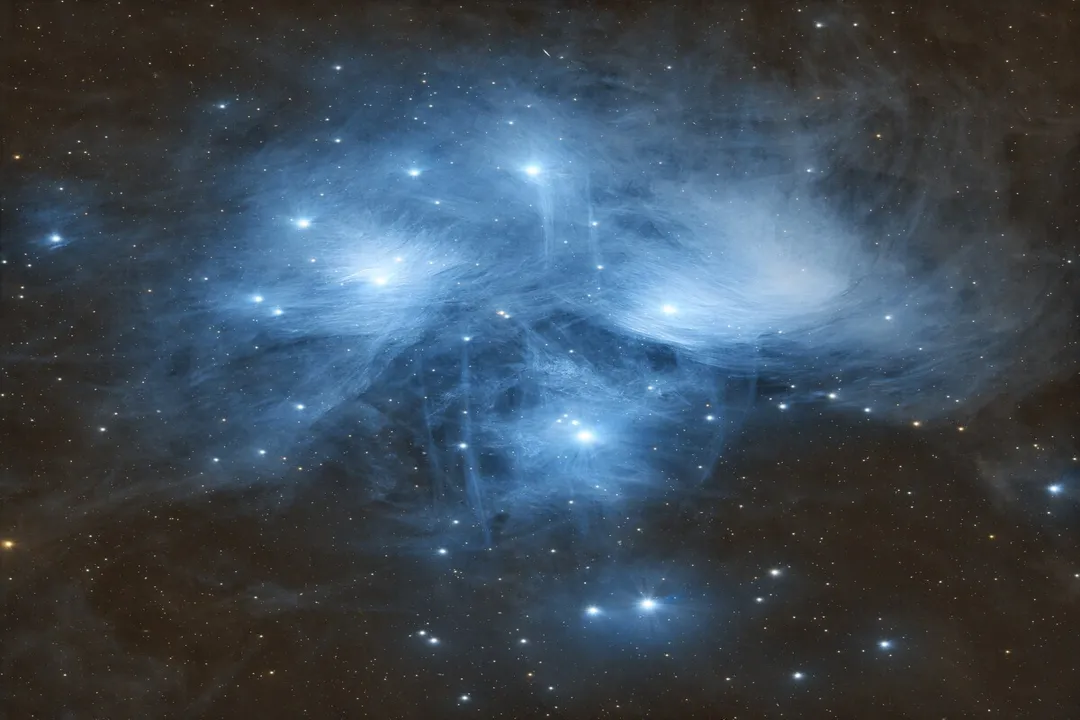
Clusters of stars, often appearing as faint, hazy patches to the unaided eye, represent some of the most dynamic and fascinating structures within our Milky Way galaxy. These groupings, known scientifically as open clusters, are fundamentally different from their ancient, dense cousins, the globular clusters. A true statement about these stellar societies is that they are collections of stars born together, sharing a common origin in time and space.
These stellar nurseries begin their lives deep within the vast, cold expanses of giant molecular clouds—cosmic reservoirs of gas and dust containing masses up to many thousands of times that of our Sun. The process of forming an open cluster is triggered when a portion of this cloud becomes unstable, perhaps due to shock waves from a nearby supernova or a collision with another cloud, initiating a gravitational collapse. This collapse fragments the gas into denser clumps, eventually forming up to several thousand stars. Because they originate from the same localized stellar birthplace, all members of an open cluster share approximately the same age and chemical composition, a characteristic that makes them indispensable tools for astronomers.
# Stellar Kinship
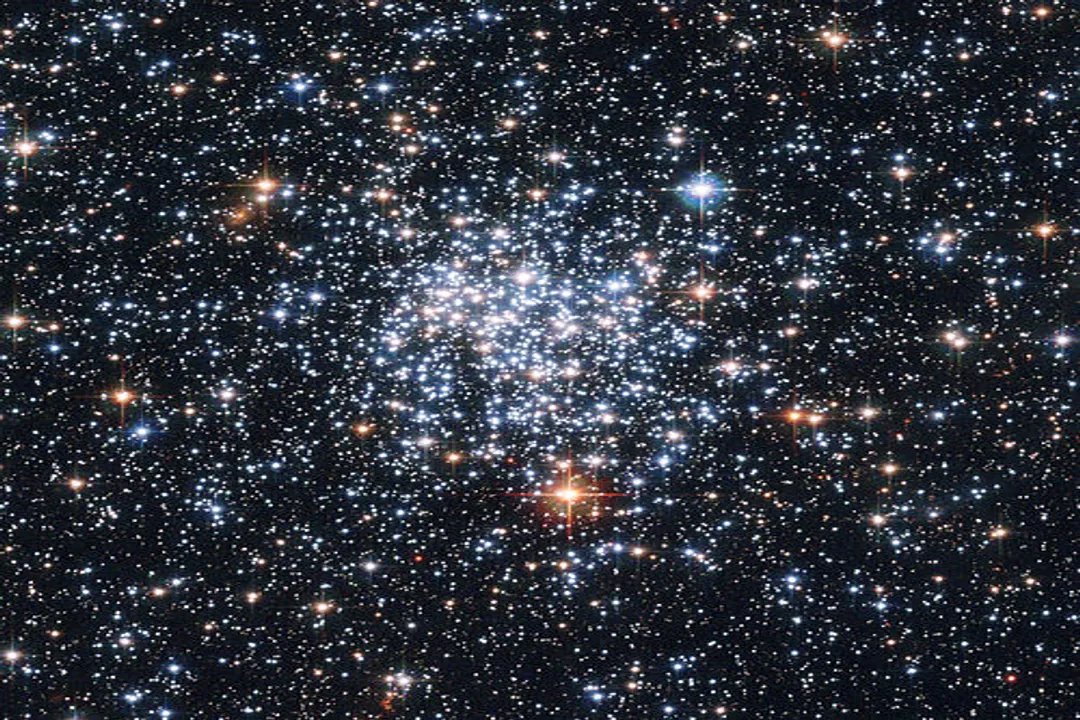
The defining feature of an open cluster is the uniformity of its stellar population, at least initially. Since the entire group formed simultaneously from the same cloud material, the stars possess a nearly identical age. This shared history is crucial. When plotting the stars on a Hertzsprung-Russell (H-R) diagram, most will line up on the main sequence. The most massive stars, which burn through their fuel rapidly, will have already begun evolving into red giants, and the position where the cluster's stars begin to peel away from the main sequence serves as a direct, reliable method for estimating the cluster's age.
Because all stars are also roughly the same distance from Earth, differences in their apparent brightness are almost entirely a function of their inherent mass. This fixed set of variables—distance, age, and initial composition—is why open clusters are considered key objects in the study of stellar evolution. Observing how these stars evolve allows astrophysicists to test models of stellar interiors; for instance, studying the depletion of light elements like lithium and beryllium in cluster members provides clues about mixing processes within the stars, variables that would be much harder to isolate in isolated field stars.
A related characteristic is their distribution of spectral types. Contrary to the idea that they might contain an equal mix of all types, the light from many open clusters is dominated by young, hot, blue stars. These blue stars are the most massive and consequently have the shortest lifespans, often living only a few tens of millions of years. As a cluster ages and disperses, its remaining visible light shifts toward the longer-lived, cooler yellow stars.
# Structural Features
Open clusters are not the tightly packed spheres we see in globular clusters; they are characterized by being loosely bound by their mutual gravitational attraction. Their structure is typically described as having a relatively distinct, dense core surrounded by a more diffuse outer region, or corona, of members. Diameters are generally constrained, often around 30 light-years across. The core region might span only about 3 to 4 light-years, while the corona extends outward perhaps 20 light-years from the center.
The difference in stellar density between a cluster core and the general galactic field is staggering. In the center of a typical open cluster, the density can reach about 1.5 stars per cubic light-year. To put that into perspective, if we consider the region around our own Sun, the density is closer to $0.003$ stars per cubic light-year. This means that in the cluster's heart, you have roughly 500 times the number of stars packed into the same volume of space as we experience here in the solar neighborhood. While the immense distances between stars in the core still mean close encounters are relatively rare—perhaps once every 10 million years for a star in a typical 1,000-star cluster—these interactions are frequent enough to significantly impact the development of surrounding circumstellar disks. Such close gravitational disturbances can even contribute to the formation of massive planets or brown dwarfs orbiting at distances of 100 Astronomical Units or more from their host star.
# Galactic Placement
The location of open clusters is highly specific, directly correlating with ongoing star formation activity. They are found almost exclusively within spiral and irregular galaxies—the types of galaxies that still possess the necessary gas and dust to create new stars. Elliptical galaxies, having long since ceased significant star formation, do not host any open clusters, as any that might have formed long ago would have already dispersed.
Within our own Milky Way, open clusters are heavily concentrated in the plane of the galactic disk. Their distribution is tightly confined, showing a scale height of only about 180 light-years perpendicular to the plane, which is tiny compared to the galaxy's overall radius of about 50,000 light-years. This concentration places them near the spiral arms where gas density peaks. Interestingly, the age of the cluster influences its current position; older open clusters are generally found further from the Galactic Center, often at greater distances above or below the galactic plane. This might seem counterintuitive, but the inner galaxy experiences stronger tidal forces that accelerate cluster disruption, meaning only the most tightly bound clusters survive long enough to be observed near the core, while older, less tightly bound ones have already been dispersed or pushed outward.
# Ephemeral Existence
Perhaps the most significant true statement about open clusters is their relatively brief lifespan. They are not permanent fixtures of the cosmos; they are inherently transient structures. Many young clusters are so low in mass that the escape velocity is easily overcome by the stars' internal motions once the formation gas evaporates, causing rapid dissolution within a few million years.
Even the more substantial clusters only last for tens to hundreds of millions of years. This limited longevity is due to both internal and external pressures. Internally, close gravitational encounters between stars can impart enough velocity to an individual star, effectively kicking it out of the cluster—a process known as evaporation. Externally, the cluster's orbit around the Galactic Center subjects it to tidal forces, especially when it passes near or through a molecular cloud, which tears the loose structure apart. Over time, this leads to the cluster transforming into a stellar association or a stream of stars moving together, before eventually scattering into the general galactic field population. In contrast, the far more massive globular clusters, with their much stronger gravitational cohesion, can survive for billions of years.
# Evolutionary Laboratories
The consistency of their initial conditions elevates open clusters from mere collections of stars to indispensable scientific laboratories. Astronomers can determine properties like metallicity, distance, and extinction with greater confidence for a cluster than for a single, isolated star because the variables that plague field-star analysis are mostly neutralized.
Consider the task of determining distance. For the closest examples, like the Pleiades or Hyades, direct parallax measurements are possible. However, for more distant clusters, the moving cluster method proves invaluable. This technique relies on the cluster members sharing a common proper motion across the sky, allowing their motions to converge toward a vanishing point. By combining this geometric information with measured radial velocities (from the Doppler shift in their spectra), simple trigonometry yields a precise distance. Once these nearby distances are calibrated using open clusters, the main sequence H-R diagram of a more distant cluster can be matched to the calibrated one, extending the astronomical distance scale further out. This chain of calibration, starting with parallax and moving cluster methods on open clusters, is ultimately necessary to calibrate standard candles like Cepheid variables, which then measure distances to other galaxies.
An interesting analytical point arises from the study of stellar remnants. While medium- to low-mass stars evolve into white dwarfs after their red giant phase, open clusters show a deficit of expected white dwarfs. One hypothesis suggests that the asymmetric loss of material when a red giant sheds its outer layers to form a planetary nebula might impart a slight gravitational 'kick'—just a few kilometers per second—sufficient to eject the newly formed white dwarf entirely from the loosely bound cluster environment. Thus, the absence of certain stars is itself a clue to the cluster's ongoing dynamical evolution.
# Birth Dynamics
The immediate aftermath of an open cluster's birth is a period of violence and rapid change. The most massive stars formed in the initial burst—the OB stars—begin to shine intensely, emitting ultraviolet radiation that ionizes and pushes away the remaining gas of the parent molecular cloud, creating an H II region. Stellar winds and radiation pressure work to clear this natal gas envelope. Furthermore, within about ten million years, the first core-collapse supernovae occur, accelerating the expulsion of gas.
This violent removal of material leads to a phenomenon called infant mortality for the cluster. Since only a fraction of the cloud's mass actually coalesces into stars (often only 1–10% of the gas volume above the critical density threshold), stripping away the remaining gas can leave the newly formed stellar group only loosely bound gravitationally. It is estimated that half of the protostellar objects might be left with circumstellar disks, but the cluster itself may retain only about a third of its original stellar count if the gas expulsion event is too energetic, with the rest becoming unbound field stars.
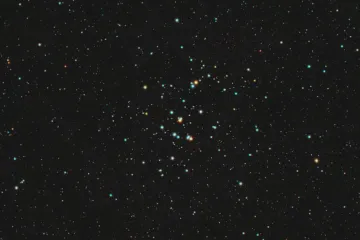
This common formation mechanism explains why some clusters form in multiples. The Hyades and Praesepe, two prominent nearby clusters, are suspected to have originated from the same cloud about 600 million years ago. When two such clusters are born closely enough, they can form a binary cluster, the most famous example being the Double Cluster of NGC 869 and NGC 884 in Perseus.
# Trumpler Classification
To systematize the growing catalog of known open clusters, Robert Trumpler developed a classification scheme in 1930 that uses a three-part designation. The first part is a Roman numeral (I through IV) indicating how disparate or spread out the stars appear, with IV being the most spread out. The second part is an Arabic numeral (1 through 3) describing the range of brightness among the members, with 3 indicating a large range. The final part is a letter (p, m, or r) signifying if the cluster is poor, medium, or rich in stars. If the cluster is currently embedded within nebulosity, an 'n' is appended to the designation. For instance, the famous Pleiades cluster is classified as I3rn, signifying it is relatively compact (I), has a large range in brightness (3), is rich (r), and is located near nebulosity (n). This system provides immediate insight into a cluster's morphology and apparent richness without needing extensive follow-up study.
# Planets
It is also true that stars within open clusters are capable of hosting exoplanets, just like solitary stars in the galactic field. Evidence for this includes planetary systems found orbiting stars in clusters such as NGC 6811 and the existence of several Hot Jupiters identified within the well-known Beehive Cluster. This demonstrates that the turbulent, high-density environment of a young cluster does not preclude the formation of stable planetary systems, though the later gravitational disruptions may certainly affect those orbits over cosmic timescales.
Related Questions
#Citations
Which of the following statements about open clusters is true? - Chegg
Which of the following statements about open clusters of stars is ...
Open cluster - Wikipedia