Can life exist in globular clusters?
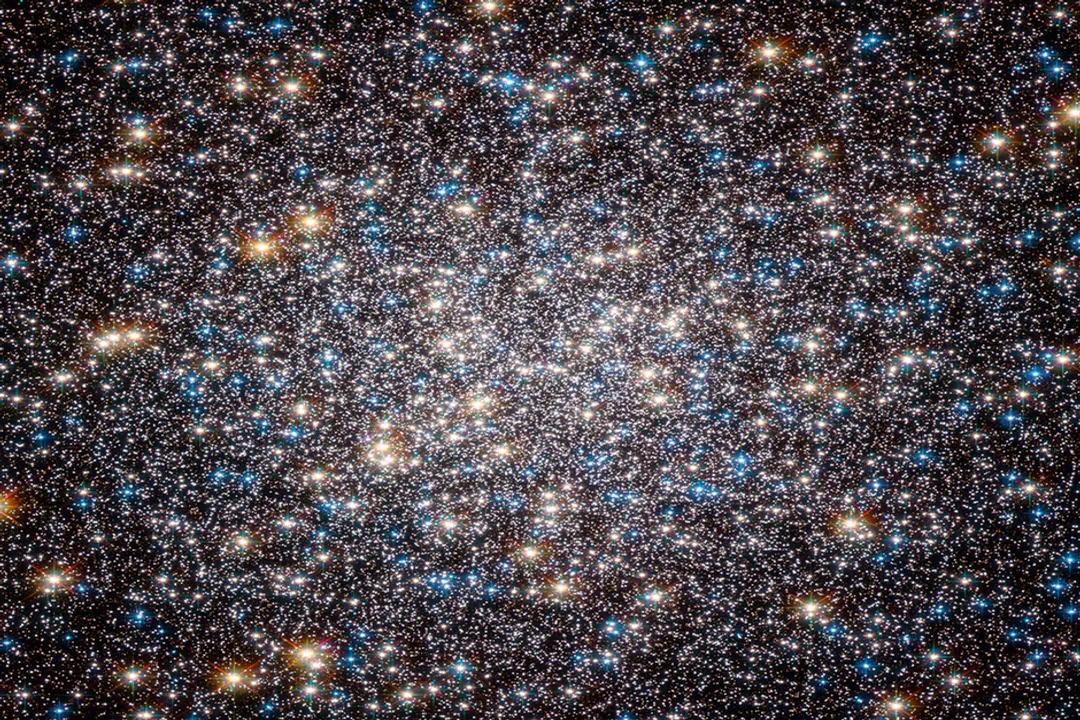
The ancient, tightly packed gatherings of stars known as globular clusters present one of the universe's most fascinating environments for astrobiology. These spherical collections, often containing hundreds of thousands to millions of stars, are fundamentally different from our own sparsely populated galactic neighborhood. The sheer concentration of stellar neighbors raises the immediate question of habitability, pitting the statistical advantage of sheer numbers against severe environmental limitations inherent to these stellar relics. [2][7]
# Old Cities
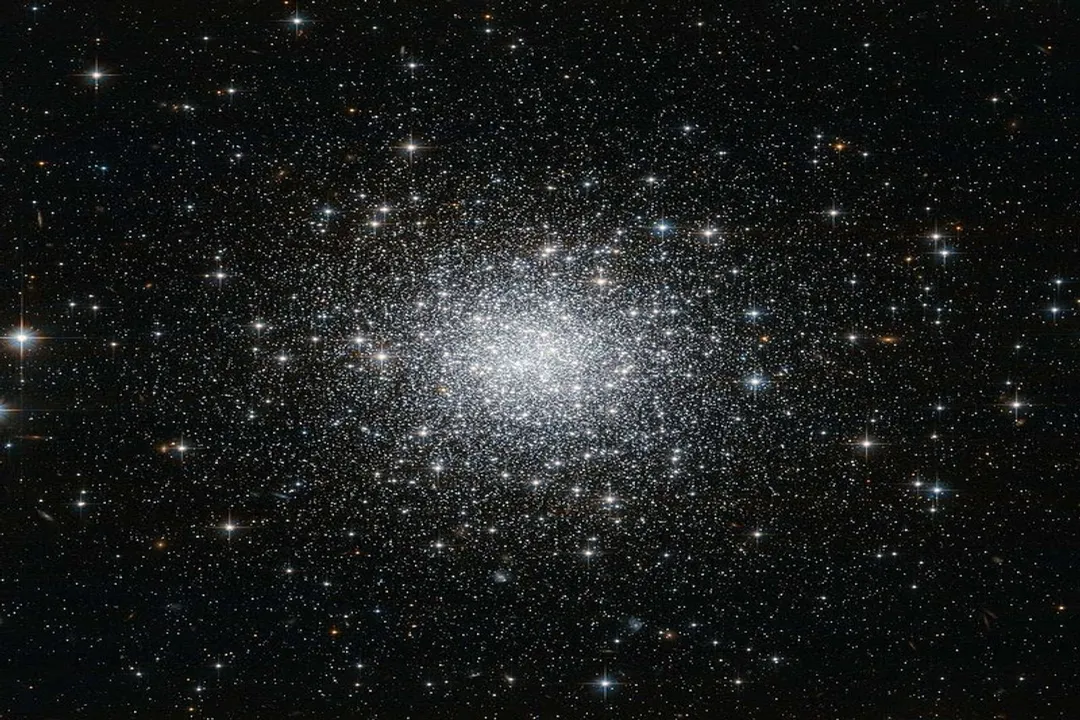
Globular clusters are among the oldest structures in the Milky Way, sometimes predating the galaxy's disk formation by billions of years. [5] This extreme age means that if life can take hold somewhere, these locations have provided an immense amount of time—perhaps over 12 billion years—for evolution to proceed, potentially leading to incredibly advanced, long-lived civilizations. [7][9] They are stellar metropolises, incredibly dense collections of stars, sometimes containing a million suns packed into a volume only a few dozen light-years across. [4]
However, the stars populating these clusters are generally of Population II, meaning they are metal-poor. [5] In astrophysics, "metals" refers to any element heavier than hydrogen and helium, such as carbon, oxygen, iron, and silicon—the very building blocks of rocky planets and biological chemistry as we understand it. [9] Because the earliest stars formed before successive generations of supernovae enriched the interstellar medium with these heavier elements, the raw materials for terrestrial worlds might be scarce. [6][9] While the sheer number of stars offers many chances for an event like abiogenesis to occur, the chemical building blocks necessary for a truly Earth-like world may be missing or extremely rare in the cluster's foundational material.
# Planetary Rarity

The metallicity issue forms the most substantial hurdle for life in these old stellar islands. Planets form from the heavy elements available in a star's protoplanetary disk. [6] A star with very low metallicity, such as those common in the oldest globular clusters, is significantly less likely to host rocky planets like Earth. [8] While gas giants might still form, the consensus leans toward a lack of suitable real estate for life needing solid surfaces and complex chemistry. [6]
Consider Omega Centauri, one of the largest and most famous globular clusters. Studies focusing on its stellar populations suggest that it is an unlikely harbor for life, specifically because of its age and chemical composition, which favors fewer small, rocky bodies capable of sustaining biological processes. [8] The implication is clear: if life requires a certain chemical prerequisite that was only widely available after the first few billion years of the universe, then the very first stellar neighborhoods—the globular clusters—may have missed the boat entirely. [9]

# Density Effects
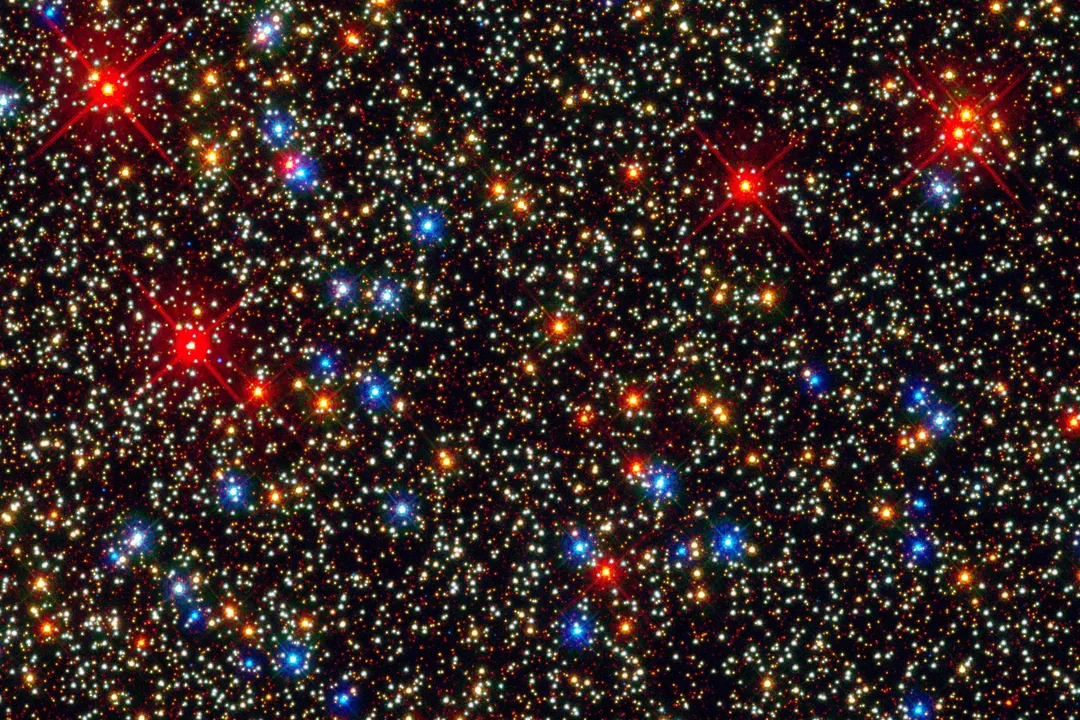
The environment inside a cluster is diametrically opposed to the peaceful isolation experienced by our own Sun in the Orion Arm of the Milky Way. The high stellar density means that the night sky, if one could see it amidst the brightness, would be stunningly illuminated. [4] Instead of a scattering of faint stars, the background would be dominated by the glare of countless other suns. [4]
This crowding leads to significant dynamic interactions. Stars pass close to one another far more frequently than in the galactic disk. [7] These close encounters can gravitationally disrupt planetary systems, ejecting planets entirely or sending them spiraling into their host stars. [4] For a civilization, this means planetary stability over billions of years—a timeline necessary for complex evolution—is heavily threatened by gravitational chaos. [7]
However, there is a counterpoint to this danger. The incredible density means that even if the probability of any single star forming a habitable planet is low due to metallicity, the total number of chances available across the entire cluster is astronomical. [2][7] It’s a high-risk, high-reward scenario statistically. If a small percentage of stars successfully form stable, life-bearing worlds despite the metallicity constraints—perhaps through mechanisms we don't yet fully appreciate, like the capture of rogue planets or unique formation processes—then the total count of civilizations in the cluster could vastly exceed that of a comparable volume of space in the galactic disk. [2]
# Life Scenarios
What would life look like under these conditions? Living inside the cluster core would be an existence defined by gravitational flux and perpetual bright skies. An observer would see the core of the cluster as a blindingly bright sphere, with individual stars appearing much closer and larger than they do to us. [4] The concept of orbital stability, essential for long-term evolutionary trajectories, might translate into a completely different view of physics and astronomy for any advanced intelligence that did arise there. [4]
One could speculate that any civilization that does thrive in the violent core of a globular cluster would likely have achieved a technological mastery that allows them to adapt to or even manipulate these gravitational challenges. Perhaps they master high-precision, rapid course correction for their planet or construct vast, self-contained mobile habitats, rather than relying on static planetary orbits. [2] This contrasts sharply with our own evolutionary history, which unfolded in a relatively calm stellar nursery. Our technological development is likely colored by a predictable, stable home environment, something an intelligent species in a cluster core would never experience.
If we look toward the periphery of the cluster, the environment might be calmer, resembling the conditions needed for planet formation more closely than the chaotic core. The challenge then reverts to the initial chemical composition: were the stars that formed on the outskirts of the cluster slightly more enriched with heavy elements, or did they form late enough to capture material from earlier star generations? Finding life, if it exists, might necessitate searching the edges, where the high-density advantage lessens, but the gravitational hazards are significantly reduced. [4]
# Stellar Longevity
The age of globular cluster stars, while seemingly a benefit for evolutionary time, also introduces complications related to stellar lifespans. Most stars in these clusters are low-mass, long-lived red dwarfs or K-type stars. [5] While a long lifespan is good for a planet's habitability clock, the radiation profiles of these cooler stars can be problematic for complex biology, often involving frequent, intense flaring activity, especially early in their lives. [5]
A star must be old enough to have allowed life to evolve, but young enough that it hasn't yet exhausted its fuel or swelled into a destructive red giant. [5] Since globular clusters are so old, many of their initial, sun-like stars may have already exhausted their fuel and died, leaving behind white dwarfs, or they may be nearing the end of their main-sequence lives. [5] This suggests that the window for habitable planet formation and subsequent evolution might be closing, or indeed may have already passed for the most massive initial inhabitants of the cluster. The question shifts from "Can life form?" to "Has the window for life already shut?"
It is an interesting exercise to compare the typical star in a globular cluster to the Sun. The Sun is a Population I star, formed relatively recently in the galactic disk, rich in metals. If we could somehow transplant a solar-mass star from the cluster's main body into our current location, its entire planetary system would likely be severely starved of the necessary silicates and iron to build an Earth-analog. The fact that our galaxy allowed for the formation of metal-rich stars after the initial cluster-building phase fundamentally changes the prospects for life formation in the disk versus the spheroid. [9]
# Scientific Search Focus
Because direct observation of planets around the faint, distant stars in globular clusters is currently extremely difficult, scientists often focus on chemical signatures and the dynamics of the system itself. [6] The search for life in these dense nurseries is less about finding green slime and more about understanding the statistical odds based on fundamental astrophysics: metallicity, stellar dynamics, and age. [2][6] While there is hope that the sheer numbers might overcome the low probability of any single system, the harsh chemical environment remains a powerful veto against the emergence of familiar biospheres. [8] Ultimately, confirming life in a globular cluster would require finding evidence of rocky planets or bio-signatures that could somehow form or survive under conditions profoundly different from those that nurtured life here on Earth. [7]
#Videos
What If We Lived in a Globular Cluster? - YouTube
Related Questions
#Citations
Is Life possible in a Globular Cluster? : r/Astronomy - Reddit
Globular Clusters Could Nurture Interstellar Civilizations
What If We Lived in a Globular Cluster? - YouTube
What would it be like if we lived inside a globular cluster? - Quora
Could globular clusters be home to intelligent life? - Astronomy Now
GLOBULAR CLUSTERS AS CRADLES OF LIFE AND ADVANCED ...
Globular Clusters as Cradles of Life and Advanced Civilizations
Omega centauri unlikely to harbor life - UCR News - UC Riverside
Globular Clusters: Home to Intelligent Life? - Centauri Dreams