What does the mass disparity between the closer Pluto and the more distant, heavier Eris imply?
Answer
It implies that the distribution of material in the early solar nebula was non-uniform.
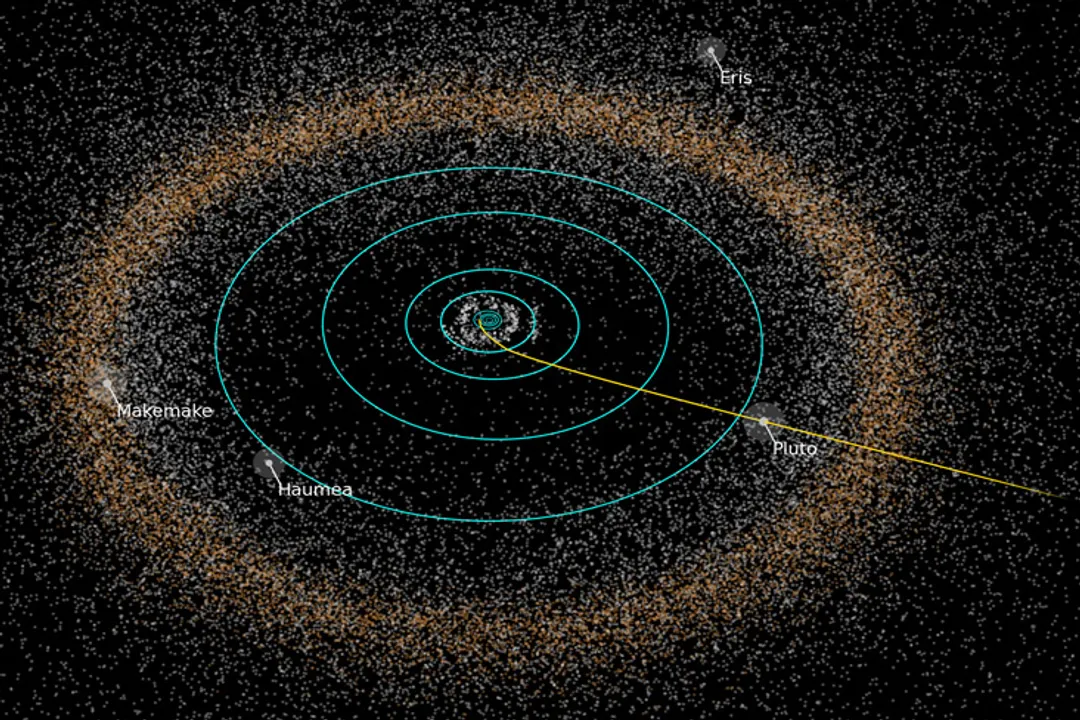
The observation that Pluto orbits closer to the Sun (around 30 AU) than Eris, yet Eris is discovered to be more massive, presents an important clue about solar system formation. This differing density gradient suggests that the initial condensation of material within the solar nebula—the cloud of gas and dust that formed the planets—was not homogenous or uniform across the entire disk. The difference implies that the initial raw materials available for accretion varied significantly based on the distance from the nascent Sun, leading to different outcomes for massive bodies like Pluto and Eris.
Related Questions
What is the general outward extension range of the Kuiper Belt from the Sun?What key compositional element differentiates KBOs from the rockier objects in the Asteroid Belt?How does Pluto function as the anchor point for understanding the overall population of KBOs?What specific physical state allows a massive KBO to earn the classification of a dwarf planet?What makes the dwarf planet Haumea a bizarre object among the major Kuiper Belt worlds?Which type of comet is considered to originate from the Kuiper Belt reservoir through gravitational perturbations?What critical information about accretion processes did the New Horizons flyby of Arrokoth provide?What measurement generally defines the starting distance of the Kuiper Belt from the Sun?What does the mass disparity between the closer Pluto and the more distant, heavier Eris imply?How is a Kuiper Belt Object (KBO) fundamentally defined by its orbital path?