How is a Kuiper Belt Object (KBO) fundamentally defined by its orbital path?
Answer
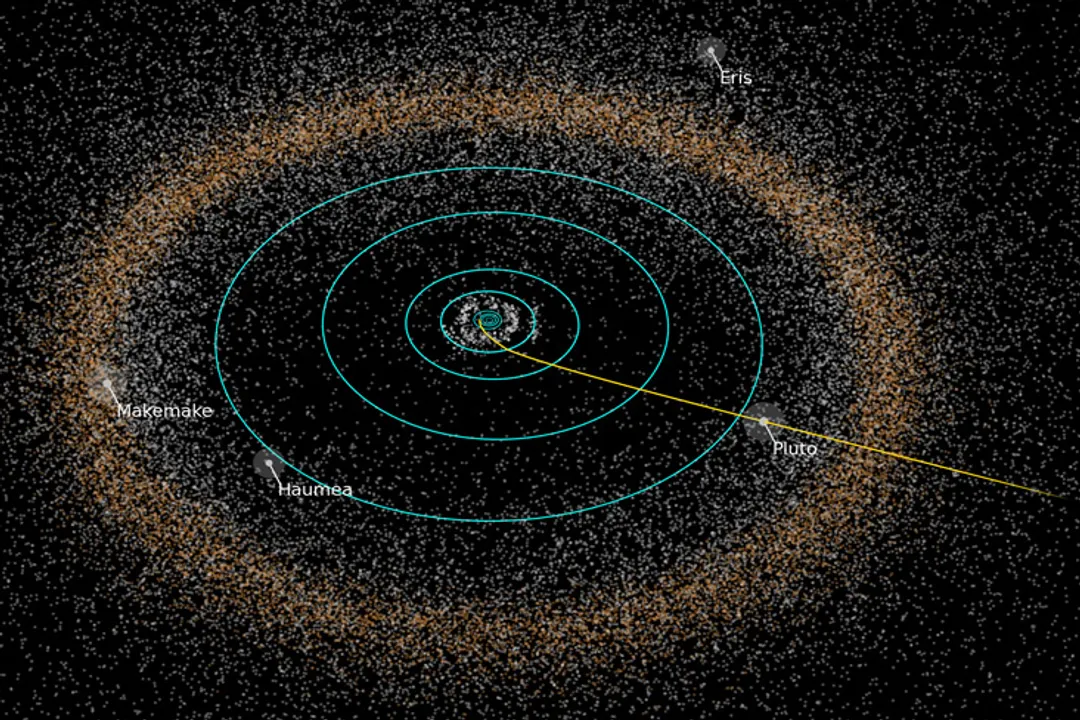
A KBO is defined as any small solar system body whose orbit primarily resides outside of Neptune's path.
The classification of an object as a Kuiper Belt Object (KBO) is based specifically on its orbital mechanics relative to the solar system’s structure, rather than just its composition or size alone. The defining criterion is its average orbital location. If the vast majority of an object's trajectory keeps it outside the influence of Neptune's primary gravitational domain—meaning its orbit primarily resides beyond Neptune's path—it is categorized as a KBO, regardless of whether it is a small icy body or a large dwarf planet like Pluto or Eris.
Related Questions
What is the general outward extension range of the Kuiper Belt from the Sun?What key compositional element differentiates KBOs from the rockier objects in the Asteroid Belt?How does Pluto function as the anchor point for understanding the overall population of KBOs?What specific physical state allows a massive KBO to earn the classification of a dwarf planet?What makes the dwarf planet Haumea a bizarre object among the major Kuiper Belt worlds?Which type of comet is considered to originate from the Kuiper Belt reservoir through gravitational perturbations?What critical information about accretion processes did the New Horizons flyby of Arrokoth provide?What measurement generally defines the starting distance of the Kuiper Belt from the Sun?What does the mass disparity between the closer Pluto and the more distant, heavier Eris imply?How is a Kuiper Belt Object (KBO) fundamentally defined by its orbital path?