What is the approximate average interior temperature characterizing a Giant Molecular Cloud (GMC)?
Answer
$10 ext{ K}$
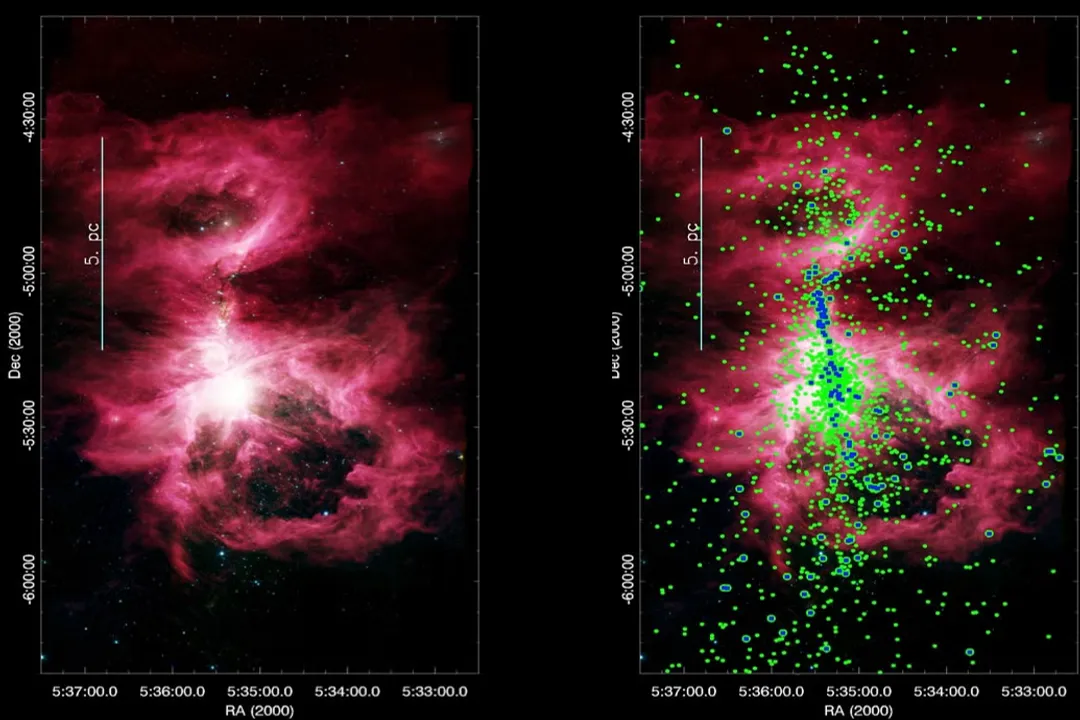
Star-forming nebulae, known as Giant Molecular Clouds (GMCs), are characterized by extremely low temperatures, which is essential for enabling gravitational collapse to overcome gas pressure. The text specifies that the average interior temperature within these vast molecular nurseries is typically very cold, hovering around $10 ext{ Kelvin}$. This frigid environment ensures that the internal thermal pressure generated by the kinetic energy of the gas particles is minimal, thus allowing the pervasive gravitational attraction exerted by the cloud's own immense mass to become the dominant force capable of initiating the contraction process leading toward star formation.
Related Questions
What is the primary elemental makeup of the Interstellar Medium (ISM)?What must balance to maintain hydrostatic equilibrium in a gas cloud?How does increased density and colder temperature affect the Jeans Mass ($M_J$)?How do Supernova Explosions act as external triggers for star formation?What role do filamentary structures play in the initial conditions for star formation?In environments rich in carbon monoxide ($ ext{CO}$), how does it aid the early stages of core contraction?What physical event causes the initial free-fall collapse to halt and form the first hydrostatic core?What is the approximate average interior temperature characterizing a Giant Molecular Cloud (GMC)?The virial theorem relates gravitational potential energy to internal thermal energy. What is this relationship?During collapse progression, what temperature is required for molecular hydrogen ($ ext{H}_2$) to dissociate?