What is the solar nebula theory for kids?
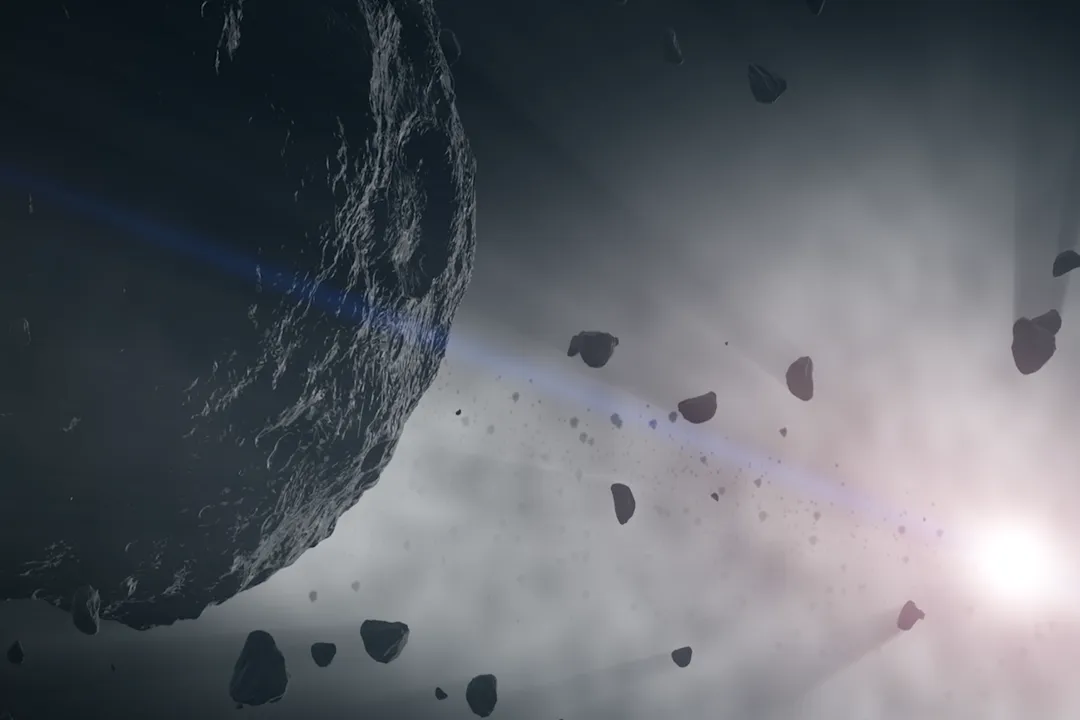
The story of our Sun, Earth, and all the other planets begins not with a bang, but with a massive, quiet cloud floating in space billions of years ago. This giant cloud wasn't empty; it was a swirling mix of gas, mostly hydrogen and helium, along with tiny bits of dust made from heavier elements. [2][6][9] Scientists call this huge structure a solar nebula. [2][6] This nebula was cold and spread out, a stellar nursery waiting for something to kickstart the construction project of our entire Solar System. [6][8]
# Cloud Start
Imagine a cloud so big that it contained all the raw materials needed to make everything we see today—the Sun, the Moon, Earth, Jupiter, and even the tiniest pebble floating past Mars. [2] This initial cloud was likely already rotating slightly, just as most large things in space tend to do, although this rotation was very slow. [2][6] For this massive cloud to start collapsing and forming a star, it needed a trigger. Many astronomers believe this trigger was the shockwave from a nearby, massive star that had already lived its life and ended in a spectacular explosion called a supernova. [2][6]
# Spinning Faster
When that shockwave hit the relatively calm gas cloud, it compressed some of the material, causing the cloud to begin collapsing inward due to its own gravity. [2][6][8] This collapse is where the physics gets quite interesting. As the cloud shrank, it began to spin much faster. Think about an ice skater spinning: when they pull their arms in tight, they spin much quicker, right? The same thing happened to the solar nebula. [2][6] The conservation of angular momentum—the tendency of a spinning object to keep spinning—forced the cloud to speed up its rotation as gravity pulled the mass closer to the center. [2][8]
If you look closely at the structure of our Solar System now, you can see the evidence of this rapid spin. Everything orbits the Sun in roughly the same direction and on a relatively flat plane. This is a direct echo of the spinning disk that formed during this collapse phase. [2][6] It’s worth noting a curious balance in the final product: while the Sun ended up holding about 99.8% of the total mass of the Solar System, the remaining planets, asteroids, and comets hold nearly all the angular momentum—the rotational energy—of the system. This suggests that the processes that built the planets involved significant outward movement of momentum during the formation stage. [2]
# Flat Disk
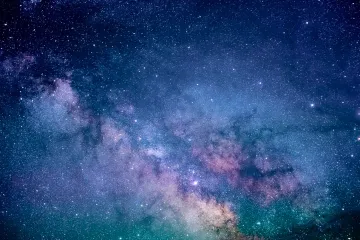
As the nebula spun faster and collapsed, the material couldn't all fall straight inward because of the centrifugal force created by the spin. Instead, the cloud flattened out into a wide, pancake-like structure called a protoplanetary disk. [2][6] Think of stirring pancake batter in a pan; it spreads out into a flat circle. In the center of this disk, the material became incredibly dense and hot due to the immense weight of the material piling up above it. [6] This hot, dense core was the protosun—the baby star that would eventually ignite to become our Sun. [2][6] The rest of the disk surrounding the protosun held the building blocks for everything else. [8]
# Clumping Together
Inside this flat, rotating disk, the work of building planets began. Initially, dust grains, which were too small to see individually, started bumping into each other. These microscopic collisions weren't destructive; instead, the particles stuck together through static electricity, much like dust bunnies forming under a bed. [6] This clumping process, called accretion, meant that small particles became larger pebbles, which became larger boulders. [2][6]
As these clumps grew bigger, their gravity started to help them out. Once an object reached a certain size—maybe a few kilometers across—its own gravitational pull became strong enough to attract and capture smaller surrounding material more effectively. [6] These growing objects are called planetesimals. [2][6] Through countless collisions and mergers over millions of years, these planetesimals smashed together, growing bigger and bigger, eventually forming protoplanets, which were essentially planetary embryos. [2][6]

# Warm Cold
The location within the protoplanetary disk played the biggest role in determining what kind of planet would form. This is where temperature differences were crucial. [2][6] Close to the hot, central protosun, it was simply too warm for lighter, volatile materials like water, methane, and ammonia to condense into solid ices. [2][6] Only materials with very high melting points, like rock and metal, could solidify in the inner regions. [2] This explains why the four planets closest to the Sun—Mercury, Venus, Earth, and Mars—are relatively small and made primarily of rock and metal; they are the terrestrial planets. [2][6]
Farther out, beyond what is often called the frost line—the boundary where it was cold enough for ices to condense—things changed drastically. [6] In these outer regions, planet-building materials included rock, metal, and abundant ices. This meant the cores of the forming planets could accumulate much more solid material, much faster. [2][6] Once these icy/rocky cores reached about ten times the mass of Earth, their gravity became powerful enough to sweep up vast amounts of the remaining lightweight hydrogen and helium gas that filled the nebula, resulting in the massive gas giants like Jupiter and Saturn and the ice giants like Uranus and Neptune. [2][6] The fact that the terrestrial planets are small and the Jovian planets are huge is a direct consequence of this temperature gradient across the original disk. [2]
# Blowing Away
The construction phase couldn't last forever. Once the mass at the center got hot and dense enough, the pressure and temperature ignited nuclear fusion, and the protosun officially became the Sun. [2][6] When the Sun "turned on," it unleashed an intense stream of charged particles called the solar wind. [2][6] This powerful wind swept through the inner and outer solar system, effectively blowing away most of the remaining, unattached gas and fine dust that hadn't yet been incorporated into planets or moons. [2][6] This rapid clearing of the nebula is what stopped the gas giants from growing even larger and finalized the structure of our Solar System as we observe it today. [2] What remains—the Sun, the eight major planets, dwarf planets, asteroids, and comets—is the remnant of that ancient, collapsing, spinning cloud of gas and dust. [6][9]
#Videos
Formation of the Solar System - The Solar Nebula theory Explained
Formation of the Solar System | The Dr. Binocs Show - YouTube
Related Questions
#Citations
Formation of the Solar System - The Solar Nebula theory Explained
Formation and evolution of the Solar System Facts for Kids
1.2. How did our Solar System form? - NASA Astrobiology Program
Video: The Solar Nebula Theory | Overview & Explanation - Study.com
Formation of the Sun and Planets | CK-12 Foundation
What About the Nebular Hypothesis? - Kids Answers
How Solar Systems Form | PBS LearningMedia
8.2: Origin of the Solar System—The Nebular Hypothesis