Which eccentricity value ($e$) is associated with an orbit classified as a parabola?
Answer
$e = 1$
The categorization of orbital paths based on eccentricity defines distinct geometric shapes. When the eccentricity ($e$) is exactly equal to one, the path taken by the object is mathematically defined as a parabola. This shape signifies a trajectory where the object possesses exactly the escape velocity needed to break free from the central body's gravitational influence but no more. Orbits with $e=1$ (parabolas) and $e>1$ (hyperbolas) are generally categorized as escape trajectories, as opposed to elliptical orbits where $e$ is strictly less than one, which represent bound orbits where the object remains gravitationally tethered to the central mass.
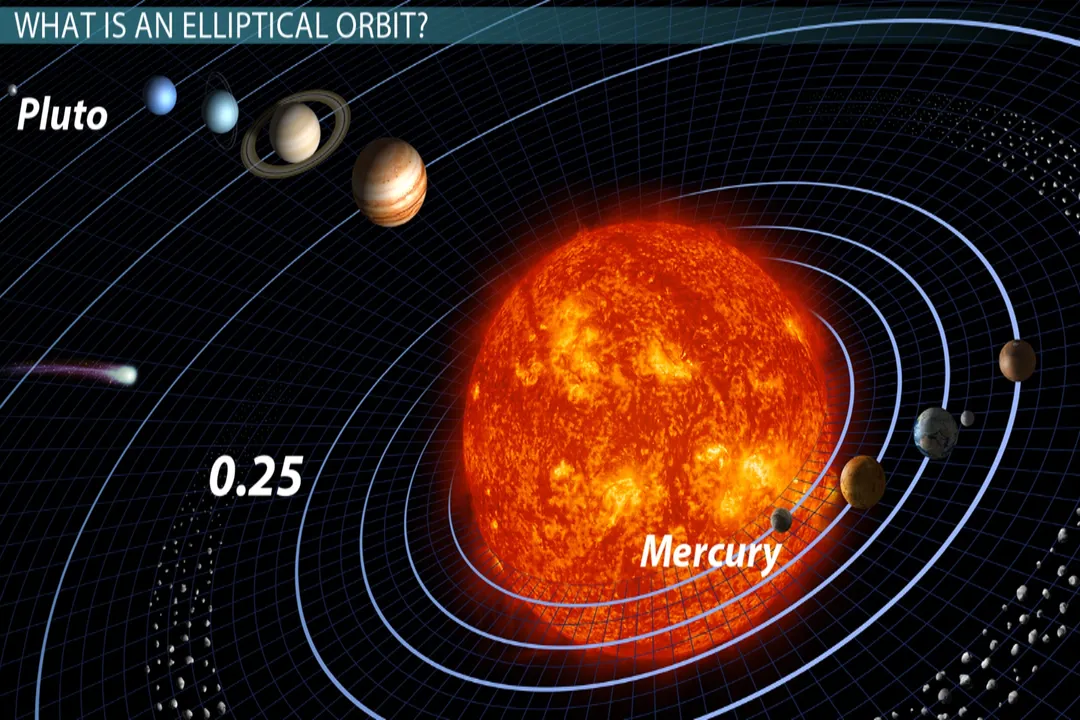
#Videos
Elliptical Orbits - Brain Waves - YouTube
Related Questions
What is the eccentricity ($e$) value defining a perfectly circular orbit path?What is the deliberate purpose of the high eccentricity in a Molniya orbit design?How does Kepler's Second Law describe object speed in an elliptical path near periapsis?Which eccentricity value ($e$) is associated with an orbit classified as a parabola?When does the Earth achieve its lowest orbital speed during its orbit around the Sun?What is the fundamental property that quantifies an orbit's deviation from circularity?In an idealized two-body problem, what makes an elliptical orbit unstable compared to a circular orbit?Which term is listed as a straightforward alternative name for an elliptical orbit?What visual characteristic defines an orbit when its eccentricity ($e$) approaches 0.9?How does the long, slow arc near apoapsis impact mission planning for spacecraft in HEOs?Which parameters are incorporated in the vis-viva equation to calculate velocity along an ellipse?